The vocabulary
Volts, amps, kW and kWh, in plain English
Four words and one formula. Learn them once and every charger spec sheet on the internet becomes readable.
By Sawyer V. · Published September 8, 2026
Every confusing thing about EV charging is confusing because of four words. Here they are, with the analogy everyone uses because it genuinely works.
Think of it as water in a pipe
| Term | Unit | The water analogy | What it means for you |
|---|---|---|---|
| Voltage | volts (V) | Water pressure | 120 V is a normal outlet. 240 V is a dryer circuit. Higher pressure moves more. |
| Current | amps (A) | How wide the pipe is | More amps means more flow, and it needs thicker wire. |
| Power | kilowatts (kW) | How fast the bucket fills | Pressure x flow. This is charging speed. |
| Energy | kilowatt-hours (kWh) | How much water ended up in the bucket | Power over time. Your battery's size, and what your bill charges for. |
The one formula
Everything follows from this
watts = volts x amps
kilowatts = volts x amps / 1000
So a 40 A charger on 240 V: 240 x 40 = 9,600 W = 9.6 kW
And a Level 1 cable at 12 A on 120 V: 120 x 12 = 1,440 W = 1.44 kW
That is the entire explanation of why Level 2 is roughly seven times faster than Level 1. Double the voltage, triple the current.
kW versus kWh: the one people mix up
kW is a rate. kWh is an amount. A 9.6 kW charger running for one hour delivers 9.6 kWh. Running for two hours, 19.2 kWh.
Your battery is measured in kWh because it is a quantity of stored energy. Your charger is measured in kW because it is a speed. Your electricity bill charges per kWh, because you pay for the amount, not the rate.
Putting it together
Battery: 75 kWh
Charger: 9.6 kW
Time from empty: 75 / 9.6 = about 7.8 hours
Cost at $0.16/kWh: 75 x 0.16 = $12.00
Two more terms you will meet
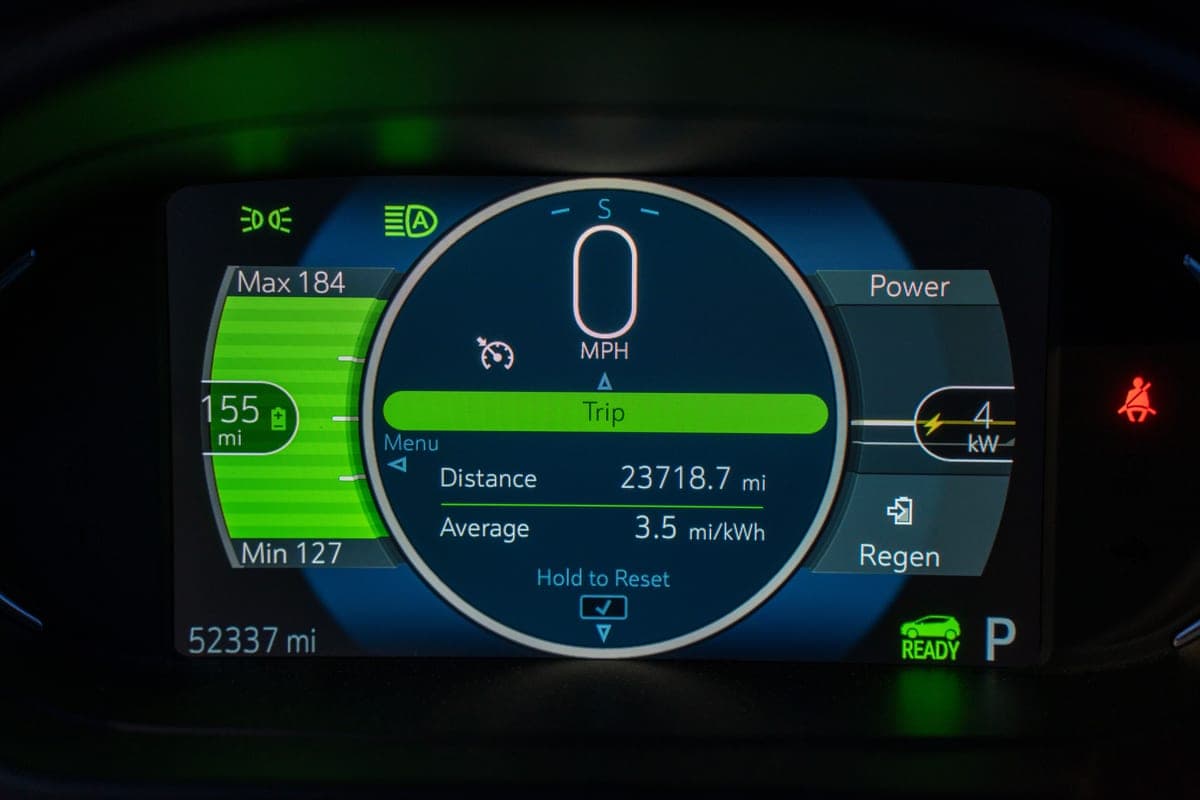
- mi/kWh -- your car's efficiency, how far it goes on a kilowatt-hour. Roughly 2 to 4 for most EVs. Multiply it by kW to get miles of range added per hour.
- Continuous load -- a device that draws its full current for three hours or more. EV chargers are one, which is why the circuit must be rated at 125% of the charger's draw. That single rule generates every breaker size in the sizing table.
Put your own numbers into the charging speed calculator and watch the formula do the work.
FAQ
Questions people actually ask
What is the difference between kW and kWh?
How do I convert amps to kilowatts?
What does mi/kWh mean?
Why does an EV charger need a bigger breaker than its rating?
Sources
Where these numbers come from
- NEC Article 625: EV charging equipment — WireRefContinuous-load definition and requirement.
Read next
Related reading
- Charging at 208 voltsWhy building power is often 208 V, the 13% speed difference that follows, and why the breaker and wire do not change.
- EV charging speed calculatorCalculate charging speed and time from your own numbers, with the working shown.
- Level 1, Level 2 and DC fast charging: which one you needLevel 1, Level 2 and DC fast charging with real speeds, and which you need at home.
- What size breaker and wire does an EV charger need?Breaker and wire size for every charger amperage, with the 125% rule worked through.
- EV charging glossaryEvery EV charging term defined in plain English, without circular definitions.