The flagship roundup
The best home EV chargers, for people buying their first one
Six Level 2 chargers, ranked for someone who has never bought one. There is a safe default, and there are good reasons to pick something else.
By Sawyer V. · Published September 8, 2026

How this page is funded: we earn a commission if you buy through our Amazon links, at no extra cost to you. It does not change what we recommend, and we say plainly when the honest answer is to buy nothing. Full disclosure.
If you want the short answer: the Emporia Level 2 EV Charger is the safe default. It runs at 48 amps hardwired, carries a 25-foot cable, sits in a NEMA Type 4 outdoor-rated enclosure and is UL listed, and its app does not require a subscription. For most first-time buyers there is no compelling reason to spend more.
That said, four of the other five here are the right answer for somebody, and we will say who. If your panel situation is uncertain, the ChargePoint Home Flex is a better buy. If you want a machine with no app at all, the Grizzl-E is. Read the reasons, not just the ranking.
Quick picks
Ranked for a first home charger. Every row jumps to the full write-up below.
| # | Product | Best for | Max output | Price |
|---|---|---|---|---|
| 1 | Emporia Level 2 EV Charger (Classic)A first charger, hardwired. J1772, 25 ft cable. | A first charger, hardwired | 48 A11.5 kW | Check price on Amazon#ad how we are funded |
| 2 |  ChargePoint Home FlexHomes with an uncertain panel. J1772, 23 ft cable. ChargePoint Home FlexHomes with an uncertain panel. J1772, 23 ft cable. | Homes with an uncertain panel | 50 A12 kW | $549.00 · View on Amazon#ad how we are funded · price as of October 27, 2026 |
| 3 |  Grizzl-E ClassicHarsh weather and no app. J1772, 24 ft cable. Grizzl-E ClassicHarsh weather and no app. J1772, 24 ft cable. | Harsh weather and no app | 40 A9.6 kW | $299.99 · View on Amazon#ad how we are funded · price as of October 27, 2026 |
| 4 |  Autel MaxiCharger AC HomeLong reach outdoors. J1772, 25 ft cable. Autel MaxiCharger AC HomeLong reach outdoors. J1772, 25 ft cable. | Long reach outdoors | 50 A12 kW | $470.00 · View on Amazon#ad how we are funded · price as of October 27, 2026 |
| 5 |  Wallbox Pulsar PlusTight wall space. J1772, 25 ft cable. Wallbox Pulsar PlusTight wall space. J1772, 25 ft cable. | Tight wall space | 48 A11.5 kW | $699.00 · View on Amazon#ad how we are funded · price as of October 27, 2026 |
| 6 | Tesla Wall Connector (Gen 3)Tesla owners. NACS, 24 ft cable. | Tesla owners | 48 A11.5 kW | Check price on Amazon#ad how we are funded |
How we chose these
We have not tested these chargers. We do not own them and there is no lab. What we did instead: read each manufacturer's published specification sheet and installation manual, checked the safety certification claims, did the electrical arithmetic on what each unit's amperage actually delivers, and compared the warranty terms as published. Every spec below is cited. How we pick sets out the whole method, including what it cannot tell you.
The thing published specs genuinely cannot tell you is long-term reliability. We have not run these for five years and will not pretend otherwise. What we can tell you is what the warranty covers, which is the part you can hold someone to.
What actually separates these units
| Charger | Max output | Connector | Cable | Enclosure | Warranty |
|---|---|---|---|---|---|
| Emporia Level 2 | 48 A / 11.5 kW | J1772 | 25 ft | NEMA 4 | 3 years |
| ChargePoint Home Flex | 50 A / 12 kW | J1772 | 23 ft | Indoor/outdoor | 3 years |
| Grizzl-E Classic | 40 A / 9.6 kW | J1772 | 24 ft | NEMA 4 / IP67 | 3 years |
| Autel MaxiCharger AC | 50 A / 12 kW | J1772 | 25 ft | NEMA 4 | 3 years |
| Wallbox Pulsar Plus | 48 A / 11.5 kW | J1772 | 25 ft | NEMA 4 | 3 years |
| Tesla Wall Connector | 48 A / 11.5 kW | NACS | 24 ft | Indoor/outdoor | 4 years |
Look at that table for a moment and notice how close together they are. Five of the six are within 2 kW of each other. All six are outdoor-capable. Five carry the same three-year warranty. This is a mature product category, and the differences that matter to you are narrower than the marketing suggests: cable length, connector, and whether the maximum amperage is even reachable in your house.
The one number that decides it for most people
Your panel's spare capacity. A 48-amp charger requires a 60-amp circuit, which requires 60 amps of headroom in your electrical service. Plenty of homes do not have that, and the fix -- a service upgrade -- costs more than any charger on this page.
What each tier needs from your panel
32 A charger: 32 x 1.25 = 40 A circuit
40 A charger: 40 x 1.25 = 50 A circuit
48 A charger: 48 x 1.25 = 60 A circuit
The manufacturer's manual states the required circuit for the specific unit and governs over any general rule.
Work through how many amps you need before you choose, and check the full sizing table on breaker and wire size.
The six chargers, in detail
Each entry ends with an explicit reason to skip it. A roundup where every pick suits everyone is a roundup nobody can act on.
1. A first charger, hardwired
Emporia Level 2 EV Charger (Classic)
Emporia · J1772 · 48 A / 11.5 kW · 25 ft cable
The safe default for a first home charger: 48 amps hardwired, a genuinely long cable, a NEMA 4 outdoor-rated case, and no subscription attached to the app.
What is good
- 48 A hardwired is the fastest tier most homes can realistically support
- 25 ft of cable reaches across a two-car garage without a fight
- NEMA Type 4 enclosure is rated for outdoor mounting
- Energy monitoring in the app with no subscription
What is not
- Drops to 40 A if you use the NEMA 14-50 plug rather than hardwiring
- The app is the only way to change the amperage setting
| Maximum output | 48 A / 11.5 kW at 240 V (hardwired) |
|---|---|
| Plug-in output | 40 A with the NEMA 14-50 plug |
| Connector | SAE J1772 |
| Cable | 25 ft |
| Enclosure | NEMA Type 4, indoor or outdoor |
| Certification | UL listed, Energy Star |
| Warranty | 3 years |
Skip this if: Skip it if you want a unit with no app or network connection at all. The Grizzl-E Classic is the simpler machine.
Specifications above are the manufacturer’s published figures. Source: Emporia Energy. We have not tested this unit — see how we pick.
2. Homes with an uncertain panel
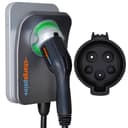
ChargePoint Home Flex
ChargePoint · J1772 · 50 A / 12 kW · 23 ft cable
The most adjustable unit here. It can be set anywhere from 16 A to 50 A, which makes it the one to buy when you do not yet know what your panel will allow.
What is good
- Six selectable amperage settings from 16 A to 50 A
- Sold in both hardwired and NEMA 14-50 versions
- Rated for indoor or outdoor installation
- The app is mature and does not require a subscription
What is not
- 23 ft is a foot shorter than the longest cables in this group
- The 50 A setting needs a bigger circuit than most panels have spare
| Maximum output | 50 A / 12 kW at 240 V |
|---|---|
| Amperage settings | 16, 24, 32, 40, 48 or 50 A |
| Connector | SAE J1772 |
| Cable | 23 ft |
| Installation | Hardwired or NEMA 14-50 |
| Certification | UL listed, Energy Star |
| Warranty | 3 years |
Skip this if: Skip it if your circuit is already fixed and you just want the cheapest safe 40 A unit. You are paying for flexibility you will not use.
Specifications above are the manufacturer’s published figures. Source: ChargePoint, ChargePoint. We have not tested this unit — see how we pick.
3. Harsh weather and no app
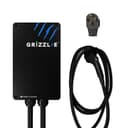
Grizzl-E Classic
United Chargers · J1772 · 40 A / 9.6 kW · 24 ft cable
A cast-aluminum box with no app, no account and no firmware to update. If you want a charger that behaves like an appliance, this is the one.
What is good
- Cast aluminum NEMA 4 / IP67 enclosure, built for outdoor mounting
- No app, no account, no network dependency
- Amperage is set with physical switches, not software
- Protections for over-current, over-voltage, ground fault and over-temperature
What is not
- 40 A ceiling, slower than the 48 A units if your panel can take more
- No scheduling, so off-peak charging has to be set in the car
- The cold-flexible 24 ft cable is only on the Extreme Edition
| Maximum output | 40 A / 9.6 kW at 240 V |
|---|---|
| Adjustable | 16, 24, 32 or 40 A |
| Connector | SAE J1772 |
| Cable | 24 ft on the Extreme Edition |
| Enclosure | Cast aluminum, NEMA 4 / IP67 |
| Certification | UL certified |
| Warranty | 3 years |
Skip this if: Skip it if you want scheduled charging or energy tracking in an app. The Classic deliberately has neither.
Specifications above are the manufacturer’s published figures. Source: United Chargers, InsideEVs. We have not tested this unit — see how we pick.
4. Long reach outdoors
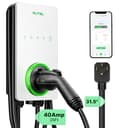
Autel MaxiCharger AC Home
Autel Energy · J1772 · 50 A / 12 kW · 25 ft cable
The 25 ft cable is the longest in this group, and the NEMA 4 case plus a cold-flexible cord make it the easiest unit to live with on an exposed outside wall.
What is good
- 25 ft cable, the longest of the wall units here
- Sold in NEMA 14-50, NEMA 6-50 and hardwired versions
- NEMA Type 4 enclosure rated for rain, snow, hail and sleet
- Wi-Fi and Bluetooth, so it still works if the Wi-Fi drops
What is not
- The 50 A version is hardwired only
- The app has more features than a first-time owner needs
| Maximum output | 50 A / 12 kW hardwired; 40 A / 9.6 kW plug-in |
|---|---|
| Connector | SAE J1772 |
| Cable | 25 ft |
| Enclosure | NEMA Type 4 |
| Certification | Tested to UL standards by CSA |
| Warranty | 3 years |
Skip this if: Skip it if your parking spot is right next to the panel. You are paying for cable you will coil up and never use.
Specifications above are the manufacturer’s published figures. Source: Autel Energy. We have not tested this unit — see how we pick.
5. Tight wall space
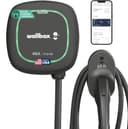
Wallbox Pulsar Plus
Wallbox · J1772 · 48 A / 11.5 kW · 25 ft cable
The smallest 48 A unit here at roughly 7.8 by 7.9 inches, which matters more than it sounds when the only free wall is beside a door.
What is good
- Smallest body of the 48 A units, under 8 inches square
- Current configurable in steps from 6 A to 48 A
- NEMA Type 4 enclosure, rated down to -22 F
- Weighs 4.4 lb without the cable, so mounting is simple
What is not
- Hardwired only at 48 A, with no plug-in version at full output
- Setup runs through the app, which some owners find fussy
| Maximum output | 48 A / 11.5 kW at 240 V |
|---|---|
| Configurable current | 6 A to 48 A |
| Connector | SAE J1772 |
| Cable | 25 ft |
| Body size | 7.8 x 7.9 x 3.9 inches without the cable |
| Operating temperature | -22 F to 104 F |
| Certification | UL 2594, UL 2231 |
| Warranty | 3 years |
Skip this if: Skip it if you want a plug-in unit you can take with you. The 48 A Pulsar Plus is hardwired.
Specifications above are the manufacturer’s published figures. Source: Wallbox, Wallbox. We have not tested this unit — see how we pick.
6. Tesla owners
Tesla Wall Connector (Gen 3)
Tesla · NACS · 48 A / 11.5 kW · 24 ft cable
48 A, a 24 ft cable and a four-year warranty, the longest in this group. The catch is the connector: Gen 3 is NACS, so a J1772 car needs an adapter.
What is good
- Four-year warranty, longer than the three-year standard here
- Up to six units can share one circuit for a two-EV household
- Wi-Fi with over-the-air firmware updates
- Scheduled departure and charge stats live in the Tesla app
What is not
- NACS connector, so a J1772 car needs an adapter on every charge
- Hardwired only
| Maximum output | 48 A / 11.5 kW at 240 V |
|---|---|
| Connector | NACS (Tesla) |
| Cable | 24 ft |
| Installation | Hardwired |
| Power sharing | Up to six units can be linked |
| Warranty | 4 years |
Skip this if: Skip it if you drive a J1772 car and do not want to keep an adapter on the cable. Buy a J1772 unit instead.
Specifications above are the manufacturer’s published figures. Source: Tesla, Tesla. We have not tested this unit — see how we pick.
Who should buy nothing
If you drive under about 40 miles on a typical day, park at home overnight, and have a normal outlet within reach of the car, the cable that came with your EV may genuinely be enough. Level 1 charging adds roughly 40 to 60 miles over a twelve-hour night. Spending $1,500 on a charger and an install to solve a problem you do not have is a bad trade, and nobody selling chargers is going to tell you that.
Run the numbers honestly in do you need a Level 2 charger. If the answer is no, that is a successful outcome.
What we would do
Buy the Emporia, hardwired, if your panel can carry 60 amps. Buy the ChargePoint Home Flex if you do not yet know what your panel can carry, because you can dial it down and up later without replacing the unit. Buy the Grizzl-E if the idea of a charger that needs firmware updates makes you tired. And if you drive a Tesla and no other car will ever use this charger, buy the Tesla Wall Connector for the four-year warranty.
FAQ
Questions people actually ask
What is the best home EV charger for a first-time buyer?
How many amps should my home charger be?
Do I need a smart charger with an app?
Are cheap EV chargers safe?
Can I install a home charger myself?
Sources
Where these numbers come from
- Emporia Level 2 EV Charger specifications — Emporia Energy
- ChargePoint Home Flex specifications and ordering information — ChargePoint
- Grizzl-E Classic product specifications — United Chargers
- MaxiCharger AC Elite Home 40A specifications — Autel Energy
- Pulsar Plus datasheet — Wallbox
- Gen 3 Wall Connector installation manual — Tesla
- NEC Article 625: EV charging equipment — WireRefContinuous-load rule used in the circuit-sizing arithmetic above.
Read next
Related reading
- What EV charger installation actually costsItemized 2026 installation costs with published ranges, plus the one variable that changes everything.
- Do you actually need a Level 2 charger?The honest test for whether you need a Level 2 charger, or whether Level 1 is enough.
- Emporia vs ChargePoint Home FlexThe two most-recommended home chargers compared. The answer depends on your panel.
- Hardwired or plug-in: which EV charger install is right?NEMA 14-50 or hardwired: amperage limits, cost, portability and what inspectors prefer.
- The best UL listed EV chargersChargers with a genuine, checkable safety listing, and how to read the wording.
- The best EV chargers for a two-EV householdCharging two EVs at home: taking turns, power sharing, or two circuits.
- The best EV charger brands for home chargingSix home-charger brands, what each is genuinely good at, and the model worth buying from each.