The big decision
Hardwired or plug-in: which EV charger install is right?
The highest-consequence choice in the whole project, and the one people make last. Here is the trade in full.
By Sawyer V. · Published September 8, 2026
How this page is funded: we earn a commission if you buy through our Amazon links, at no extra cost to you. It does not change what we recommend, and we say plainly when the honest answer is to buy nothing. Full disclosure.
Both are legitimate, both are code-compliant when done properly, and the internet is full of people insisting the other one is wrong. Here is the actual trade.
The amperage ceiling
This is the technical crux. A NEMA 14-50 receptacle sits on a 50-amp circuit. The continuous-load rule means a device on a 50-amp circuit can draw at most 40 amps continuously. So a plug-in charger caps at 40 A, regardless of what the unit is capable of hardwired.
Why plug-in stops at 40 A
NEMA 14-50 receptacle: 50 A circuit
Continuous load limit: 50 / 1.25 = 40 A
So the charger draws at most 40 A = 9.6 kW
Hardwired on a 60 A circuit: 60 / 1.25 = 48 A = 11.5 kW
In miles: about 34 per hour against about 40. Over a ten-hour night, 340 miles against 400. For most households that is a difference without a distinction.
The full comparison
| Hardwired | Plug-in (NEMA 14-50) | |
|---|---|---|
| Maximum continuous draw | 48 A or more, circuit permitting | 40 A |
| Take it with you when you move | No | Yes |
| Swap the charger without an electrician | No | Yes |
| Connection durability | Better -- no plug to wear | Receptacle wears with repeated use |
| Outdoor suitability | Better -- fewer openings | Needs a weather-rated receptacle and cover |
| Cost if the circuit already exists | Electrician required | Potentially zero |
| Cost if the circuit is new | Similar | Similar, plus the receptacle |
The receptacle-quality problem nobody mentions
A NEMA 14-50 was designed for a range or an RV hookup -- devices plugged in once and left. An EV charger is often plugged and unplugged, and it draws near the receptacle's limit for hours at a time. Cheap receptacles have been a genuine source of overheating in this application.
If you go plug-in, ask your electrician for a good-quality industrial-grade receptacle rather than the cheapest one that fits, and do not treat the charger as something to unplug daily. NEMA 14-50 outlets covers what to specify.
The case for each, in one line
- Hardwire it if you own the home, want maximum amperage, or the charger lives outside.
- Plug it in if you rent, may move soon, already have a suitable 240 V outlet, or want to swap chargers later without an electrician.
Units for each route
Ranked for a first home charger. Every row jumps to the full write-up below.
| # | Product | Best for | Max output | Price |
|---|---|---|---|---|
| 1 | Emporia Level 2 EV Charger (Classic)A first charger, hardwired. J1772, 25 ft cable. | A first charger, hardwired | 48 A11.5 kW | Check price on Amazon#ad how we are funded |
| 2 |  ChargePoint Home FlexHomes with an uncertain panel. J1772, 23 ft cable. ChargePoint Home FlexHomes with an uncertain panel. J1772, 23 ft cable. | Homes with an uncertain panel | 50 A12 kW | $549.00 · View on Amazon#ad how we are funded · price as of October 27, 2026 |
| 3 |  Wallbox Pulsar PlusTight wall space. J1772, 25 ft cable. Wallbox Pulsar PlusTight wall space. J1772, 25 ft cable. | Tight wall space | 48 A11.5 kW | $699.00 · View on Amazon#ad how we are funded · price as of October 27, 2026 |
The units in detail
Two units sold in both configurations, and one that is hardwired only -- so you can see what the choice costs you.
1. A first charger, hardwired
Emporia Level 2 EV Charger (Classic)
Emporia · J1772 · 48 A / 11.5 kW · 25 ft cable
The safe default for a first home charger: 48 amps hardwired, a genuinely long cable, a NEMA 4 outdoor-rated case, and no subscription attached to the app.
What is good
- 48 A hardwired is the fastest tier most homes can realistically support
- 25 ft of cable reaches across a two-car garage without a fight
- NEMA Type 4 enclosure is rated for outdoor mounting
- Energy monitoring in the app with no subscription
What is not
- Drops to 40 A if you use the NEMA 14-50 plug rather than hardwiring
- The app is the only way to change the amperage setting
| Maximum output | 48 A / 11.5 kW at 240 V (hardwired) |
|---|---|
| Plug-in output | 40 A with the NEMA 14-50 plug |
| Connector | SAE J1772 |
| Cable | 25 ft |
| Enclosure | NEMA Type 4, indoor or outdoor |
| Certification | UL listed, Energy Star |
| Warranty | 3 years |
Skip this if: Skip it if you want a unit with no app or network connection at all. The Grizzl-E Classic is the simpler machine.
Specifications above are the manufacturer’s published figures. Source: Emporia Energy. We have not tested this unit — see how we pick.
2. Homes with an uncertain panel
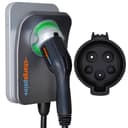
ChargePoint Home Flex
ChargePoint · J1772 · 50 A / 12 kW · 23 ft cable
The most adjustable unit here. It can be set anywhere from 16 A to 50 A, which makes it the one to buy when you do not yet know what your panel will allow.
What is good
- Six selectable amperage settings from 16 A to 50 A
- Sold in both hardwired and NEMA 14-50 versions
- Rated for indoor or outdoor installation
- The app is mature and does not require a subscription
What is not
- 23 ft is a foot shorter than the longest cables in this group
- The 50 A setting needs a bigger circuit than most panels have spare
| Maximum output | 50 A / 12 kW at 240 V |
|---|---|
| Amperage settings | 16, 24, 32, 40, 48 or 50 A |
| Connector | SAE J1772 |
| Cable | 23 ft |
| Installation | Hardwired or NEMA 14-50 |
| Certification | UL listed, Energy Star |
| Warranty | 3 years |
Skip this if: Skip it if your circuit is already fixed and you just want the cheapest safe 40 A unit. You are paying for flexibility you will not use.
Specifications above are the manufacturer’s published figures. Source: ChargePoint, ChargePoint. We have not tested this unit — see how we pick.
3. Tight wall space
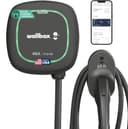
Wallbox Pulsar Plus
Wallbox · J1772 · 48 A / 11.5 kW · 25 ft cable
The smallest 48 A unit here at roughly 7.8 by 7.9 inches, which matters more than it sounds when the only free wall is beside a door.
What is good
- Smallest body of the 48 A units, under 8 inches square
- Current configurable in steps from 6 A to 48 A
- NEMA Type 4 enclosure, rated down to -22 F
- Weighs 4.4 lb without the cable, so mounting is simple
What is not
- Hardwired only at 48 A, with no plug-in version at full output
- Setup runs through the app, which some owners find fussy
| Maximum output | 48 A / 11.5 kW at 240 V |
|---|---|
| Configurable current | 6 A to 48 A |
| Connector | SAE J1772 |
| Cable | 25 ft |
| Body size | 7.8 x 7.9 x 3.9 inches without the cable |
| Operating temperature | -22 F to 104 F |
| Certification | UL 2594, UL 2231 |
| Warranty | 3 years |
Skip this if: Skip it if you want a plug-in unit you can take with you. The 48 A Pulsar Plus is hardwired.
Specifications above are the manufacturer’s published figures. Source: Wallbox, Wallbox. We have not tested this unit — see how we pick.
FAQ
Questions people actually ask
Is a hardwired EV charger better than plug-in?
Why does a plug-in charger max out at 40 amps?
Can I plug my EV charger into a dryer outlet?
Do I need a special outlet for a plug-in EV charger?
Sources
Where these numbers come from
- NEC Article 625: EV charging equipment — WireRefContinuous-load rule that produces the 40 A plug-in ceiling.
- ChargePoint Home Flex installation FAQ — ChargePointManufacturer documentation of both installation types.
Read next
Related reading
- EV charger disconnect requirementsThe 2023 rule, the 2026 rewrite that dropped the 60-amp threshold, and why a plug-in install sidesteps the whole question.
- The NEMA 14-50 outlet, explainedWhat a NEMA 14-50 is, the circuit it needs, its 40-amp charging limit, and what to specify.
- What size breaker and wire does an EV charger need?Breaker and wire size for every charger amperage, with the 125% rule worked through.
- The best home EV chargers, for people buying their first oneSix Level 2 chargers ranked for a first-time buyer, with an honest reason to skip each one.
- How an EV charger gets installedThe full installation process step by step, and the point where a homeowner must stop.
- The best hardwired EV chargersHardwired chargers compared: why they reach 48 A, and which unit suits which garage.
- The best plug-in EV chargersPlug-in chargers for a NEMA 14-50: portable, swappable, and capped at 40 amps.
- The best NEMA 14-50 outlet for EV chargingWhich NEMA 14-50 receptacle to specify, and why the cheap one is a false economy.
- Portable vs wall-mounted EV chargerWho a portable charger is worth it for, and who should put one on the wall instead.
- Roughing in an EV charger for a new buildConduit, panel space and circuit size to specify while the walls are open, and what to skip.
- Taking your EV charger with you when you moveWhat moves with you and what stays, plus the plug-in choice that makes it a non-question.