Reference
Charging at 208 volts
Most American houses have 240-volt service. Apartment blocks, condo garages and mixed-use buildings often do not -- they have 208 volts, and every kilowatt figure on a charger's box was calculated at 240.
By Sawyer V. · Published October 17, 2026
How this page is funded: we earn a commission if you buy through our Amazon links, at no extra cost to you. It does not change what we recommend, and we say plainly when the honest answer is to buy nothing. Full disclosure.
The verdict: if the building gives you 208 volts, buy the charger you would otherwise have bought, size the circuit exactly as you would at 240 volts, and expect roughly 13% less power than the number on the box. There is no 208-volt version of a home charger to go looking for, and nothing is wrong with your installation. What matters far more in a shared building is the amperage you are allocated, which is why an adjustable charger is the right choice here.
Where 208 volts comes from
A single-family house is normally fed single-phase at 120/240 volts: two legs 240 volts apart, which is where a dryer outlet and an EV circuit get their 240. Larger buildings are fed three-phase, and the common American three-phase service is 208/120 volts. Any single leg to neutral is 120 volts, exactly as at home -- but any two legs are 208 volts, not 240, because of the geometry of a three-phase system. That is the whole explanation. Your charger is connected across two legs of someone else's bigger service.
This is why the subject comes up in apartment garages, condo buildings, offices, and the ground floor of mixed-use blocks, and almost never in a detached house. Charging in an apartment and best EV charger for a condo cover the other problems those buildings bring.
What it costs you, in kilowatts and miles
The ratio, once
208 V / 240 V = 0.867, so every power figure is 13.3% lower.
48 A x 208 V = 9,984 W, about 10.0 kW (against 11.5 kW at 240 V).
40 A x 208 V = 8,320 W, about 8.3 kW (against 9.6 kW).
32 A x 208 V = 6,656 W, about 6.7 kW (against 7.7 kW).
| Setting | 240 V | 208 V | Miles per hour at 208 V |
|---|---|---|---|
| 16 A | 3.8 kW | 3.3 kW | about 9 |
| 32 A | 7.7 kW | 6.7 kW | about 18 |
| 40 A | 9.6 kW | 8.3 kW | about 22 |
| 48 A | 11.5 kW | 10.0 kW | about 27 |
| 64 A | 15.4 kW | 13.3 kW | about 36 |
| 80 A | 19.2 kW | 16.6 kW | about 45 |
Thirteen percent sounds worse than it feels. At 48 amps on 208 volts a car still gains about 27 miles an hour, so a nine-hour night is roughly 240 miles. The Department of Energy's general figure for Level 2 -- about 25 miles of range per hour -- is comfortably met at 208 volts. Charging speed calculator lets you put your own voltage, amps and efficiency in.
What does not change: the circuit
This is the part that surprises people. Breakers and conductors are sized on current, and the current does not change with voltage -- a 48-amp charger draws 48 amps at 208 volts just as it does at 240. So the continuous-load rule gives the same answer either way: the circuit is sized at 125% of the charger's rated current.
A charger draws its rated current continuously, so the breaker is 125% of it: 16 A needs 20 A, 32 A needs 40 A, 40 A needs 50 A, 48 A needs 60 A, 64 A needs 80 A, 80 A needs 100 A. Breaker and wire size.
Which chargers publish a 208-volt rating
Most makers print only 240 volts on the specification sheet, which is not the same as the charger refusing to work at 208 -- Level 2 equipment as a class is built for both, per the Department of Energy. But two chargers on this site state it explicitly, and when a building is involved an explicit rating is worth having in writing:
- Leviton EV480: Leviton publishes 48 A at 208/240 V and quotes 11.6 kW, on a 60 A breaker, with a NEMA Type 3R enclosure and optional RFID access control -- which is a genuinely useful feature in a shared garage. Leviton EV Series review.
- Autel MaxiCharger AC 80A: Autel publishes 208/240 V AC, 60 Hz, single phase, with output adjustable from 6 A to 80 A in the app, plus a card reader and ANSI C12.20 metering. Autel MaxiCharger 80A review.
- ChargePoint Home Flex does not publish a 208 V figure in the datasheet we hold, but it publishes six amperage settings from 16 A to 50 A -- and in a building, being able to match whatever circuit you are given matters more than the voltage does.
If you want access control as well, which is the usual requirement in a shared garage, best EV charger with access control ranks the category.
Chargers for a 208-volt building
Two units whose makers publish a 208/240 V rating, and one chosen for the setting range a building install actually needs. Live Amazon prices with the date they were read.
1. RFID access control
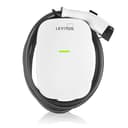
Leviton EV Series 48 A charger (EV480)
Leviton · J1772 · 48 A / 11.5 kW · 18 ft cable
Leviton's hardwired 48-amp EV Series unit: an 18 ft J1772 cord, a NEMA Type 3R enclosure rated -22 F to 122 F, optional RFID access control and ENERGY STAR certification. The EV48W version adds Wi-Fi and the My Leviton app.
What is good
- Optional RFID access control for a shared or open driveway
- NEMA Type 3R enclosure rated -22 F to 122 F
- ENERGY STAR certified, with a long list of published UL standards
- Pre-attached input cable and mounting hardware included
What is not
- 18 ft cord, shorter than most 48 A units on this site
- Hardwired only
- The app is on the Wi-Fi EV48W, not the EV480
| Output | 48 A, 208/240 V; Leviton quotes 11.6 kW |
|---|---|
| Breaker | 60 A |
| Connector | SAE J1772 |
| Cord | 18 ft |
| Enclosure | NEMA Type 3R |
| Operating temperature | -22 F to 122 F |
| Access control | Optional RFID, disabled when shipped |
| Status lights | Power present, charging, fault |
| Standards | UL 2594, UL 2231-1, UL 2231-2, UL 2251, among others |
| Wi-Fi version | EV48W, with the My Leviton app |
Skip this if: Skip it if your charge port is far from the wall -- the cord is 18 ft -- or if you want a plug-in unit. The EV480 is hardwired only.
Specifications above are the manufacturer’s published figures. Source: Leviton, Leviton. We have not tested this unit — see how we pick.
2. 80 A with an app and access control
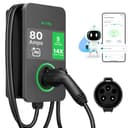
Autel MaxiCharger AC 80A
Autel Energy · J1772 · 80 A / 19.2 kW · 25 ft cable
The connected 80-amp charger: 19.2 kW, adjustable all the way down to 6 A from the app, an RFID card reader and a -40 F to 131 F rating. It asks for a 100 A circuit at full output.
What is good
- 19.2 kW, the ceiling of AC Level 2 charging
- Adjustable from 6 A to 80 A in the app, so one unit fits almost any circuit
- Built-in RFID card reader, which is rare outside access-control models
- Published -40 F to 131 F range, the widest of the 80 A units here
- Long list of published safety standards plus ENERGY STAR certification
What is not
- 80 A continuous needs a 100 A circuit, which most homes cannot spare
- Derates above 113 F, so a hot garage will not see the full figure
- Hardwired only, with no plug-in version
- 4G connectivity is an optional extra, not standard
- Costs far more than the 48 A chargers most households can actually use
| Maximum output | 19.2 kW (240 V AC x 80 A) |
|---|---|
| Adjustable | 6 A to 80 A, in the app |
| Voltage | 208/240 V AC, 60 Hz, single phase |
| Connector | SAE J1772 or NACS |
| Cable | 19 ft (6 m) or 25 ft (7.5 m) |
| Installation | Hardwired; wall or pedestal mount |
| Enclosure | NEMA 3S, IK10 |
| Operating temperature | -40 F to 131 F, derating above 113 F |
| Ground fault | 20 mA CCID |
| Access control | Card reader, ISO 15693 and ISO 14443 A/B |
| Connectivity | Wi-Fi, Ethernet, RS485 and Wi-SUN; 4G optional |
| Metering | ANSI C12.20 (0.5%) compliant |
| Size | 14.5 x 8.5 x 5.1 in; 20.3 lb with the 19 ft cable |
| Warranty | 3 years, extendable up to 5 |
Skip this if: Skip it if your panel cannot spare a 100 A circuit or your car tops out at 11.5 kW -- the 48 A tier does the same job for far less.
Specifications above are the manufacturer’s published figures. Source: Autel Energy. We have not tested this unit — see how we pick.
3. Homes with an uncertain panel
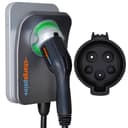
ChargePoint Home Flex
ChargePoint · J1772 · 50 A / 12 kW · 23 ft cable
The most adjustable unit here. It can be set anywhere from 16 A to 50 A, which makes it the one to buy when you do not yet know what your panel will allow.
What is good
- Six selectable amperage settings from 16 A to 50 A
- Sold in both hardwired and NEMA 14-50 versions
- Rated for indoor or outdoor installation
- The app is mature and does not require a subscription
What is not
- 23 ft is a foot shorter than the longest cables in this group
- The 50 A setting needs a bigger circuit than most panels have spare
| Maximum output | 50 A / 12 kW at 240 V |
|---|---|
| Amperage settings | 16, 24, 32, 40, 48 or 50 A |
| Connector | SAE J1772 |
| Cable | 23 ft |
| Installation | Hardwired or NEMA 14-50 |
| Certification | UL listed, Energy Star |
| Warranty | 3 years |
Skip this if: Skip it if your circuit is already fixed and you just want the cheapest safe 40 A unit. You are paying for flexibility you will not use.
Specifications above are the manufacturer’s published figures. Source: ChargePoint, ChargePoint. We have not tested this unit — see how we pick.
FAQ
Questions people actually ask
Can you charge an EV at 208 volts?
How much slower is 208 volt charging?
Why is my building 208 volts and my house 240?
Does 208 volts change the breaker or wire size?
Which EV chargers are rated for 208 volts?
How do I find out if my circuit is 208 or 240 volts?
Sources
Where these numbers come from
- Electric Vehicle Charging Stations: AC Level 2 equipment — U.S. Department of Energy, Alternative Fuels Data CenterAC Level 2 equipment offers charging through 240 V (typical in residential applications) or 208 V (typical in commercial applications) electrical service. Level 2 can operate at 40 to 80 amperes and a Level 2 unit can range from 2.9 to 19.2 kW power output, adding roughly 25 miles of range per hour. Most residential Level 2 chargers operate at up to 30 A delivering 7.2 kW and require a dedicated 40 A circuit to comply with National Electrical Code Article 625. In the United States the common three-phase voltages are typically 208/120 V and 480/277 V. Read 2026-10-17.
- NEC Article 625: EV Charging Equipment — WireRef625.41 Continuous Load Rating: EV charging is classified as a continuous load because the EVSE draws its maximum rated current for 3 or more hours during a typical charge session, so the branch circuit is sized at 125% of the rated current -- a 48 A charger requires a 60 A circuit. 625.42 Branch Circuit Requirements: each EVSE requires a dedicated branch circuit unless an approved energy management system controls the load. Read 2026-10-17.
- Leviton EV Series 48 A charging station (EV480) — Leviton48 A output at 208/240 V, which Leviton quotes as 11.6 kW, on a 60 A breaker; SAE J1772; 18 ft cord; NEMA Type 3R enclosure; -22 F to 122 F; optional RFID access control disabled when shipped; UL 2594, UL 2231-1, UL 2231-2 and UL 2251 among others; ENERGY STAR certified.
- Autel MaxiCharger AC 80A — Autel Energy19.2 kW (240 V AC x 80 A) with output adjustable 6 A to 80 A in the app; 208/240 V AC, 60 Hz, single phase; SAE J1772 or NACS; 19 ft or 25 ft cable; hardwired with wall or pedestal mount; NEMA 3S and IK10 enclosure; -40 F to 131 F with derating above 113 F; UL 2594, UL 2231-1, UL 2231-2, UL 1998 and CSA C22.2 No. 280 plus ENERGY STAR; 3-year warranty extendable to 5. Read 2026-10-01.
- ChargePoint Home Flex data sheet — ChargePointAmperage settings of 16, 24, 32, 40, 48 and 50 A; maximum 50 A / 12 kW; 23 ft cable; hardwired and NEMA 14-50 versions; UL listed and ENERGY STAR certified.
- Fuel economy of 2026 Cadillac and GMC vehicles — U.S. EPA and U.S. Department of Energy, fueleconomy.govPublished consumption ratings used here: Cadillac Lyriq 37 kWh/100 mi, GMC Sierra EV 50 kWh/100 mi, GMC Hummer EV 70 kWh/100 mi (2025). Read 2026-10-11.
Read next
Related reading
- What size breaker and wire does an EV charger need?Breaker and wire size for every charger amperage, with the 125% rule worked through.
- Charging an EV when you live in an apartmentThe realistic options for apartment EV charging, ranked by how well they actually work.
- The best EV chargers for a condoChargers for a condo space: the HOA questions, metering, and units that suit a shared garage.
- Volts, amps, kW and kWh, in plain EnglishThe four electrical terms that matter and the one formula that ties them together.
- Load management: charging without a panel upgradeHow load management avoids a panel upgrade, what it costs in speed, and when to use it.