Road trips
What to pack in an EV road trip charging kit
Your plan is the fast-charging network. The kit is what turns a hotel parking lot or a relative's garage into an overnight top-up.
By Sawyer V. · Published September 8, 2026
How this page is funded: we earn a commission if you buy through our Amazon links, at no extra cost to you. It does not change what we recommend, and we say plainly when the honest answer is to buy nothing. Full disclosure.
Let us be clear about the role of a charging kit on a road trip: it is not your plan. Your plan is the DC fast-charging network along your route, and your car's navigation almost certainly routes around it.
The kit is for the other thing -- turning wherever you sleep into somewhere you wake up with more range than you arrived with. That is worth carrying, and it is a much smaller kit than the internet suggests.
The kit, ranked
| Item | Verdict |
|---|---|
| The Level 1 cable that came with your car | Always. It weighs little and there is a 120 V outlet almost everywhere. |
| A portable Level 2 charger with a NEMA 14-50 plug | Yes, if you stay anywhere with a dryer, RV or workshop outlet. It turns 5 miles per hour into 30. |
| A NEMA TT-30 adapter | Yes, if campgrounds are ever on your route. TT-30 is the standard RV site outlet. |
| A J1772-to-NACS adapter, or the reverse | Yes, if your car and the network you rely on differ. See adapters. |
| A NEMA 6-50 adapter | Maybe. Welder outlets are common in workshops and rural garages. |
| A NEMA 10-30 adapter | Maybe. Older dryer outlets. Note these have no separate ground, so check your charger supports it. |
| A household extension cord | Never. Why. |
| A generator | No. The weight, noise and inefficiency are absurd next to the charging network. |
What the portable actually buys you overnight
One night at a motel with a 14-50 outlet
Portable at 32 A: 32 x 240 = 7.7 kW
At 3.5 mi/kWh: about 27 miles of range per hour
10 hours overnight: about 270 miles
The same night on Level 1: about 50 miles.
That is the difference between starting the next leg full and starting it needing a fast charger before breakfast.
Practical road-trip habits
- Ask when you book, not when you arrive. "Is there an outlet I could plug my car into overnight, and what would you charge for it?" gets a yes far more often than showing up with a cable.
- Offer to pay. A night of Level 2 charging is a few dollars of electricity. Offering removes the objection entirely.
- Carry a plug adapter list, or a photo of your kit, so you can tell someone exactly what you need to plug into.
- Turn the current down if you are on an unfamiliar circuit. A portable set to 16 amps is gentler on old wiring and still adds about 130 miles overnight.
- Do not leave it unattended on someone else's dubious outlet. Check it is not warm before you go to bed.
Portables worth carrying
Ranked for a first home charger. Every row jumps to the full write-up below.
| # | Product | Best for | Max output | Price |
|---|---|---|---|---|
| 1 | J+ Booster 2The best portable overall. J1772, 25 ft cable. | The best portable overall | 40 A9.6 kW | Check price on Amazon#ad how we are funded |
| 2 |  Lectron portable Level 2 chargerTravel and rentals. J1772, 21 ft cable. Lectron portable Level 2 chargerTravel and rentals. J1772, 21 ft cable. | Travel and rentals | 32 A7.7 kW | $269.99 · View on Amazon#ad how we are funded · price as of October 27, 2026 |
The travel chargers in detail
Two portables sized for a trunk, with the case against each.
1. The best portable overall
J+ Booster 2
J+ Americas · J1772 · 40 A / 9.6 kW · 25 ft cable
A 40 A portable in a military-grade aluminum body, ETL certified to UL standards and IP67 rated, weighing 2.2 lb without cables. The portable that behaves like a wall unit.
What is good
- 40 A, matching many wall-mounted units
- Eight amperage settings from 6 A to 40 A, so it fits almost any outlet
- Adapters for a wide range of outlets, including NEMA TT-30 for campgrounds
- IP67 and drive-over resistant, which portables usually are not
- 2.2 lb without cables, so it genuinely travels
What is not
- Costs more than most portables, and more than some wall units
- Every extra outlet adapter is a separate purchase
- Still a portable, so it is not rated for permanent outdoor mounting
| Maximum output | 40 A / 9.6 kW at 240 V |
|---|---|
| Adjustable | 6, 8, 12, 16, 20, 24, 32 or 40 A |
| Power range | 1.4 kW to 9.6 kW |
| Connector | SAE J1772 |
| Cable | 21 ft or 25 ft, depending on version |
| Adapters included | NEMA 14-50 and 5-15 |
| Further adapters available | 5-20, 6-15, 6-20, 6-50, TT-30 |
| Weight | 2.2 lb without cables; 7 lb with cables and adapters |
| Body | Military-grade aluminum, drive-over resistant to 6,600 lb wheel loads |
| Rating | IP67 waterproof and dustproof |
| Certification | ETL certified to UL standards |
Skip this if: Skip it if you only ever charge in one place. A hardwired wall unit is cheaper for a fixed installation.
Specifications above are the manufacturer’s published figures. Source: J+ Americas. We have not tested this unit — see how we pick.
2. Travel and rentals
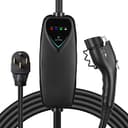
Lectron portable Level 2 charger
Lectron · J1772 · 32 A / 7.7 kW · 21 ft cable
A plug-in portable that runs at Level 2 speed from a NEMA 14-50 and drops to a standard wall outlet with the included adapter. The travel unit, not the garage unit.
What is good
- Level 2 speed from a NEMA 14-50 without an installed charger
- Falls back to a standard household outlet with the adapter
- Small enough to keep in the trunk
What is not
- 32 A ceiling, meaningfully slower than a 48 A wall unit
- Not weather-rated for permanent outdoor mounting
- Repeated plugging and unplugging wears a NEMA 14-50 receptacle faster than a hardwired unit
| Maximum output | 32 A / 7.7 kW at 240 V |
|---|---|
| Connector | SAE J1772 |
| Plug | NEMA 14-50, with an adapter for a standard outlet |
| Use | Portable. Lives in the car, not on the wall |
Skip this if: Skip it if this is your only charger and you have a garage. A wall unit is faster and does not live in your trunk.
Specifications above are the manufacturer’s published figures. Source: Lectron. We have not tested this unit — see how we pick.
FAQ
Questions people actually ask
What should I carry in an EV for road trips?
Can I charge my EV at a campground?
Do I need a portable charger for road trips?
Should I carry a generator to charge my EV?
Sources
Where these numbers come from
- Portable Level 2 EV charger 40A (UL) -- J+ Booster 2 — J+ AmericasPublished adapter range including NEMA TT-30 and 6-50.
Read next
Related reading
- Charging at a hotel or AirbnbWhat to ask before booking, which outlets to look for, and the etiquette that gets a yes.
- Outlet types for EV charging: a field guideEvery outlet you might charge from, what each delivers, and which adapters to carry.
- The best portable EV chargersPortable Level 2 chargers for renters and travelers, with the honest case for buying none.
- EV charging adapters, sorted outWhich charging adapters you need, which came free with the car, and the safety rules.
- The best EV charger for campgrounds and RV hookupsCharging at RV parks: the adapters for TT-30 and 14-50 hookups, and the etiquette.
- The best NACS to CCS adapters for Tesla SuperchargersWhat to check before buying a Supercharger adapter, why UL 2252 matters, and two options compared.
- How to charge a Tesla at a non-Tesla charging stationThe two adapters a Tesla needs away from Superchargers, and the retrofit check to make first.
- Lectron Vortex Plus reviewUL 2252 certified, 500 A, IP67, V3 and V4 only: who Lectron's Supercharger adapter suits.
- Lectron Vortex Plus vs A2Z Typhoon ProTwo Supercharger adapters with near-identical ratings; the published UL 2252 certification decides it.