Ford
The best home charger for an F-150 Lightning
The truck with the biggest battery in most driveways. This is where maximum amperage stops being overkill.
By Sawyer V. · Published September 8, 2026
How this page is funded: we earn a commission if you buy through our Amazon links, at no extra cost to you. It does not change what we recommend, and we say plainly when the honest answer is to buy nothing. Full disclosure.
The connector
Published lists confirm that by mid-2026 essentially every major automaker selling EVs in the US -- Ford included -- had signed on to NACS. Timing varies by model and model year, so look at your own truck's charge port. A J1772 charger works directly on a CCS-equipped truck and with the included adapter on a NACS-equipped one.
Why the amperage answer is different here
This site consistently argues that most people do not need 48 amps. A full-size electric pickup is the honest exception, for three reasons that stack:
- The battery is large, so replacing a given percentage takes proportionally longer than on a compact EV.
- Efficiency is lower. A big, heavy, un-aerodynamic truck uses more energy per mile, so the same errands consume more kWh.
- Towing makes both worse. Efficiency while towing can fall dramatically, meaning a towing day can need a genuinely large overnight replacement.
Replacing a big day
150 miles at 2.0 mi/kWh (a plausible loaded-truck figure) = 75 kWh
At 32 A (7.7 kW): about 9 hours 45 minutes
At 48 A (11.5 kW): about 6 hours 30 minutes
Run your own efficiency figure -- the truck reports it -- in the calculator.
That is a real difference in whether you wake up ready. Confirm your panel can carry a 60-amp circuit before committing -- breaker and wire size.
Ford's own higher-power equipment
Ford has offered home charging equipment capable of higher output than a standard 48-amp unit, which requires a correspondingly larger circuit and, on many homes, panel work. If that is what you have or are considering, read Ford's own installation documentation for its circuit requirement -- it is not the same as the standard 60-amp answer, and your electrician needs the real figure.
Chargers that suit a Lightning
Ranked for a first home charger. Every row jumps to the full write-up below.
| # | Product | Best for | Max output | Price |
|---|---|---|---|---|
| 1 | Emporia Level 2 EV Charger (Classic)A first charger, hardwired. J1772, 25 ft cable. | A first charger, hardwired | 48 A11.5 kW | Check price on Amazon#ad how we are funded |
| 2 |  ChargePoint Home FlexHomes with an uncertain panel. J1772, 23 ft cable. ChargePoint Home FlexHomes with an uncertain panel. J1772, 23 ft cable. | Homes with an uncertain panel | 50 A12 kW | $549.00 · View on Amazon#ad how we are funded · price as of October 27, 2026 |
| 3 |  Wallbox Pulsar PlusTight wall space. J1772, 25 ft cable. Wallbox Pulsar PlusTight wall space. J1772, 25 ft cable. | Tight wall space | 48 A11.5 kW | $699.00 · View on Amazon#ad how we are funded · price as of October 27, 2026 |
The chargers in detail
Three 48-amp units, with the case against each.
1. A first charger, hardwired
Emporia Level 2 EV Charger (Classic)
Emporia · J1772 · 48 A / 11.5 kW · 25 ft cable
The safe default for a first home charger: 48 amps hardwired, a genuinely long cable, a NEMA 4 outdoor-rated case, and no subscription attached to the app.
What is good
- 48 A hardwired is the fastest tier most homes can realistically support
- 25 ft of cable reaches across a two-car garage without a fight
- NEMA Type 4 enclosure is rated for outdoor mounting
- Energy monitoring in the app with no subscription
What is not
- Drops to 40 A if you use the NEMA 14-50 plug rather than hardwiring
- The app is the only way to change the amperage setting
| Maximum output | 48 A / 11.5 kW at 240 V (hardwired) |
|---|---|
| Plug-in output | 40 A with the NEMA 14-50 plug |
| Connector | SAE J1772 |
| Cable | 25 ft |
| Enclosure | NEMA Type 4, indoor or outdoor |
| Certification | UL listed, Energy Star |
| Warranty | 3 years |
Skip this if: Skip it if you want a unit with no app or network connection at all. The Grizzl-E Classic is the simpler machine.
Specifications above are the manufacturer’s published figures. Source: Emporia Energy. We have not tested this unit — see how we pick.
2. Homes with an uncertain panel
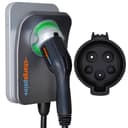
ChargePoint Home Flex
ChargePoint · J1772 · 50 A / 12 kW · 23 ft cable
The most adjustable unit here. It can be set anywhere from 16 A to 50 A, which makes it the one to buy when you do not yet know what your panel will allow.
What is good
- Six selectable amperage settings from 16 A to 50 A
- Sold in both hardwired and NEMA 14-50 versions
- Rated for indoor or outdoor installation
- The app is mature and does not require a subscription
What is not
- 23 ft is a foot shorter than the longest cables in this group
- The 50 A setting needs a bigger circuit than most panels have spare
| Maximum output | 50 A / 12 kW at 240 V |
|---|---|
| Amperage settings | 16, 24, 32, 40, 48 or 50 A |
| Connector | SAE J1772 |
| Cable | 23 ft |
| Installation | Hardwired or NEMA 14-50 |
| Certification | UL listed, Energy Star |
| Warranty | 3 years |
Skip this if: Skip it if your circuit is already fixed and you just want the cheapest safe 40 A unit. You are paying for flexibility you will not use.
Specifications above are the manufacturer’s published figures. Source: ChargePoint, ChargePoint. We have not tested this unit — see how we pick.
3. Tight wall space
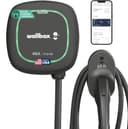
Wallbox Pulsar Plus
Wallbox · J1772 · 48 A / 11.5 kW · 25 ft cable
The smallest 48 A unit here at roughly 7.8 by 7.9 inches, which matters more than it sounds when the only free wall is beside a door.
What is good
- Smallest body of the 48 A units, under 8 inches square
- Current configurable in steps from 6 A to 48 A
- NEMA Type 4 enclosure, rated down to -22 F
- Weighs 4.4 lb without the cable, so mounting is simple
What is not
- Hardwired only at 48 A, with no plug-in version at full output
- Setup runs through the app, which some owners find fussy
| Maximum output | 48 A / 11.5 kW at 240 V |
|---|---|
| Configurable current | 6 A to 48 A |
| Connector | SAE J1772 |
| Cable | 25 ft |
| Body size | 7.8 x 7.9 x 3.9 inches without the cable |
| Operating temperature | -22 F to 104 F |
| Certification | UL 2594, UL 2231 |
| Warranty | 3 years |
Skip this if: Skip it if you want a plug-in unit you can take with you. The 48 A Pulsar Plus is hardwired.
Specifications above are the manufacturer’s published figures. Source: Wallbox, Wallbox. We have not tested this unit — see how we pick.
FAQ
Questions people actually ask
What charger do I need for an F-150 Lightning?
Should I get a 48-amp charger for an electric truck?
Can the F-150 Lightning power my house?
How long does an F-150 Lightning take to charge at home?
Sources
Where these numbers come from
- All EVs with a NACS charging port in 2026 — SimpleSwitchPublished list of native-NACS models by manufacturer and model year. Fetched 2026-09-08.
- All the EVs that use Tesla's NACS plug — CarGurusCorroborating published list of NACS adoption by manufacturer. Fetched 2026-09-08.
Read next
Related reading
- The best home charger for a RivianConnector guidance for R1T and R1S, and why a big battery justifies more amps.
- What size breaker and wire does an EV charger need?Breaker and wire size for every charger amperage, with the 125% rule worked through.
- 32 A vs 40 A vs 48 A: how many amps do you actually need?What each amperage tier delivers in miles per hour, and the circuit each one requires.
- EV charging speed calculatorCalculate charging speed and time from your own numbers, with the working shown.
- The best home EV chargers for an electric truckChargers for electric pickups, the connector each truck uses, and why trucks justify 48-50 A.
- The best home charger for a Chevrolet Silverado EVA J1772 charger for a CCS truck, and why a big battery justifies 48-50 A.