Level 1 picks
The best Level 1 EV chargers
Slow, cheap and genuinely sufficient for a lot of households. Your car probably came with one -- here is when to upgrade it and when not to bother.
By Sawyer V. · Published September 10, 2026

How this page is funded: we earn a commission if you buy through our Amazon links, at no extra cost to you. It does not change what we recommend, and we say plainly when the honest answer is to buy nothing. Full disclosure.
Level 1 charging means plugging into a normal household outlet. Every EV ships with a cable that does it, which makes this the one product category where the honest first answer is usually "you already own this".
Level 1 capable picks
Ranked for a first home charger. Every row jumps to the full write-up below.
| # | Product | Best for | Max output | Price |
|---|---|---|---|---|
| 1 | J+ Booster 2The best portable overall. J1772, 25 ft cable. | The best portable overall | 40 A9.6 kW | Check price on Amazon#ad how we are funded |
| 2 |  Lectron portable Level 2 chargerTravel and rentals. J1772, 21 ft cable. Lectron portable Level 2 chargerTravel and rentals. J1772, 21 ft cable. | Travel and rentals | 32 A7.7 kW | $269.99 · View on Amazon#ad how we are funded · price as of October 26, 2026 |
| 3 | MUSTART Level 2 portable chargerBudget portable. J1772, 25 ft cable. | Budget portable | 40 A9.6 kW | Check price on Amazon#ad how we are funded |
What Level 1 actually delivers
A normal outlet, overnight
Typical draw: 12 A at 120 V = 1.44 kW
At 3.5 mi/kWh: about 5 miles of range per hour
8 hours: about 40 miles. 12 hours: about 60 miles
Some cars and cables draw 16 A on a 20 A circuit, giving roughly 6 to 7 miles per hour.
Compare that with your actual daily average -- odometer over a normal week, divided by seven. If it is comfortably under what you can replace overnight, Level 1 works and you should spend nothing. The full test, and do you need Level 2 at all.
The only Level 1 upgrade worth buying
You cannot make Level 1 meaningfully faster. A 120-volt, 15-amp circuit limits a continuous load to 12 amps, and no cable changes that. So a "better Level 1 charger" is not a faster one.
What is worth buying is a dual-mode portable -- a unit that ships with both a 5-15 adapter for a normal outlet and a NEMA 14-50 plug for a 240-volt one. It does Level 1 today, and the day you get access to a dryer outlet, a relative's garage or an installed circuit, it becomes a Level 2 charger without a second purchase.
| Outlet | Level | Power | Miles per hour |
|---|---|---|---|
| NEMA 5-15 (normal wall outlet) | 1 | 1.4 kW | about 5 |
| NEMA 5-20 (20 A outlet) | 1 | 1.9 kW | about 7 |
| NEMA TT-30 (RV site) | 1 | 2.9 kW | about 10 |
| NEMA 14-50 (range / RV hookup) | 2 | 9.6 kW | about 34 |
Doing Level 1 safely
- Plug straight into the wall. No extension cords, no power strips -- why.
- Use a dedicated circuit if you can. A 15-amp circuit shared with a freezer and a workshop will trip.
- Check the outlet. An old, loose receptacle carrying 12 amps continuously for hours is a genuine hazard. Warm to the touch means stop.
- Plug in every night, not when the battery is low. Level 1 works by never falling behind.
The dual-mode portables in detail
Three units that charge at Level 1 from a normal outlet and Level 2 from a 240-volt one, each with the case against it.
1. The best portable overall
J+ Booster 2
J+ Americas · J1772 · 40 A / 9.6 kW · 25 ft cable
A 40 A portable in a military-grade aluminum body, ETL certified to UL standards and IP67 rated, weighing 2.2 lb without cables. The portable that behaves like a wall unit.
What is good
- 40 A, matching many wall-mounted units
- Eight amperage settings from 6 A to 40 A, so it fits almost any outlet
- Adapters for a wide range of outlets, including NEMA TT-30 for campgrounds
- IP67 and drive-over resistant, which portables usually are not
- 2.2 lb without cables, so it genuinely travels
What is not
- Costs more than most portables, and more than some wall units
- Every extra outlet adapter is a separate purchase
- Still a portable, so it is not rated for permanent outdoor mounting
| Maximum output | 40 A / 9.6 kW at 240 V |
|---|---|
| Adjustable | 6, 8, 12, 16, 20, 24, 32 or 40 A |
| Power range | 1.4 kW to 9.6 kW |
| Connector | SAE J1772 |
| Cable | 21 ft or 25 ft, depending on version |
| Adapters included | NEMA 14-50 and 5-15 |
| Further adapters available | 5-20, 6-15, 6-20, 6-50, TT-30 |
| Weight | 2.2 lb without cables; 7 lb with cables and adapters |
| Body | Military-grade aluminum, drive-over resistant to 6,600 lb wheel loads |
| Rating | IP67 waterproof and dustproof |
| Certification | ETL certified to UL standards |
Skip this if: Skip it if you only ever charge in one place. A hardwired wall unit is cheaper for a fixed installation.
Specifications above are the manufacturer’s published figures. Source: J+ Americas. We have not tested this unit — see how we pick.
2. Travel and rentals
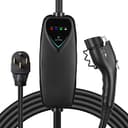
Lectron portable Level 2 charger
Lectron · J1772 · 32 A / 7.7 kW · 21 ft cable
A plug-in portable that runs at Level 2 speed from a NEMA 14-50 and drops to a standard wall outlet with the included adapter. The travel unit, not the garage unit.
What is good
- Level 2 speed from a NEMA 14-50 without an installed charger
- Falls back to a standard household outlet with the adapter
- Small enough to keep in the trunk
What is not
- 32 A ceiling, meaningfully slower than a 48 A wall unit
- Not weather-rated for permanent outdoor mounting
- Repeated plugging and unplugging wears a NEMA 14-50 receptacle faster than a hardwired unit
| Maximum output | 32 A / 7.7 kW at 240 V |
|---|---|
| Connector | SAE J1772 |
| Plug | NEMA 14-50, with an adapter for a standard outlet |
| Use | Portable. Lives in the car, not on the wall |
Skip this if: Skip it if this is your only charger and you have a garage. A wall unit is faster and does not live in your trunk.
Specifications above are the manufacturer’s published figures. Source: Lectron. We have not tested this unit — see how we pick.
3. Budget portable
MUSTART Level 2 portable charger
MUSTART · J1772 · 40 A / 9.6 kW · 25 ft cable
A 40 A portable with an LCD display, adjustable current and a delay timer, at the budget end of the category. The display is genuinely useful on a unit with no app.
What is good
- 40 A from a portable, the same speed as many wall units on a NEMA 14-50
- LCD display shows current, voltage and power without needing an app
- Built-in delay timer for off-peak charging with no phone involved
- Adjustable current, so it works on smaller circuits too
What is not
- Two-year warranty, shorter than the three-year category standard
- We could not verify a specific safety listing from published sources -- confirm before buying
- No app or connectivity of any kind
| Maximum output | 40 A / 9.6 kW at 240 V |
|---|---|
| Adjustable | 15, 25 or 40 A, depending on version |
| Connector | SAE J1772 |
| Cable | 25 ft |
| Plug | NEMA 14-50 |
| Display | LCD showing current, voltage, power and status |
| Delay timer | 1 to 10 hours |
| Warranty | 2 years |
Skip this if: Skip it if you need a documented safety listing you can verify -- see the note below before buying.
Specifications above are the manufacturer’s published figures. Source: MUSTART. We have not tested this unit — see how we pick.
FAQ
Questions people actually ask
What is the best Level 1 EV charger?
How many miles per hour does Level 1 charging add?
Can I get a faster Level 1 charger?
Is Level 1 charging bad for the battery?
Sources
Where these numbers come from
- Portable Level 2 EV charger 40A (UL) -- J+ Booster 2 — J+ AmericasCurrent settings, adapters, weight, IP rating and certification. Fetched 2026-09-10.
- Lectron Level 2 EV chargers — LectronPublished output, plug type and included adapters.
- MUSTART Level 2 EV charger, 40 A, NEMA 14-50, 25 ft — MUSTARTPublished output, display, delay timer and warranty.
- NEC Article 625: EV charging equipment — WireRef
Read next
Related reading
- Level 1 charging: when the cable in your trunk is enoughHow fast Level 1 really is, and the math on whether it covers your daily driving.
- Do you actually need a Level 2 charger?The honest test for whether you need a Level 2 charger, or whether Level 1 is enough.
- Outlet types for EV charging: a field guideEvery outlet you might charge from, what each delivers, and which adapters to carry.
- The best portable EV chargersPortable Level 2 chargers for renters and travelers, with the honest case for buying none.