Outlets
Outlet types for EV charging: a field guide
What each socket looks like, what it delivers, and which adapters earn their space in the trunk.
By Sawyer V. · Published September 8, 2026
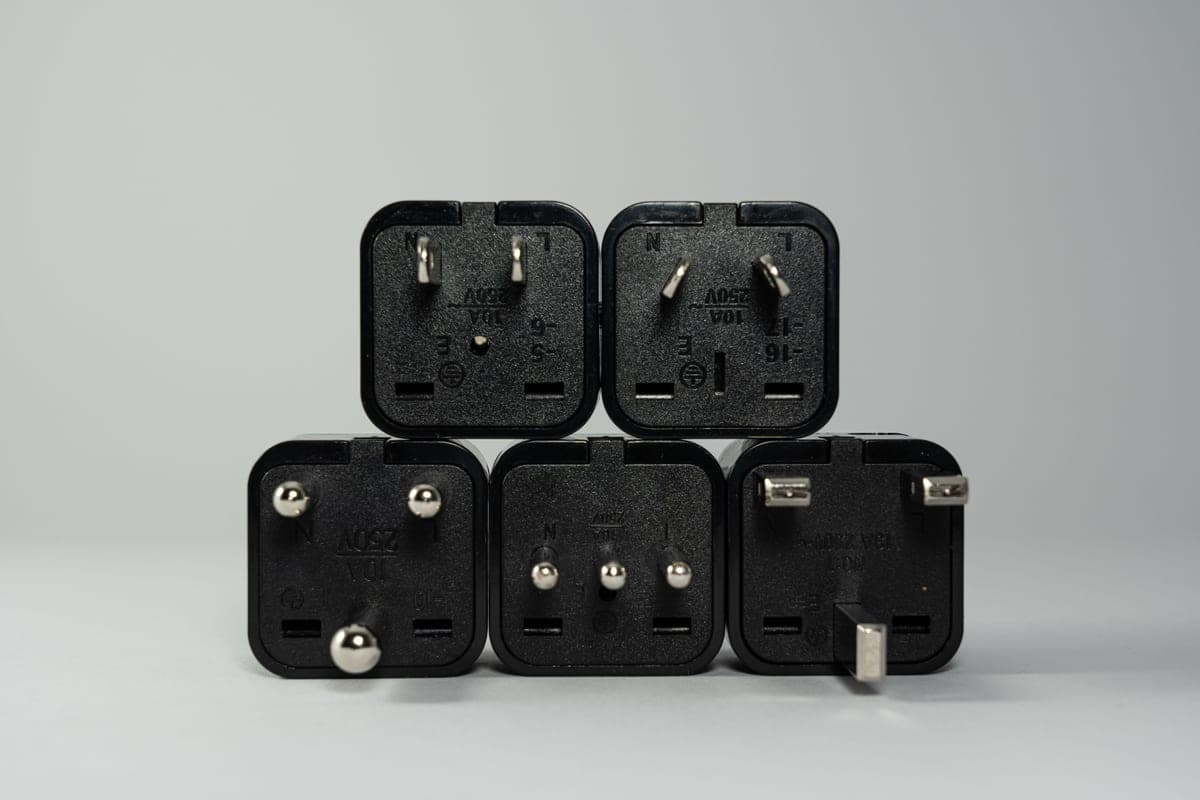
The outlet decides your charging speed far more than the charger does. Here is what you will encounter, what each delivers, and which adapters are worth owning.
| Outlet | Volts | Circuit | Max charging | Miles per hour | Where you find it |
|---|---|---|---|---|---|
| NEMA 5-15 | 120 V | 15 A | 12 A / 1.4 kW | about 5 | Every normal wall outlet |
| NEMA 5-20 | 120 V | 20 A | 16 A / 1.9 kW | about 7 | Garages, workshops |
| NEMA TT-30 | 120 V | 30 A | 24 A / 2.9 kW | about 10 | RV sites and campgrounds |
| NEMA 6-20 | 240 V | 20 A | 16 A / 3.8 kW | about 13 | Workshops |
| NEMA 10-30 | 240 V | 30 A | 24 A / 5.8 kW | about 20 | Older dryer outlets, no separate ground |
| NEMA 14-30 | 240 V | 30 A | 24 A / 5.8 kW | about 20 | Modern dryer outlets |
| NEMA 6-50 | 240 V | 50 A | 40 A / 9.6 kW | about 34 | Welder outlets |
| NEMA 14-50 | 240 V | 50 A | 40 A / 9.6 kW | about 34 | Ranges, RV hookups, EV circuits |
The three worth carrying adapters for
- NEMA 14-50. The one that matters. It is the EV-charging standard, it is on every RV hookup, and it gives you 40 amps. Most portables ship with this plug already.
- NEMA 5-15. The fallback that works everywhere. Most portables include this adapter.
- NEMA TT-30. Only if campgrounds appear on your routes, but then it is genuinely useful -- about 100 miles overnight.
Everything else is situational. Buy an adapter when you know you will meet the outlet, not on the theory that you might.
The one to be careful with: NEMA 10-30
The old three-prong dryer outlet has two hots and a neutral, but no separate ground. Modern practice requires a separate ground for this kind of load, and many chargers will refuse to operate without one -- correctly.
If your charger explicitly supports a 10-30 adapter, follow its manufacturer's instructions. Do not improvise a ground, do not use an adapter that ties neutral to ground, and if in doubt, do not use the outlet.
How to tell what you are looking at
The pin pattern is the identifier. A 5-15 has two flat blades and a round ground. A 14-50 has two angled flat blades, an L-shaped neutral and a round ground -- it is unmistakably large. A 6-50 has two flat blades and a ground with no neutral. TT-30 is round with three angled slots and looks like nothing else.
If you cannot identify it with certainty, photograph it and ask before plugging anything in. A wrong assumption here is not a mild inconvenience.
FAQ
Questions people actually ask
What outlet do I need for a Level 2 EV charger?
Can I charge my EV from a dryer outlet?
What is a NEMA TT-30 outlet?
Can I chain two adapters together?
Sources
Where these numbers come from
- Portable Level 2 EV charger 40A (UL) -- J+ Booster 2 — J+ AmericasPublished adapter range: 5-15, 5-20, 6-15, 6-20, 6-50, 14-50, TT-30.
- NEC Article 625: EV charging equipment — WireRefContinuous-load rule behind the maximum charging column.
Read next
Related reading
- The NEMA 14-50 outlet, explainedWhat a NEMA 14-50 is, the circuit it needs, its 40-amp charging limit, and what to specify.
- The NEMA 6-50 outlet for EV chargingThe three-wire 240V, 50A alternative to the 14-50: when it is cheaper and when it is not an option.
- What to pack in an EV road trip charging kitWhich adapters and cables earn their space on a road trip, and what is dead weight.
- The best portable EV chargersPortable Level 2 chargers for renters and travelers, with the honest case for buying none.
- The best dryer outlet splitters for EV chargingCharge from your dryer outlet instead of adding a circuit, and the 24-amp limit that comes with it.
- The best dual-voltage portable EV chargersPortables that run from a standard outlet and a 240 V outlet, and how fast each one really is.