Winter
EV charging in cold weather
Cold costs you range and slows charging. Here is why, what to do about it, and why we are not printing a percentage.
By Sawyer V. · Published September 8, 2026
How this page is funded: we earn a commission if you buy through our Amazon links, at no extra cost to you. It does not change what we recommend, and we say plainly when the honest answer is to buy nothing. Full disclosure.
Three separate things happen to an EV in cold weather, and they get blurred together into a single vague fear. Separated out, each one has a straightforward response.
1. Range drops
Two causes. Battery chemistry is less efficient when cold, and heating the cabin takes real energy -- unlike a gasoline car, which heats the cabin with waste engine heat it has anyway.
We are not going to print a percentage. The figure depends on how cold, how fast you drive, how much heat you use and which car you own, and any single number is wrong for most readers. What is reliably true is the direction, and that the effect is largest on short trips where the car never fully warms up.
2. Charging slows
A cold battery accepts power more slowly, and some incoming energy goes to warming the pack rather than filling it. This affects DC fast charging dramatically and home Level 2 charging much less -- at 7 to 11 kW you are usually well inside what even a cold battery accepts.
3. The cable goes stiff
This is the one you will actually notice and complain about. A charging cable that coils easily at 70 F can be genuinely difficult at 0 F.
It is also the one the charger can fix. Several manufacturers sell cold-flexible cable versions specifically for this -- the Grizzl-E Extreme Edition's 24 ft cable is sold on exactly that claim -- and units publish operating temperature ranges: the Wallbox Pulsar Plus publishes -22 F to 104 F. Cold-weather chargers.
Chargers built for cold
Ranked for a first home charger. Every row jumps to the full write-up below.
| # | Product | Best for | Max output | Price |
|---|---|---|---|---|
| 1 |  Grizzl-E ClassicHarsh weather and no app. J1772, 24 ft cable. Grizzl-E ClassicHarsh weather and no app. J1772, 24 ft cable. | Harsh weather and no app | 40 A9.6 kW | $299.99 · View on Amazon#ad how we are funded · price as of October 27, 2026 |
| 2 |  Wallbox Pulsar PlusTight wall space. J1772, 25 ft cable. Wallbox Pulsar PlusTight wall space. J1772, 25 ft cable. | Tight wall space | 48 A11.5 kW | $699.00 · View on Amazon#ad how we are funded · price as of October 27, 2026 |
The four habits that fix most of it
- Precondition while plugged in. Warming the cabin and the battery from wall power instead of the battery is the single most effective thing you can do. Most cars can be scheduled to do it before your departure time.
- Plug in every night. A battery kept topped up and near a comfortable temperature behaves far better than one sitting low and cold.
- Park inside if you can. Even an unheated garage is meaningfully warmer than a driveway, and it starts the battery from a better place.
- Use heated seats and steering wheel over cabin heat. They warm you directly and use far less energy than heating the whole cabin.
The cold-climate chargers in detail
Two units with published low-temperature performance.
1. Harsh weather and no app
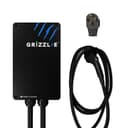
Grizzl-E Classic
United Chargers · J1772 · 40 A / 9.6 kW · 24 ft cable
A cast-aluminum box with no app, no account and no firmware to update. If you want a charger that behaves like an appliance, this is the one.
What is good
- Cast aluminum NEMA 4 / IP67 enclosure, built for outdoor mounting
- No app, no account, no network dependency
- Amperage is set with physical switches, not software
- Protections for over-current, over-voltage, ground fault and over-temperature
What is not
- 40 A ceiling, slower than the 48 A units if your panel can take more
- No scheduling, so off-peak charging has to be set in the car
- The cold-flexible 24 ft cable is only on the Extreme Edition
| Maximum output | 40 A / 9.6 kW at 240 V |
|---|---|
| Adjustable | 16, 24, 32 or 40 A |
| Connector | SAE J1772 |
| Cable | 24 ft on the Extreme Edition |
| Enclosure | Cast aluminum, NEMA 4 / IP67 |
| Certification | UL certified |
| Warranty | 3 years |
Skip this if: Skip it if you want scheduled charging or energy tracking in an app. The Classic deliberately has neither.
Specifications above are the manufacturer’s published figures. Source: United Chargers, InsideEVs. We have not tested this unit — see how we pick.
2. Tight wall space
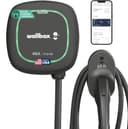
Wallbox Pulsar Plus
Wallbox · J1772 · 48 A / 11.5 kW · 25 ft cable
The smallest 48 A unit here at roughly 7.8 by 7.9 inches, which matters more than it sounds when the only free wall is beside a door.
What is good
- Smallest body of the 48 A units, under 8 inches square
- Current configurable in steps from 6 A to 48 A
- NEMA Type 4 enclosure, rated down to -22 F
- Weighs 4.4 lb without the cable, so mounting is simple
What is not
- Hardwired only at 48 A, with no plug-in version at full output
- Setup runs through the app, which some owners find fussy
| Maximum output | 48 A / 11.5 kW at 240 V |
|---|---|
| Configurable current | 6 A to 48 A |
| Connector | SAE J1772 |
| Cable | 25 ft |
| Body size | 7.8 x 7.9 x 3.9 inches without the cable |
| Operating temperature | -22 F to 104 F |
| Certification | UL 2594, UL 2231 |
| Warranty | 3 years |
Skip this if: Skip it if you want a plug-in unit you can take with you. The 48 A Pulsar Plus is hardwired.
Specifications above are the manufacturer’s published figures. Source: Wallbox, Wallbox. We have not tested this unit — see how we pick.
FAQ
Questions people actually ask
Does cold weather affect EV charging?
How much range does an EV lose in cold weather?
Should I plug in my EV every night in winter?
Do EV chargers work in freezing temperatures?
Sources
Where these numbers come from
- Pulsar Plus datasheet — WallboxPublished -22 F to 104 F operating temperature range.
- Grizzl-E Classic product specifications — United ChargersPublished cold-flexible cable on the Extreme Edition.
Read next
Related reading
- Your winter EV charging kitFive winter purchases in priority order, plus the four habits that matter more than any of them.
- Charge port frozen shutA frozen port door or a connector stuck in the car: the fixes that work, the one that cracks plastic, and the prevention.
- The best EV chargers for cold climatesChargers with published low-temperature ratings and cold-flexible cables, plus what winter really costs you.
- Do you actually need a Level 2 charger?The honest test for whether you need a Level 2 charger, or whether Level 1 is enough.
- The best EV chargers for mounting outdoorsChargers genuinely rated for outdoor mounting, and what NEMA 4 and IP67 actually certify.
- Running low with nowhere to chargeWhat genuinely helps if you run low, and why emergency battery packs are not the answer.