Code
EV charger disconnect requirements
Until recently this was a question only owners of very large chargers had to ask. The 2026 National Electrical Code rewrote the rule and made it everybody's question -- if your town has adopted it.
By Sawyer V. · Published October 17, 2026
How this page is funded: we earn a commission if you buy through our Amazon links, at no extra cost to you. It does not change what we recommend, and we say plainly when the honest answer is to buy nothing. Full disclosure.
The verdict: if you are hardwiring a charger in 2026, assume a disconnect is required and get it priced, then confirm with your local inspector which code edition your town is enforcing. If you are plugging a charger into a NEMA 14-50, the plug itself is your disconnecting means and there is nothing further to buy. That one sentence is the practical difference between the two install routes this year, and it is a new reason to think about plug-in that did not exist under the previous code cycle.
What a disconnecting means actually is
It is a switch that someone can reach and open to make the equipment safe to work on -- for an electrician replacing the unit, or for a firefighter who needs the charger dead. It is not the same thing as the breaker in your panel, although a breaker can serve the purpose if it is in a readily accessible location. On a detached garage or a long driveway run, the panel often is not, which is the case the rule is written for.
The two code editions, side by side
| 2023 NEC | 2026 NEC | |
|---|---|---|
| When a disconnect is required | EVSE rated more than 60 A or more than 150 V to ground | All permanently connected EVSE; the thresholds were removed |
| Where it goes | A readily accessible location | A readily accessible location |
| If it is remote from the equipment | A plaque on the equipment stating its location | A plaque or directory at the equipment stating its location |
| Plug-in equipment | Covered by the same threshold | The attachment plug may serve, up to 60 A or 150 V to ground |
| Lockable open | Yes, per 110.25 | Yes, per 110.25 |
| Multifamily | Not separately addressed | 625.43(B): a plaque or directory identifying which disconnect serves which unit |
| Emergency shutoff | Not required | 625.43(D), for installations other than one- and two-family dwellings |
Which chargers were always caught by this
Even under the old threshold, the large end of the market needed a disconnect, because it is rated above 60 amperes. On this site that means the 80-amp Grizzl-E Ultimate and the Autel MaxiCharger AC 80A at 80 amps, and the Enphase HCS-80 at 64 amps continuous on an 80-amp breaker -- which is a good reminder that the model number is not the rating. Anybody who has had one of those installed has already met this rule and paid for it.
The group newly affected by the 2026 rewrite is the mainstream: a hardwired 40- or 48-amp charger, which is most of what gets installed in American garages. 48 amp vs 80 amp covers why 48 is the common tier, and the Grizzl-E Ultimate 48A on the buy rows below is a typical example of the class.
The emergency-shutoff subsection, and who it is for
The most eye-catching part of the 2026 rewrite is 625.43(D), which requires a clearly identified emergency shutoff for permanently connected installations in other than one- and two-family dwellings. It has to sit between 20 and 100 feet from the equipment and in sight of it, be marked "EVSE EMERGENCY DISCONNECT" and "WARNING: ELECTRIC VEHICLE(S) WILL REMAIN ENERGIZED", be manual reset, and open all ungrounded conductors at once. If you own a single-family house, this one is not about you. If you are the person organizing chargers in a condo garage, it very much is -- and so is the multifamily plaque rule in 625.43(B).
What this means for your quote
- Ask which code edition your jurisdiction enforces. The answer changes what the inspector will require, and your electrician should know it already. EV charger permits and inspection covers the process.
- Ask whether your panel counts as readily accessible from the charger location. If it does, the breaker may serve and the extra device may not be needed.
- Get the disconnect itemized rather than bundled, so you can compare quotes. Hiring an electrician lists the other line items worth naming.
- Price the plug-in alternative at the same time. If the plug is your disconnecting means, a 14-50 install can come out cheaper than it used to relative to hardwiring -- but it also caps you at 40 amps, so run both numbers.
And the usual caveat, which matters more here than anywhere else on this site: this page is a reference to published code language, not an interpretation of your installation. The authority having jurisdiction decides what your install needs. Can I install my own EV charger is the honest answer to the next question.
The chargers this rule touches
The mainstream hardwired tier the 2026 change newly affects, the receptacle that makes the plug your disconnect, and the two 80-amp units that always needed one. Live Amazon prices with the date they were read.
1. Ultimate build quality on a 60 A circuit
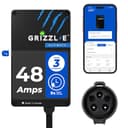
Grizzl-E Ultimate 48A
United Chargers · J1772 + NACS · 48 A / 11.5 kW · 25 ft cable
The Ultimate's hardware at the amperage most houses can feed: 48 A and 11.5 kW, hardwired, Wi-Fi and OCPP, in the same cast-aluminum Type 4 case. The catch is what United Chargers publishes about dialing it down -- the adjustable steps stop at 40 A.
What is good
- 48 A on a 60 A circuit, which a normal 200 A panel can usually spare
- Same cast-aluminum UL Type 4 case and -22 F rating as the 80 A Ultimate
- 25 ft cable, the long end of the range
- Wi-Fi, a mobile app and OCPP, so it is not locked to one vendor's cloud
- Offered with either a J1772 or a NACS connector
What is not
- Hardwire only -- there is no plug-in version of the Ultimate
- United Chargers publishes adjustable steps of 40/32/24/16 A, so the published step list does not include 48 A itself
- No ENERGY STAR certification listed, unlike the 80 A Ultimate
- A J1772 unit needs an adapter on every charge if you drive a NACS car
- Costs more than the 40 A Grizzl-E Classic for speed many owners will not use
| Maximum output | 48 A / 11.5 kW |
|---|---|
| Adjustable current | 40 A, 32 A, 24 A, 16 A (as published) |
| Connector | J1772 or NACS, chosen at purchase |
| Cable | 25 ft (7.6 m) |
| Installation | Hardwire only |
| Enclosure | Aluminum, UL Type 4 indoor/outdoor rating |
| Operating temperature | -30 C to +50 C (-22 F to 122 F) |
| Connectivity | Wi-Fi (2.4 GHz), mobile app, OCPP |
| Certification | UL, file E510712 |
| Weight | 11.00 kg / 24.25 lb, shipped |
| Enclosure size | 10.25 x 6.25 x 3.75 in |
| Country of origin | Canada, per United Chargers |
| Model number | GRS-077-W-HW-25N48-A-GB |
| Warranty | 3 years, or 5 years |
Skip this if: Skip it if your car accepts more than 11.5 kW and your panel can carry a 100 A circuit -- that is what the 80 A model is for. Skip it too if you want a plug-in unit; this is hardwire only.
Specifications above are the manufacturer’s published figures. Source: United Chargers. We have not tested this unit — see how we pick.
2. The receptacle to specify
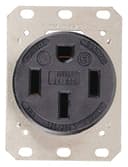
Hubbell HBL9450A NEMA 14-50 receptacle
Hubbell Wiring Device-Kellems · NEMA 14-50 · 50 A / 12 kW
The industrial-grade 14-50 electricians specify when they know the circuit will feed an EV charger every night. Full-size brass contacts and a clamping terminal, not the stab-and-hope design of a builder-grade outlet.
What is good
- Industrial grade, with the clamping terminal design that keeps a high-current connection tight
- Accepts 10 through 4 AWG, so it fits whatever conductor your run needs
- UL listed and CSA certified, with a published file number you can look up
- Weather-resistant rated, which matters for a garage or an outdoor box
What is not
- Costs several times a builder-grade 14-50, which is the entire point
- Installation is licensed electrical work -- this is not a part you fit yourself
- No cover plate included on the single pack
| Rating | 50 A, 125/250 V, 12,500 W maximum |
|---|---|
| Configuration | NEMA 14-50R, 3-pole, 4-wire grounding |
| Wire range | 10 to 4 AWG |
| Grade | Industrial |
| Certification | UL listed (file E2186), CSA certified |
| Standard | NEMA WD-6 compliant |
Skip this if: Skip it only if your charger is being hardwired -- then you do not need a receptacle at all, and hardwiring is the more durable answer.
Specifications above are the manufacturer’s published figures. Source: Hubbell Wiring Device-Kellems. We have not tested this unit — see how we pick.
3. 80 A with an app and access control
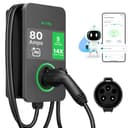
Autel MaxiCharger AC 80A
Autel Energy · J1772 · 80 A / 19.2 kW · 25 ft cable
The connected 80-amp charger: 19.2 kW, adjustable all the way down to 6 A from the app, an RFID card reader and a -40 F to 131 F rating. It asks for a 100 A circuit at full output.
What is good
- 19.2 kW, the ceiling of AC Level 2 charging
- Adjustable from 6 A to 80 A in the app, so one unit fits almost any circuit
- Built-in RFID card reader, which is rare outside access-control models
- Published -40 F to 131 F range, the widest of the 80 A units here
- Long list of published safety standards plus ENERGY STAR certification
What is not
- 80 A continuous needs a 100 A circuit, which most homes cannot spare
- Derates above 113 F, so a hot garage will not see the full figure
- Hardwired only, with no plug-in version
- 4G connectivity is an optional extra, not standard
- Costs far more than the 48 A chargers most households can actually use
| Maximum output | 19.2 kW (240 V AC x 80 A) |
|---|---|
| Adjustable | 6 A to 80 A, in the app |
| Voltage | 208/240 V AC, 60 Hz, single phase |
| Connector | SAE J1772 or NACS |
| Cable | 19 ft (6 m) or 25 ft (7.5 m) |
| Installation | Hardwired; wall or pedestal mount |
| Enclosure | NEMA 3S, IK10 |
| Operating temperature | -40 F to 131 F, derating above 113 F |
| Ground fault | 20 mA CCID |
| Access control | Card reader, ISO 15693 and ISO 14443 A/B |
| Connectivity | Wi-Fi, Ethernet, RS485 and Wi-SUN; 4G optional |
| Metering | ANSI C12.20 (0.5%) compliant |
| Size | 14.5 x 8.5 x 5.1 in; 20.3 lb with the 19 ft cable |
| Warranty | 3 years, extendable up to 5 |
Skip this if: Skip it if your panel cannot spare a 100 A circuit or your car tops out at 11.5 kW -- the 48 A tier does the same job for far less.
Specifications above are the manufacturer’s published figures. Source: Autel Energy. We have not tested this unit — see how we pick.
4. A fast charger with no software
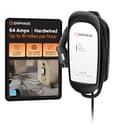
Enphase HCS-80
Enphase · J1772 · 64 A / 15.4 kW · 25 ft cable
The no-app option in this tier: 64 A continuous on an 80 A breaker, a watertight NEMA Type 4 case and a five-year warranty. Formerly sold as a ClipperCreek.
What is good
- Five-year warranty, the longest in this group
- Watertight NEMA Type 4 enclosure, rated -22 F to 122 F
- No app, no account and no network dependency
- Integrated cable wrap and a wall-mounted J1772 holster
- Published compliance with six UL standards plus ENERGY STAR
What is not
- 64 A, not 80 A, so 15.4 kW rather than 19.2 kW
- Still needs a dedicated 80 A circuit, which many panels cannot spare
- No scheduling or energy reporting -- that has to happen in the car
- J1772 only, so a NACS car needs an adapter
- The most expensive unit covered here
| Maximum output | 64 A continuous / 15.4 kW |
|---|---|
| Circuit breaker | Dedicated, 2-pole 80 A |
| Connector | SAE J1772 |
| Cable | 25 ft (7.6 m) or 18 ft (5.5 m), pre-wired |
| Input | Pre-wired 8 AWG service whip, 3 ft |
| Enclosure | NEMA Type 4, watertight |
| Operating temperature | -22 F to 122 F |
| Size | 19.7 x 8.9 x 5.3 in; 17.8 lb |
| Mounting | Wall or pedestal (pedestal sold separately) |
| Ground fault | Integral CCID, 20 mA, auto reset |
| Indicators | Four LEDs: power, charging, power fault, charging fault |
| Warranty | 5 years |
Skip this if: Skip it if you want 19.2 kW -- this is 15.4 kW -- or if you want app scheduling. It has no network connection at all.
Specifications above are the manufacturer’s published figures. Source: Enphase Energy. We have not tested this unit — see how we pick.
FAQ
Questions people actually ask
Does an EV charger need a disconnect switch?
Can the breaker be the disconnecting means?
Do plug-in EV chargers need a disconnect?
Does a 48-amp charger need a disconnect?
What is an EVSE emergency disconnect?
How much does an EV charger disconnect add to the job?
Sources
Where these numbers come from
- 625.43 EVSE Disconnecting Means -- 2026 NEC code change summary — Electrical License Renewal (NEC continuing-education content)Reproduces both editions. 2023 code language: "For EVSE and WPTE rated more than 60 amperes or more than 150 volts to ground, the disconnecting means shall be provided and installed in a readily accessible location. If the disconnecting means is installed remote from the equipment, a plaque shall be installed on the equipment denoting the location of the disconnecting means." 2026: section 625.43 was reorganized and expanded into four subsections; the previous thresholds of more than 60 amperes or more than 150 volts to ground were removed and all EVSE and WPTE disconnects are now addressed under 625.43. 625.43(A) general -- one or more disconnecting means in accordance with (B) through (D). 625.43(B) multifamily dwellings -- a plaque or directory must identify which disconnect serves which unit. 625.43(C) equipment disconnects -- all permanently connected EVSE and WPTE must have a disconnecting means in a readily accessible location, with a plaque or directory at the equipment if it is remote; for cord- and plug-connected EVSE the attachment plug is permitted to serve as the disconnecting means for units rated not exceeding 60 amperes or not exceeding 150 volts to ground, and the disconnect must be lockable open in accordance with 110.25. 625.43(D) emergency shutoff -- clearly identified emergency shutoff devices are required for all permanently connected EVSE and WPTE installations in other than one- and two-family dwellings, installed 20 to 100 feet from the equipment and in sight of it, marked "EVSE EMERGENCY DISCONNECT" and "WARNING: ELECTRIC VEHICLE(S) WILL REMAIN ENERGIZED" per 110.22(A), manual reset type, disconnecting all ungrounded conductors simultaneously. Read 2026-10-17.
- NEC Article 625: EV Charging Equipment — WireRef625.41 Continuous Load Rating: EV charging is classified as a continuous load because the EVSE draws its maximum rated current for 3 or more hours during a typical charge session, so the branch circuit is sized at 125% of the rated current -- a 48 A charger requires a 60 A circuit. 625.42 Branch Circuit Requirements: each EVSE requires a dedicated branch circuit unless an approved energy management system controls the load. Read 2026-10-17.
- Enphase HCS-80 EVSE data sheet — Enphase Energy64 A continuous / 15.4 kW output on a dedicated 2-pole 80 A breaker, pre-wired 8 AWG 3 ft service whip, SAE J1772 cable at 25 ft or 18 ft, NEMA Type 4 watertight enclosure, integral CCID 20 mA ground-fault protection with auto reset, four LED indicators, NEC Article 625, UL 2594 among others, 5-year warranty. Read 2026-10-01.
- Autel MaxiCharger AC 80A — Autel Energy19.2 kW (240 V AC x 80 A) with output adjustable 6 A to 80 A in the app; 208/240 V AC, 60 Hz, single phase; SAE J1772 or NACS; 19 ft or 25 ft cable; hardwired with wall or pedestal mount; NEMA 3S and IK10 enclosure; -40 F to 131 F with derating above 113 F; UL 2594, UL 2231-1, UL 2231-2, UL 1998 and CSA C22.2 No. 280 plus ENERGY STAR; 3-year warranty extendable to 5. Read 2026-10-01.
- Grizzl-E Ultimate 48 — United ChargersMax power 48 A / 11.5 kW, hardwire only, adjustable current published as 40A/32A/24A/16A, J1772 and NACS, 25 ft cable, UL Type 4 indoor/outdoor, OCPP, UL E510712, Wi-Fi 2.4 GHz and mobile app, -22 F to 122 F. Read 2026-10-11.
Read next
Related reading
- Do you need a permit for an EV charger?When a permit is required, what it costs, what the inspector checks, and why to bother.
- What size breaker and wire does an EV charger need?Breaker and wire size for every charger amperage, with the 125% rule worked through.
- Hiring an electrician for your EV chargerThe questions to ask, what a comparable quote contains, and the red flags.
- Hardwired or plug-in: which EV charger install is right?NEMA 14-50 or hardwired: amperage limits, cost, portability and what inspectors prefer.
- Can you install your own EV charger?What you can legally do yourself, what needs an electrician, and why the difference matters.