Amperage
48 amps vs 80 amps: which do you need?
This is the last real decision in home charging, and it is settled by your electrical panel and your car's onboard charger -- not by the charger on the shelf.
By Sawyer V. · Published October 11, 2026
How this page is funded: we earn a commission if you buy through our Amazon links, at no extra cost to you. It does not change what we recommend, and we say plainly when the honest answer is to buy nothing. Full disclosure.
The verdict in one line: buy a 48-amp charger. Then read the two questions below, and if you can answer yes to both, go to 80. That ordering is deliberate -- almost everybody arrives at this page hoping the top tier is worth it, and almost everybody is better served by the tier below, because the limit is the house and the car rather than the box on the wall.
Gate one: will your car take it?
The charger offers power and the car's onboard charger decides how much it accepts. Plenty of EVs cap at 11.5 kW, which is exactly what a 48-amp charger delivers. On those cars an 80-amp charger is slower than nothing -- it is identical, on a circuit twice the size and a unit that costs considerably more.
The EPA makes this checkable for GM's EVs, which it rates as separate trims with the onboard charger named in the trim title -- "LYRIQ (11 kW Charger)" and "LYRIQ (19 kW Charger)" are different EPA entries. For other makes, open the car's charging screen and read the maximum AC current it will accept. A car that stops at 48 A has settled this question for you.
Gate two: will your panel carry it?
What each tier asks for
A charger is a continuous load, so the breaker is 125% of the rated current.
48 A x 1.25 = a 60 A circuit. Output: 48 x 240 = 11.5 kW.
64 A x 1.25 = an 80 A circuit. Output: 64 x 240 = 15.4 kW.
80 A x 1.25 = a 100 A circuit. Output: 80 x 240 = 19.2 kW.
A 100 A continuous circuit is half a 200 A service, before the air conditioning, range, dryer and water heater.
On a 100 A or 150 A service, the 80-amp tier is simply not available without a service upgrade, and that upgrade routinely costs more than the entire charger. Run the numbers first: electrical panel load calculation. If the answer is tight, a charger with load management shares an existing circuit instead of demanding a new one -- see load management explained.
What the difference actually buys, in miles
| Vehicle | 48 A (11.5 kW) | 64 A (15.4 kW) | 80 A (19.2 kW) |
|---|---|---|---|
| Efficient sedan, 25 kWh/100 mi | about 46 mi/h | about 62 mi/h | about 77 mi/h |
| Cadillac Lyriq, 37 kWh/100 mi | about 31 mi/h | about 42 mi/h | about 52 mi/h |
| GMC Sierra EV, 50 kWh/100 mi | about 23 mi/h | about 31 mi/h | about 38 mi/h |
| GMC Hummer EV, 70 kWh/100 mi | about 16 mi/h | about 22 mi/h | about 27 mi/h |
Now read those rows against a ten-hour overnight window. The 48-amp column delivers 160 to 460 miles depending on the car. Unless you drive more than that in a day, every column to its right is buying you capability you will use on a handful of days a year. That is the honest case, and it is why the recommendation is 48.
The 64-amp tier people forget
Between the two tiers everyone argues about sits a third: 64 A continuous on an 80 A circuit, 15.4 kW. An 80 A circuit is meaningfully easier and cheaper to feed than a 100 A one, and 15.4 kW captures most of the gap. The Enphase HCS-80 is the unit in this tier on this site, and the "80" in its name is the breaker, not the output -- see the Enphase HCS-80 review. If gate one is open but gate two is marginal, this is the answer nobody offers you.
Who should buy which tier
| If this is you | Tier | Why |
|---|---|---|
| Any normal car, any normal house | 48 A | 11.5 kW overnight covers everything; 60 A circuit |
| Car capped at 11.5 kW, whatever the panel | 48 A | 80 A charges at exactly the same speed |
| 100 A or 150 A service | 48 A, or less | 100 A continuous is not available to you |
| 19 kW car, 200 A service with real headroom | 80 A | The only case where the circuit pays |
| Electric truck, high daily miles, same-day turnaround | 80 A if the panel allows | About 11 extra mi/h on a 70 kWh/100 mi truck |
| Gate one open, gate two marginal | 64 A | 15.4 kW on an 80 A circuit, cheaper to feed |
| Two EVs on one circuit | 48 A with load management | Sharing beats a bigger single charger |
| Renting, or moving soon | 40 A plug-in | See plug-in picks |
If you have settled on 48, best 48 amp EV charger ranks that field and 32A vs 40A vs 48A covers the tiers below. If you have settled on 80, best 80 amp EV charger ranks the three units that get there.
One pick per tier
Two 48 A units and two that reach the top tier, so you can price the decision. Live Amazon prices with the date they were read.
1. A familiar brand, hardwired
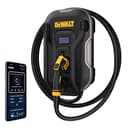
DEWALT 48 A EV Charger (DXPAEV048)
DEWALT · J1772 · 48 A / 11.5 kW · 25 ft cable
A 48 A hardwired charger with a 25 ft cable, an LCD screen and an app, from a brand most garages already trust. Adjustable from 12 A, IP66, CSA certified, three-year warranty.
What is good
- 48 A / 11.5 kW, the top tier a normal 60 A home circuit supports
- Adjustable from 12 A, a wider floor than most chargers offer
- 25 ft cable with a protective cage and an anti-slip handle
- An LCD screen on the unit, so basic status does not depend on a phone
- Scheduling and energy monitoring in a free app, with no subscription
- A three-year warranty backed by 24/7 technical support, and a national install partner
What is not
- Hardwired only -- DEWALT's plug-in version is the separate 40 A model
- DEWALT publishes no operating temperature range for it
- CSA certified, but DEWALT does not name the standard or publish a file number the way Grizzl-E and Lectron do
- No ENERGY STAR certification listed, unlike several rivals at this price
- J1772 only, so a NACS car needs an adapter on every charge
- Costs more than the 48 A chargers most first-time buyers end up with
| Maximum output | 48 A / 11.5 kW |
|---|---|
| Adjustable | 12 A to 48 A |
| Connector | SAE J1772 (DEWALT notes a Tesla adapter is sold separately) |
| Cable | 25 ft, UL certified, with a protective cage and anti-slip handle |
| Installation | Hardwired; mounting bracket and hardware included |
| Enclosure | IP66, described as a NEMA 4X type enclosure |
| Display | LCD screen on the unit |
| Connectivity | Bluetooth and Wi-Fi, through the free DEWALT EV Charger app |
| App features | Start and stop charging, energy monitoring, off-peak scheduling |
| Certification | CSA certified for indoor and outdoor use |
| Maker's range claim | Up to 46 miles of range per hour |
| Warranty | 3-year limited, with 24/7 technical support |
Skip this if: Skip it if you want a plug-in unit -- this one is hardwired, and DEWALT's plug-in version is the 40 A model. Skip it too if a published temperature range matters to you; DEWALT does not list one.
Specifications above are the manufacturer’s published figures. Source: DEWALT. We have not tested this unit — see how we pick.
2. Ultimate build quality on a 60 A circuit
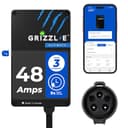
Grizzl-E Ultimate 48A
United Chargers · J1772 + NACS · 48 A / 11.5 kW · 25 ft cable
The Ultimate's hardware at the amperage most houses can feed: 48 A and 11.5 kW, hardwired, Wi-Fi and OCPP, in the same cast-aluminum Type 4 case. The catch is what United Chargers publishes about dialing it down -- the adjustable steps stop at 40 A.
What is good
- 48 A on a 60 A circuit, which a normal 200 A panel can usually spare
- Same cast-aluminum UL Type 4 case and -22 F rating as the 80 A Ultimate
- 25 ft cable, the long end of the range
- Wi-Fi, a mobile app and OCPP, so it is not locked to one vendor's cloud
- Offered with either a J1772 or a NACS connector
What is not
- Hardwire only -- there is no plug-in version of the Ultimate
- United Chargers publishes adjustable steps of 40/32/24/16 A, so the published step list does not include 48 A itself
- No ENERGY STAR certification listed, unlike the 80 A Ultimate
- A J1772 unit needs an adapter on every charge if you drive a NACS car
- Costs more than the 40 A Grizzl-E Classic for speed many owners will not use
| Maximum output | 48 A / 11.5 kW |
|---|---|
| Adjustable current | 40 A, 32 A, 24 A, 16 A (as published) |
| Connector | J1772 or NACS, chosen at purchase |
| Cable | 25 ft (7.6 m) |
| Installation | Hardwire only |
| Enclosure | Aluminum, UL Type 4 indoor/outdoor rating |
| Operating temperature | -30 C to +50 C (-22 F to 122 F) |
| Connectivity | Wi-Fi (2.4 GHz), mobile app, OCPP |
| Certification | UL, file E510712 |
| Weight | 11.00 kg / 24.25 lb, shipped |
| Enclosure size | 10.25 x 6.25 x 3.75 in |
| Country of origin | Canada, per United Chargers |
| Model number | GRS-077-W-HW-25N48-A-GB |
| Warranty | 3 years, or 5 years |
Skip this if: Skip it if your car accepts more than 11.5 kW and your panel can carry a 100 A circuit -- that is what the 80 A model is for. Skip it too if you want a plug-in unit; this is hardwire only.
Specifications above are the manufacturer’s published figures. Source: United Chargers. We have not tested this unit — see how we pick.
3. A 19.2 kW car and a large service
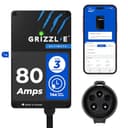
Grizzl-E Ultimate 80A
United Chargers · J1772 · 80 A / 19.2 kW · 25 ft cable
The top of AC Level 2: 80 A and 19.2 kW, hardwired, adjustable down through eight settings. The catch is the circuit -- 80 A continuous asks for a 100 A circuit, which most houses cannot spare.
What is good
- 80 A / 19.2 kW is the ceiling of AC Level 2 charging
- Eight current settings, from 80 A right down to 16 A, so one unit fits almost any circuit
- 25 ft cable and a cast-aluminum UL Type 4 enclosure rated -22 F to 122 F
- UL listed with a published file number, plus Energy Star certification
- OCPP support alongside the maker's own app, which is rare at this price
What is not
- 80 A continuous needs a 100 A circuit, which most homes cannot spare
- Very few cars accept more than 11.5 kW on AC, so the headline figure is unusable for most buyers
- Hardwired only -- there is no plug-in version
- Costs far more than the 48 A tier that most households will actually use
- 2.4 GHz Wi-Fi only, like the rest of the Grizzl-E Connect range
| Maximum output | 80 A / 19.2 kW |
|---|---|
| Adjustable | 80, 64, 56, 48, 40, 32, 24 or 16 A |
| Connector | SAE J1772 or NACS, chosen at purchase |
| Cable | 25 ft (7.6 m) |
| Installation | Hardwired only |
| Enclosure | Cast aluminum, UL Type 4 indoor/outdoor |
| Operating temperature | -30 C to +50 C (-22 F to 122 F) |
| Enclosure size | 10.25 x 6.25 x 3.75 in |
| Weight | 26.46 lb (12 kg), shipped |
| Connectivity | Wi-Fi (2.4 GHz), the Grizzl-E Connect app, and OCPP |
| Country of origin | Canada, per United Chargers |
| Certification | UL, file E510712; Energy Star |
| In the box | Charger, hardwire kit, mounting cradle, EasyEvPlug |
| Warranty | 3 years, or 5 years chosen at purchase |
Skip this if: Skip it unless your car actually accepts more than 11.5 kW and your panel can carry a 100 A circuit. Both have to be true, and for most homes neither is.
Specifications above are the manufacturer’s published figures. Source: United Chargers. We have not tested this unit — see how we pick.
4. 80 A with an app and access control
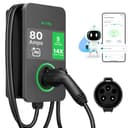
Autel MaxiCharger AC 80A
Autel Energy · J1772 · 80 A / 19.2 kW · 25 ft cable
The connected 80-amp charger: 19.2 kW, adjustable all the way down to 6 A from the app, an RFID card reader and a -40 F to 131 F rating. It asks for a 100 A circuit at full output.
What is good
- 19.2 kW, the ceiling of AC Level 2 charging
- Adjustable from 6 A to 80 A in the app, so one unit fits almost any circuit
- Built-in RFID card reader, which is rare outside access-control models
- Published -40 F to 131 F range, the widest of the 80 A units here
- Long list of published safety standards plus ENERGY STAR certification
What is not
- 80 A continuous needs a 100 A circuit, which most homes cannot spare
- Derates above 113 F, so a hot garage will not see the full figure
- Hardwired only, with no plug-in version
- 4G connectivity is an optional extra, not standard
- Costs far more than the 48 A chargers most households can actually use
| Maximum output | 19.2 kW (240 V AC x 80 A) |
|---|---|
| Adjustable | 6 A to 80 A, in the app |
| Voltage | 208/240 V AC, 60 Hz, single phase |
| Connector | SAE J1772 or NACS |
| Cable | 19 ft (6 m) or 25 ft (7.5 m) |
| Installation | Hardwired; wall or pedestal mount |
| Enclosure | NEMA 3S, IK10 |
| Operating temperature | -40 F to 131 F, derating above 113 F |
| Ground fault | 20 mA CCID |
| Access control | Card reader, ISO 15693 and ISO 14443 A/B |
| Connectivity | Wi-Fi, Ethernet, RS485 and Wi-SUN; 4G optional |
| Metering | ANSI C12.20 (0.5%) compliant |
| Size | 14.5 x 8.5 x 5.1 in; 20.3 lb with the 19 ft cable |
| Warranty | 3 years, extendable up to 5 |
Skip this if: Skip it if your panel cannot spare a 100 A circuit or your car tops out at 11.5 kW -- the 48 A tier does the same job for far less.
Specifications above are the manufacturer’s published figures. Source: Autel Energy. We have not tested this unit — see how we pick.
FAQ
Questions people actually ask
Is an 80 amp EV charger worth it?
What circuit does an 80 amp charger need?
How much faster is 80 amps than 48 amps?
Is there anything between 48 and 80 amps?
Will a bigger charger charge my car faster?
Sources
Where these numbers come from
- Fuel economy of 2026 Cadillac and GMC vehicles — U.S. EPA and U.S. Department of Energy, fueleconomy.govThe EPA rates the 11 kW and 19 kW onboard-charger versions of GM's EVs as separate trims and names the charger in the trim title, e.g. LYRIQ (11 kW Charger) and LYRIQ (19 kW Charger); consumption figures used here: Cadillac Lyriq 37 kWh/100 mi, GMC Sierra EV 50, GMC Hummer EV 70 (2025). Read 2026-10-11.
- Electric Vehicle Charging Infrastructure: AC Level 2 equipment — U.S. Department of Energy, Alternative Fuels Data CenterAC Level 2 runs at 240 V in homes, delivers 2.9 to 19.2 kW, and adds roughly 25 miles of range per hour of charging, on the J1772 or J3400 (NACS) connector. Read 2026-10-11.
- WireRef NEC Article 625: EV charging equipment — WireRefEV charging equipment is a continuous load, so the branch circuit is sized at 125% of the charger's rated current; NEC Article 625 governs EV supply equipment. Read 2026-10-11.
- Grizzl-E Ultimate 48 — United ChargersSKU GRS-HW-25NACS48-B, model GRS-077-W-HW-25N48-A-GB, aluminum enclosure, origin Canada, 11.00 kg / 24.25 lbs, AC Level 2, connector J1772 and NACS, max power 48 A / 11.5 kW, hardwire only, UL Type 4 indoor/outdoor, OCPP, UL E510712, Wi-Fi 2.4 GHz and mobile app, adjustable current 40A/32A/24A/16A, 25 ft cable, enclosure 10.25 x 6.25 x 3.75 in, -30 C to +50 C (-22 F to 122 F). Read 2026-10-11.
- Grizzl-E Ultimate — United ChargersSKU GRU-077-W-HW-25DJ80-A-GB, aluminum enclosure, origin Canada, 12.00 kg / 26.46 lbs, AC Level 2, connector J1772 and NACS, max power 80 A / 19.2 kW, hardwire only, UL Type 4 indoor/outdoor, OCPP, certifications UL E510712 and Energy Star, Wi-Fi 2.4 GHz and mobile app, adjustable current 80A/64A/56A/48A/40A/32A/24A/16A, 25 ft cable, enclosure 10.25 x 6.25 x 3.75 in, -30 C to +50 C (-22 F to 122 F). Read 2026-10-11.
- Enphase HCS-80 EVSE data sheet — Enphase Energy64 A continuous / 15.4 kW output, dedicated 2-pole 80 A breaker, pre-wired 8 AWG 3 ft service whip, SAE J1772 cable at 25 ft or 18 ft, enclosure 19.7 x 8.9 x 5.3 in at 17.8 lb, wall or pedestal mounting, indoor/outdoor rated, -22 F to 122 F, NEMA Type 4 watertight enclosure, integral CCID 20 mA ground-fault protection with auto reset, four LED indicators, NEC Article 625, SAE J1772 and ENERGY STAR, UL 2594, UL 2251, UL 2231-1, UL 2231-2, UL 1998 and UL 991, 5-year warranty. Read 2026-10-01.
- Autel MaxiCharger AC 80A — Autel Energy19.2 kW (240 V AC x 80 A), adjustable 6 A to 80 A in the app, 208/240 V AC 60 Hz single phase, SAE J1772 or NACS, cable 19 ft (6 m) or 25 ft (7.5 m), hardwired with wall or pedestal mount, NEMA 3S and IK10 enclosure, -40 F to 131 F with derating above 113 F, 20 mA CCID ground-fault detection, card reader ISO 15693 and ISO 14443 A/B, Wi-Fi, Ethernet, RS485 and Wi-SUN with optional 4G, ANSI C12.20 (0.5%) metering, 14.5 x 8.5 x 5.1 in and 20.3 lb with the 19 ft cable, UL 2594, UL 2231-1, UL 2231-2, UL 1998 and CSA C22.2 No. 280 plus ENERGY STAR, 3-year warranty extendable to 5. Read 2026-10-01.
Read next
Related reading
- 32 A vs 40 A vs 48 A: how many amps do you actually need?What each amperage tier delivers in miles per hour, and the circuit each one requires.
- The best 80-amp EV chargersThe chargers that reach 19.2 kW, the circuit they need, and the test for whether the tier helps you.
- The best 48-amp EV chargersThe fastest home tier: 48-amp picks, the 60-amp circuit they need, and who should skip it.
- Grizzl-E Ultimate 48A vs 80AThe 48 A and 80 A Ultimates compared on circuit, output, adjustable steps, ENERGY STAR and weight.
- Can your electrical panel take an EV charger?What a load calculation is, what goes into it, and how to get a rough answer yourself.