Garage installs
The best EV charger for a garage
The easiest place to install a charger, and the place where people most often buy one with a cable that does not reach.
By Sawyer V. · Published September 8, 2026

How this page is funded: we earn a commission if you buy through our Amazon links, at no extra cost to you. It does not change what we recommend, and we say plainly when the honest answer is to buy nothing. Full disclosure.
A garage is the best-case installation. The panel is often on the same wall or a shared one, the unit is out of the weather, and the run is short -- which is why published figures put a garage-adjacent install at the cheap end of the range.
The mistake people make here is not electrical. It is geometry.
Garage picks
Ranked for a first home charger. Every row jumps to the full write-up below.
| # | Product | Best for | Max output | Price |
|---|---|---|---|---|
| 1 | Emporia Level 2 EV Charger (Classic)A first charger, hardwired. J1772, 25 ft cable. | A first charger, hardwired | 48 A11.5 kW | Check price on Amazon#ad how we are funded |
| 2 |  Wallbox Pulsar PlusTight wall space. J1772, 25 ft cable. Wallbox Pulsar PlusTight wall space. J1772, 25 ft cable. | Tight wall space | 48 A11.5 kW | $699.00 · View on Amazon#ad how we are funded · price as of October 27, 2026 |
| 3 |  Autel MaxiCharger AC HomeLong reach outdoors. J1772, 25 ft cable. Autel MaxiCharger AC HomeLong reach outdoors. J1772, 25 ft cable. | Long reach outdoors | 50 A12 kW | $470.00 · View on Amazon#ad how we are funded · price as of October 27, 2026 |
| 4 |  ChargePoint Home FlexHomes with an uncertain panel. J1772, 23 ft cable. ChargePoint Home FlexHomes with an uncertain panel. J1772, 23 ft cable. | Homes with an uncertain panel | 50 A12 kW | $549.00 · View on Amazon#ad how we are funded · price as of October 27, 2026 |
Measure before you buy, not after
Cable length is the one spec you cannot fix later. Do this before you choose a model:
- Park the car exactly the way you actually park it, including reversing in if that is what you do.
- Find the charge port. It might be front left, front right, rear left or rear quarter depending on the car -- this alone changes the answer by ten feet.
- Run a tape from the intended charger position to the port, following the path the cable will actually take: down the wall, across the floor, up to the port.
- Add three feet of slack. A cable pulled taut is a cable that will get damaged.
- Now compare with the published cable length. If it is close, buy the longer unit.
Tight garages and narrow walls
If the only free wall is beside a door or between the panel and a window, body size matters. The Wallbox Pulsar Plus publishes 7.8 by 7.9 inches, which is the smallest of the 48-amp units here and genuinely solves that problem.
Two cars, one garage
Two EVs sharing one charger works fine if they take turns overnight -- which, given a ten-hour window and typical daily driving, they usually can. If they must charge simultaneously, you need either two circuits or a unit with power sharing. Work through load management before buying two of anything.
The garage chargers in detail
Four units chosen for reach and for fitting on a real wall.
1. A first charger, hardwired
Emporia Level 2 EV Charger (Classic)
Emporia · J1772 · 48 A / 11.5 kW · 25 ft cable
The safe default for a first home charger: 48 amps hardwired, a genuinely long cable, a NEMA 4 outdoor-rated case, and no subscription attached to the app.
What is good
- 48 A hardwired is the fastest tier most homes can realistically support
- 25 ft of cable reaches across a two-car garage without a fight
- NEMA Type 4 enclosure is rated for outdoor mounting
- Energy monitoring in the app with no subscription
What is not
- Drops to 40 A if you use the NEMA 14-50 plug rather than hardwiring
- The app is the only way to change the amperage setting
| Maximum output | 48 A / 11.5 kW at 240 V (hardwired) |
|---|---|
| Plug-in output | 40 A with the NEMA 14-50 plug |
| Connector | SAE J1772 |
| Cable | 25 ft |
| Enclosure | NEMA Type 4, indoor or outdoor |
| Certification | UL listed, Energy Star |
| Warranty | 3 years |
Skip this if: Skip it if you want a unit with no app or network connection at all. The Grizzl-E Classic is the simpler machine.
Specifications above are the manufacturer’s published figures. Source: Emporia Energy. We have not tested this unit — see how we pick.
2. Tight wall space
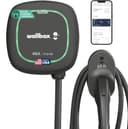
Wallbox Pulsar Plus
Wallbox · J1772 · 48 A / 11.5 kW · 25 ft cable
The smallest 48 A unit here at roughly 7.8 by 7.9 inches, which matters more than it sounds when the only free wall is beside a door.
What is good
- Smallest body of the 48 A units, under 8 inches square
- Current configurable in steps from 6 A to 48 A
- NEMA Type 4 enclosure, rated down to -22 F
- Weighs 4.4 lb without the cable, so mounting is simple
What is not
- Hardwired only at 48 A, with no plug-in version at full output
- Setup runs through the app, which some owners find fussy
| Maximum output | 48 A / 11.5 kW at 240 V |
|---|---|
| Configurable current | 6 A to 48 A |
| Connector | SAE J1772 |
| Cable | 25 ft |
| Body size | 7.8 x 7.9 x 3.9 inches without the cable |
| Operating temperature | -22 F to 104 F |
| Certification | UL 2594, UL 2231 |
| Warranty | 3 years |
Skip this if: Skip it if you want a plug-in unit you can take with you. The 48 A Pulsar Plus is hardwired.
Specifications above are the manufacturer’s published figures. Source: Wallbox, Wallbox. We have not tested this unit — see how we pick.
3. Long reach outdoors
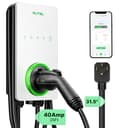
Autel MaxiCharger AC Home
Autel Energy · J1772 · 50 A / 12 kW · 25 ft cable
The 25 ft cable is the longest in this group, and the NEMA 4 case plus a cold-flexible cord make it the easiest unit to live with on an exposed outside wall.
What is good
- 25 ft cable, the longest of the wall units here
- Sold in NEMA 14-50, NEMA 6-50 and hardwired versions
- NEMA Type 4 enclosure rated for rain, snow, hail and sleet
- Wi-Fi and Bluetooth, so it still works if the Wi-Fi drops
What is not
- The 50 A version is hardwired only
- The app has more features than a first-time owner needs
| Maximum output | 50 A / 12 kW hardwired; 40 A / 9.6 kW plug-in |
|---|---|
| Connector | SAE J1772 |
| Cable | 25 ft |
| Enclosure | NEMA Type 4 |
| Certification | Tested to UL standards by CSA |
| Warranty | 3 years |
Skip this if: Skip it if your parking spot is right next to the panel. You are paying for cable you will coil up and never use.
Specifications above are the manufacturer’s published figures. Source: Autel Energy. We have not tested this unit — see how we pick.
4. Homes with an uncertain panel
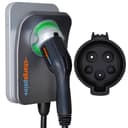
ChargePoint Home Flex
ChargePoint · J1772 · 50 A / 12 kW · 23 ft cable
The most adjustable unit here. It can be set anywhere from 16 A to 50 A, which makes it the one to buy when you do not yet know what your panel will allow.
What is good
- Six selectable amperage settings from 16 A to 50 A
- Sold in both hardwired and NEMA 14-50 versions
- Rated for indoor or outdoor installation
- The app is mature and does not require a subscription
What is not
- 23 ft is a foot shorter than the longest cables in this group
- The 50 A setting needs a bigger circuit than most panels have spare
| Maximum output | 50 A / 12 kW at 240 V |
|---|---|
| Amperage settings | 16, 24, 32, 40, 48 or 50 A |
| Connector | SAE J1772 |
| Cable | 23 ft |
| Installation | Hardwired or NEMA 14-50 |
| Certification | UL listed, Energy Star |
| Warranty | 3 years |
Skip this if: Skip it if your circuit is already fixed and you just want the cheapest safe 40 A unit. You are paying for flexibility you will not use.
Specifications above are the manufacturer’s published figures. Source: ChargePoint, ChargePoint. We have not tested this unit — see how we pick.
FAQ
Questions people actually ask
How high should I mount an EV charger in a garage?
How long should the charging cable be?
Can two EVs share one home charger?
Sources
Where these numbers come from
- Pulsar Plus datasheet — WallboxPublished body dimensions cited above.
- Level 2 EV charger installation cost, 2026 — SimpleSwitchPublished labor ranges by run difficulty. Fetched 2026-09-08.
Read next
Related reading
- How long should your EV charger cable be?How to measure your run properly, and which chargers have the longest cables.
- Hardwired or plug-in: which EV charger install is right?NEMA 14-50 or hardwired: amperage limits, cost, portability and what inspectors prefer.
- Load management: charging without a panel upgradeHow load management avoids a panel upgrade, what it costs in speed, and when to use it.
- The best home EV chargers, for people buying their first oneSix Level 2 chargers ranked for a first-time buyer, with an honest reason to skip each one.