Measuring up
How long should your EV charger cable be?
The one specification you cannot fix after installation. Ten minutes with a tape measure now prevents a genuinely expensive mistake.
By Sawyer V. · Published September 8, 2026
How this page is funded: we earn a commission if you buy through our Amazon links, at no extra cost to you. It does not change what we recommend, and we say plainly when the honest answer is to buy nothing. Full disclosure.
Home charger cables run roughly 16 to 25 feet. That sounds like plenty until you realize the cable does not travel in a straight line, and that your car's charge port might be on the opposite end of the vehicle from where you assumed.
This is the one spec that cannot be corrected later. Everything else -- amperage, app, enclosure -- you can live with. A cable that does not reach means a new charger.
Find your charge port first
Charge ports live in different places depending on the car: front-left fender, front-right fender, rear-left quarter, rear-right quarter. In a garage where you park nose-in, a rear-left port and a front-right port are ten or more feet apart. Go look before you measure.
The measuring method
- Park the car the way you actually park it. If you reverse in, reverse in. If you park slightly left because of the shelving, do that.
- Mark the intended charger position on the wall, at roughly 40 to 50 inches off the floor.
- Run a tape along the real path: down from the charger toward the floor, across the floor, around anything in the way, up to the charge port.
- Add three feet. A cable under tension gets damaged where it meets the connector, and you need slack to plug in comfortably.
- Compare to the published length. If the result is within two feet of the cable spec, buy the longer unit.
Published cable lengths
| Charger | Published cable length |
|---|---|
| Autel MaxiCharger AC Home | 25 ft |
| Wallbox Pulsar Plus | 25 ft |
| Emporia Level 2 | 25 ft |
| Grizzl-E Classic (Extreme Edition) | 24 ft |
| Tesla Wall Connector Gen 3 | 24 ft |
| ChargePoint Home Flex | 23 ft |
The longest-cable picks
Ranked for a first home charger. Every row jumps to the full write-up below.
| # | Product | Best for | Max output | Price |
|---|---|---|---|---|
| 1 |  Autel MaxiCharger AC HomeLong reach outdoors. J1772, 25 ft cable. Autel MaxiCharger AC HomeLong reach outdoors. J1772, 25 ft cable. | Long reach outdoors | 50 A12 kW | $470.00 · View on Amazon#ad how we are funded · price as of October 27, 2026 |
| 2 |  Wallbox Pulsar PlusTight wall space. J1772, 25 ft cable. Wallbox Pulsar PlusTight wall space. J1772, 25 ft cable. | Tight wall space | 48 A11.5 kW | $699.00 · View on Amazon#ad how we are funded · price as of October 27, 2026 |
| 3 | Emporia Level 2 EV Charger (Classic)A first charger, hardwired. J1772, 25 ft cable. | A first charger, hardwired | 48 A11.5 kW | Check price on Amazon#ad how we are funded |
What not to do about a cable that is too short
Do not use a household extension cord. A charger draws its full rated current continuously for hours, and a cord that is not rated for that heats up at the connections. This is a genuine fire risk, not a warranty technicality. EV charger extension cords covers the narrow set of circumstances where extra length can be done properly.
The right fix for a short cable is to move the charger, not extend the cable. Moving a wall unit five feet along a wall is a modest change to the electrical run and costs a fraction of what going wrong costs.
The long-cable units in detail
The three units with the most reach, and the case against each.
1. Long reach outdoors
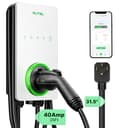
Autel MaxiCharger AC Home
Autel Energy · J1772 · 50 A / 12 kW · 25 ft cable
The 25 ft cable is the longest in this group, and the NEMA 4 case plus a cold-flexible cord make it the easiest unit to live with on an exposed outside wall.
What is good
- 25 ft cable, the longest of the wall units here
- Sold in NEMA 14-50, NEMA 6-50 and hardwired versions
- NEMA Type 4 enclosure rated for rain, snow, hail and sleet
- Wi-Fi and Bluetooth, so it still works if the Wi-Fi drops
What is not
- The 50 A version is hardwired only
- The app has more features than a first-time owner needs
| Maximum output | 50 A / 12 kW hardwired; 40 A / 9.6 kW plug-in |
|---|---|
| Connector | SAE J1772 |
| Cable | 25 ft |
| Enclosure | NEMA Type 4 |
| Certification | Tested to UL standards by CSA |
| Warranty | 3 years |
Skip this if: Skip it if your parking spot is right next to the panel. You are paying for cable you will coil up and never use.
Specifications above are the manufacturer’s published figures. Source: Autel Energy. We have not tested this unit — see how we pick.
2. Tight wall space
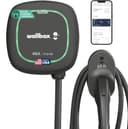
Wallbox Pulsar Plus
Wallbox · J1772 · 48 A / 11.5 kW · 25 ft cable
The smallest 48 A unit here at roughly 7.8 by 7.9 inches, which matters more than it sounds when the only free wall is beside a door.
What is good
- Smallest body of the 48 A units, under 8 inches square
- Current configurable in steps from 6 A to 48 A
- NEMA Type 4 enclosure, rated down to -22 F
- Weighs 4.4 lb without the cable, so mounting is simple
What is not
- Hardwired only at 48 A, with no plug-in version at full output
- Setup runs through the app, which some owners find fussy
| Maximum output | 48 A / 11.5 kW at 240 V |
|---|---|
| Configurable current | 6 A to 48 A |
| Connector | SAE J1772 |
| Cable | 25 ft |
| Body size | 7.8 x 7.9 x 3.9 inches without the cable |
| Operating temperature | -22 F to 104 F |
| Certification | UL 2594, UL 2231 |
| Warranty | 3 years |
Skip this if: Skip it if you want a plug-in unit you can take with you. The 48 A Pulsar Plus is hardwired.
Specifications above are the manufacturer’s published figures. Source: Wallbox, Wallbox. We have not tested this unit — see how we pick.
3. A first charger, hardwired
Emporia Level 2 EV Charger (Classic)
Emporia · J1772 · 48 A / 11.5 kW · 25 ft cable
The safe default for a first home charger: 48 amps hardwired, a genuinely long cable, a NEMA 4 outdoor-rated case, and no subscription attached to the app.
What is good
- 48 A hardwired is the fastest tier most homes can realistically support
- 25 ft of cable reaches across a two-car garage without a fight
- NEMA Type 4 enclosure is rated for outdoor mounting
- Energy monitoring in the app with no subscription
What is not
- Drops to 40 A if you use the NEMA 14-50 plug rather than hardwiring
- The app is the only way to change the amperage setting
| Maximum output | 48 A / 11.5 kW at 240 V (hardwired) |
|---|---|
| Plug-in output | 40 A with the NEMA 14-50 plug |
| Connector | SAE J1772 |
| Cable | 25 ft |
| Enclosure | NEMA Type 4, indoor or outdoor |
| Certification | UL listed, Energy Star |
| Warranty | 3 years |
Skip this if: Skip it if you want a unit with no app or network connection at all. The Grizzl-E Classic is the simpler machine.
Specifications above are the manufacturer’s published figures. Source: Emporia Energy. We have not tested this unit — see how we pick.
FAQ
Questions people actually ask
How long should an EV charger cable be?
Which EV charger has the longest cable?
Can I use an extension cord with an EV charger?
Does cable length affect charging speed?
Sources
Where these numbers come from
- MaxiCharger AC Elite Home 40A specifications — Autel Energy
- Pulsar Plus datasheet — Wallbox
- ChargePoint Home Flex specifications and ordering information — ChargePoint
Read next
Related reading
- The best EV charger for a garageGarage-friendly chargers: mounting position, cable reach and units that fit tight walls.
- EV charger extension cords: the honest answerWhy household extension cords are dangerous for charging, and the safe alternatives.
- Autel MaxiCharger AC HomeUp to 50 A hardwired, 25 ft cable, NEMA 4, Wi-Fi and Bluetooth. The longest reach here.
- The best home EV chargers, for people buying their first oneSix Level 2 chargers ranked for a first-time buyer, with an honest reason to skip each one.
- The best EV charging cablesPortable charging cables and properly rated J1772 extensions, plus the rule never to break.
- The best EV charger holsters and cable organizersHolsters and hooks that keep the connector off the floor and the cable out from under the wheels.
- Lectron NEXUS review48 A hardwired or 40 A plug-in, 23 ft of cable, ETL listed and no app: who the NEXUS suits.
- The best long-cable EV chargersThe 25 ft and 23 ft chargers ranked, plus the measurement to take before you buy.