Certified picks
The best UL listed EV chargers
The one specification with no acceptable trade-off, and the one most often obscured by careful wording. Here are units whose listing you can actually check.
By Sawyer V. · Published September 10, 2026

How this page is funded: we earn a commission if you buy through our Amazon links, at no extra cost to you. It does not change what we recommend, and we say plainly when the honest answer is to buy nothing. Full disclosure.
A home EV charger draws 32 to 48 amps continuously, for hours, often outdoors, for years. It is the one component in this project where the cheaper option is not a trade-off you can reason about -- and it is the one most often fudged with wording that sounds like certification without being it.
Properly certified picks
Ranked for a first home charger. Every row jumps to the full write-up below.
| # | Product | Best for | Max output | Price |
|---|---|---|---|---|
| 1 | Emporia Level 2 EV Charger (Classic)A first charger, hardwired. J1772, 25 ft cable. | A first charger, hardwired | 48 A11.5 kW | Check price on Amazon#ad how we are funded |
| 2 |  ChargePoint Home FlexHomes with an uncertain panel. J1772, 23 ft cable. ChargePoint Home FlexHomes with an uncertain panel. J1772, 23 ft cable. | Homes with an uncertain panel | 50 A12 kW | $549.00 · View on Amazon#ad how we are funded · price as of October 27, 2026 |
| 3 |  Wallbox Pulsar PlusTight wall space. J1772, 25 ft cable. Wallbox Pulsar PlusTight wall space. J1772, 25 ft cable. | Tight wall space | 48 A11.5 kW | $699.00 · View on Amazon#ad how we are funded · price as of October 27, 2026 |
| 4 |  Grizzl-E ClassicHarsh weather and no app. J1772, 24 ft cable. Grizzl-E ClassicHarsh weather and no app. J1772, 24 ft cable. | Harsh weather and no app | 40 A9.6 kW | $299.99 · View on Amazon#ad how we are funded · price as of October 27, 2026 |
How to read the wording
| Wording on the listing | What it means | Accept? |
|---|---|---|
| UL listed | The finished device was evaluated by UL | Yes |
| ETL listed | Evaluated by Intertek to the applicable UL standard | Yes |
| Tested to UL standards by CSA | Evaluated by CSA, a Nationally Recognized Testing Laboratory | Yes |
| Energy Star certified | An efficiency program, not a safety listing | Not a substitute |
| UL certified components | Some internal parts are listed. The device is not | No |
| Meets UL standards | A self-assertion nobody independent verified | No |
| CE marked | A European self-declaration | No |
Safety certifications explained has the full version, and how to evaluate a marketplace listing covers checking an unfamiliar brand.
Why this has practical consequences
- Inspectors reject unlisted equipment. A new 240-volt circuit almost always needs a permit, and an unlisted charger can fail the inspection -- leaving you with a circuit and no legal charger.
- Insurers ask questions if unlisted equipment is implicated in a claim.
- Rebate programs require it. Utility and state programs typically demand listed, often Energy Star certified, equipment.
- Landlords and HOAs frequently require it in writing.
The enclosure rating is a separate thing
NEMA enclosure ratings and IP codes describe protection against water and dust. They are not safety listings and neither substitutes for the other. A charger needs both: a listing for the electrical design, and an enclosure rating suited to where it will live.
The certified chargers in detail
Four units with published, checkable safety listings, each with the case against it.
1. A first charger, hardwired
Emporia Level 2 EV Charger (Classic)
Emporia · J1772 · 48 A / 11.5 kW · 25 ft cable
The safe default for a first home charger: 48 amps hardwired, a genuinely long cable, a NEMA 4 outdoor-rated case, and no subscription attached to the app.
What is good
- 48 A hardwired is the fastest tier most homes can realistically support
- 25 ft of cable reaches across a two-car garage without a fight
- NEMA Type 4 enclosure is rated for outdoor mounting
- Energy monitoring in the app with no subscription
What is not
- Drops to 40 A if you use the NEMA 14-50 plug rather than hardwiring
- The app is the only way to change the amperage setting
| Maximum output | 48 A / 11.5 kW at 240 V (hardwired) |
|---|---|
| Plug-in output | 40 A with the NEMA 14-50 plug |
| Connector | SAE J1772 |
| Cable | 25 ft |
| Enclosure | NEMA Type 4, indoor or outdoor |
| Certification | UL listed, Energy Star |
| Warranty | 3 years |
Skip this if: Skip it if you want a unit with no app or network connection at all. The Grizzl-E Classic is the simpler machine.
Specifications above are the manufacturer’s published figures. Source: Emporia Energy. We have not tested this unit — see how we pick.
2. Homes with an uncertain panel
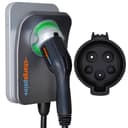
ChargePoint Home Flex
ChargePoint · J1772 · 50 A / 12 kW · 23 ft cable
The most adjustable unit here. It can be set anywhere from 16 A to 50 A, which makes it the one to buy when you do not yet know what your panel will allow.
What is good
- Six selectable amperage settings from 16 A to 50 A
- Sold in both hardwired and NEMA 14-50 versions
- Rated for indoor or outdoor installation
- The app is mature and does not require a subscription
What is not
- 23 ft is a foot shorter than the longest cables in this group
- The 50 A setting needs a bigger circuit than most panels have spare
| Maximum output | 50 A / 12 kW at 240 V |
|---|---|
| Amperage settings | 16, 24, 32, 40, 48 or 50 A |
| Connector | SAE J1772 |
| Cable | 23 ft |
| Installation | Hardwired or NEMA 14-50 |
| Certification | UL listed, Energy Star |
| Warranty | 3 years |
Skip this if: Skip it if your circuit is already fixed and you just want the cheapest safe 40 A unit. You are paying for flexibility you will not use.
Specifications above are the manufacturer’s published figures. Source: ChargePoint, ChargePoint. We have not tested this unit — see how we pick.
3. Tight wall space
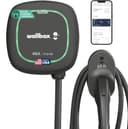
Wallbox Pulsar Plus
Wallbox · J1772 · 48 A / 11.5 kW · 25 ft cable
The smallest 48 A unit here at roughly 7.8 by 7.9 inches, which matters more than it sounds when the only free wall is beside a door.
What is good
- Smallest body of the 48 A units, under 8 inches square
- Current configurable in steps from 6 A to 48 A
- NEMA Type 4 enclosure, rated down to -22 F
- Weighs 4.4 lb without the cable, so mounting is simple
What is not
- Hardwired only at 48 A, with no plug-in version at full output
- Setup runs through the app, which some owners find fussy
| Maximum output | 48 A / 11.5 kW at 240 V |
|---|---|
| Configurable current | 6 A to 48 A |
| Connector | SAE J1772 |
| Cable | 25 ft |
| Body size | 7.8 x 7.9 x 3.9 inches without the cable |
| Operating temperature | -22 F to 104 F |
| Certification | UL 2594, UL 2231 |
| Warranty | 3 years |
Skip this if: Skip it if you want a plug-in unit you can take with you. The 48 A Pulsar Plus is hardwired.
Specifications above are the manufacturer’s published figures. Source: Wallbox, Wallbox. We have not tested this unit — see how we pick.
4. Harsh weather and no app
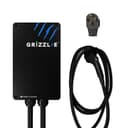
Grizzl-E Classic
United Chargers · J1772 · 40 A / 9.6 kW · 24 ft cable
A cast-aluminum box with no app, no account and no firmware to update. If you want a charger that behaves like an appliance, this is the one.
What is good
- Cast aluminum NEMA 4 / IP67 enclosure, built for outdoor mounting
- No app, no account, no network dependency
- Amperage is set with physical switches, not software
- Protections for over-current, over-voltage, ground fault and over-temperature
What is not
- 40 A ceiling, slower than the 48 A units if your panel can take more
- No scheduling, so off-peak charging has to be set in the car
- The cold-flexible 24 ft cable is only on the Extreme Edition
| Maximum output | 40 A / 9.6 kW at 240 V |
|---|---|
| Adjustable | 16, 24, 32 or 40 A |
| Connector | SAE J1772 |
| Cable | 24 ft on the Extreme Edition |
| Enclosure | Cast aluminum, NEMA 4 / IP67 |
| Certification | UL certified |
| Warranty | 3 years |
Skip this if: Skip it if you want scheduled charging or energy tracking in an app. The Classic deliberately has neither.
Specifications above are the manufacturer’s published figures. Source: United Chargers, InsideEVs. We have not tested this unit — see how we pick.
FAQ
Questions people actually ask
Does an EV charger have to be UL listed?
Is ETL as good as UL?
What is the difference between UL listed and UL certified components?
Which UL standards apply to EV chargers?
Sources
Where these numbers come from
- Emporia Level 2 EV Charger specifications — Emporia Energy
- ChargePoint Home Flex specifications and ordering information — ChargePoint
- Pulsar Plus datasheet — Wallbox
- Grizzl-E Classic product specifications — United Chargers
- NEC Article 625: EV charging equipment — WireRefContinuous-load rule behind every circuit figure on this page.
Read next
Related reading
- How to check an EV charger's safety certificationWhat UL, ETL and CSA marks mean, and the wording designed to look like certification.
- Buying a marketplace EV charger: the checks that matterHow to evaluate a cheap marketplace charger: certification wording, specs, warranty and support.
- Do you need a permit for an EV charger?When a permit is required, what it costs, what the inspector checks, and why to bother.
- The cheapest home EV charger that is still a good ideaThe cheapest Level 2 chargers that are still properly certified, and the corners not to cut.
- The best ENERGY STAR certified EV chargersHome chargers checked against the EPA's certified list, and how to verify a model number yourself.
- How long does an EV charger last?What wears out on a home charger, what the three-year warranties cover, and the checks to run.