Head to head
ChargePoint Home Flex vs Tesla Wall Connector
One is the most adjustable J1772 unit on this site; the other is Tesla's own. For most households, the connector on your car settles it before anything else does.
By Sawyer V. · Published September 10, 2026
How this page is funded: we earn a commission if you buy through our Amazon links, at no extra cost to you. It does not change what we recommend, and we say plainly when the honest answer is to buy nothing. Full disclosure.
These two come up together because they sit at opposite ends of one decision. The Home Flex is built to fit whatever circuit you have; the Wall Connector is built for Teslas. Both are 48-amp-class units, so raw speed rarely separates them.
Side by side
| ChargePoint Home Flex | Tesla Wall Connector (Gen 3) | |
|---|---|---|
| Maximum output | 50 A / 12 kW | 48 A / 11.5 kW |
| Connector | SAE J1772 | NACS (Tesla) |
| Cable | 23 ft | 24 ft |
| Installation | Hardwired or NEMA 14-50 plug | Hardwired |
| Certification | UL listed, Energy Star | Listed to applicable UL standards |
| Warranty | 3 years | 4 years |
The connector decides it for most people
The Wall Connector ends in Tesla's NACS plug. A Tesla uses it directly; a J1772 car needs a NACS-to-J1772 adapter to use it. The Home Flex ends in a J1772 plug, which a J1772 car uses directly and a Tesla uses through the J1772 adapter that comes with it. Which home charger a Tesla needs walks through all three routes.
When the Home Flex wins
- Your panel capacity is uncertain. It adjusts from 16 A to 50 A, so it can go in at a lower setting now and be raised if you add capacity later. Chargers for a 100-amp panel.
- You want to plug in. The Home Flex is sold in a NEMA 14-50 version; the Wall Connector is hardwired only.
- Any J1772 car will use it, now or when you next change cars.
When the Wall Connector wins
- Every car is a Tesla. Nothing ever goes between the connector and the car.
- Two Teslas, one tight panel. Up to six Wall Connectors can be linked to share capacity. Chargers for two EVs.
- The longer warranty. Four years against three.
The two, at a glance
Ranked for a first home charger. Every row jumps to the full write-up below.
| # | Product | Best for | Max output | Price |
|---|---|---|---|---|
| 1 |  ChargePoint Home FlexHomes with an uncertain panel. J1772, 23 ft cable. ChargePoint Home FlexHomes with an uncertain panel. J1772, 23 ft cable. | Homes with an uncertain panel | 50 A12 kW | $549.00 · View on Amazon#ad how we are funded · price as of October 26, 2026 |
| 2 | Tesla Wall Connector (Gen 3)Tesla owners. NACS, 24 ft cable. | Tesla owners | 48 A11.5 kW | Check price on Amazon#ad how we are funded |
Both chargers in full
Full specifications and the case against each.
1. Homes with an uncertain panel
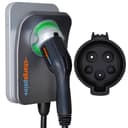
ChargePoint Home Flex
ChargePoint · J1772 · 50 A / 12 kW · 23 ft cable
The most adjustable unit here. It can be set anywhere from 16 A to 50 A, which makes it the one to buy when you do not yet know what your panel will allow.
What is good
- Six selectable amperage settings from 16 A to 50 A
- Sold in both hardwired and NEMA 14-50 versions
- Rated for indoor or outdoor installation
- The app is mature and does not require a subscription
What is not
- 23 ft is a foot shorter than the longest cables in this group
- The 50 A setting needs a bigger circuit than most panels have spare
| Maximum output | 50 A / 12 kW at 240 V |
|---|---|
| Amperage settings | 16, 24, 32, 40, 48 or 50 A |
| Connector | SAE J1772 |
| Cable | 23 ft |
| Installation | Hardwired or NEMA 14-50 |
| Certification | UL listed, Energy Star |
| Warranty | 3 years |
Skip this if: Skip it if your circuit is already fixed and you just want the cheapest safe 40 A unit. You are paying for flexibility you will not use.
Specifications above are the manufacturer’s published figures. Source: ChargePoint, ChargePoint. We have not tested this unit — see how we pick.
2. Tesla owners
Tesla Wall Connector (Gen 3)
Tesla · NACS · 48 A / 11.5 kW · 24 ft cable
48 A, a 24 ft cable and a four-year warranty, the longest in this group. The catch is the connector: Gen 3 is NACS, so a J1772 car needs an adapter.
What is good
- Four-year warranty, longer than the three-year standard here
- Up to six units can share one circuit for a two-EV household
- Wi-Fi with over-the-air firmware updates
- Scheduled departure and charge stats live in the Tesla app
What is not
- NACS connector, so a J1772 car needs an adapter on every charge
- Hardwired only
| Maximum output | 48 A / 11.5 kW at 240 V |
|---|---|
| Connector | NACS (Tesla) |
| Cable | 24 ft |
| Installation | Hardwired |
| Power sharing | Up to six units can be linked |
| Warranty | 4 years |
Skip this if: Skip it if you drive a J1772 car and do not want to keep an adapter on the cable. Buy a J1772 unit instead.
Specifications above are the manufacturer’s published figures. Source: Tesla, Tesla. We have not tested this unit — see how we pick.
The verdict
Tesla Wall Connector if every car that will plug in is a Tesla. ChargePoint Home Flex for a J1772 car, a mixed garage, a plug-in install, or a panel you are not yet sure about. If you want one unit that serves both connectors, look at the Universal Wall Connector.
FAQ
Questions people actually ask
Is ChargePoint or the Tesla Wall Connector better?
Can a Tesla use a ChargePoint Home Flex?
Can a non-Tesla use the Tesla Wall Connector?
Which is faster, ChargePoint or Tesla?
Sources
Where these numbers come from
Read next
Related reading
- ChargePoint Home Flex16 to 50 A adjustable, 23 ft cable, UL listed and Energy Star. The pick when your panel is a question mark.
- Tesla Wall Connector (Gen 3)48 A, 24 ft, NACS, four-year warranty and power sharing. A J1772 car needs an adapter.
- Tesla Wall Connector vs Universal Wall ConnectorTesla's two wall units: NACS-only against a built-in J1772 adapter and Powershare support.
- The best home charger for a TeslaWall Connector, Universal, or a J1772 unit with the included adapter -- and how to choose.