Tight panels
The best EV chargers for a 100-amp panel
A 100-amp service does not rule out home charging. It rules out buying the biggest charger on the shelf and hoping.
By Sawyer V. · Published September 10, 2026
How this page is funded: we earn a commission if you buy through our Amazon links, at no extra cost to you. It does not change what we recommend, and we say plainly when the honest answer is to buy nothing. Full disclosure.
Being told your panel is "only 100 amps" sounds like a verdict. It is not. It means the charger you buy has to be chosen around a real constraint rather than picked off a best-of list -- and the good news is that the constraint costs you far less charging speed than you would expect.
Picks for a 100-amp service
Ranked for a first home charger. Every row jumps to the full write-up below.
| # | Product | Best for | Max output | Price |
|---|---|---|---|---|
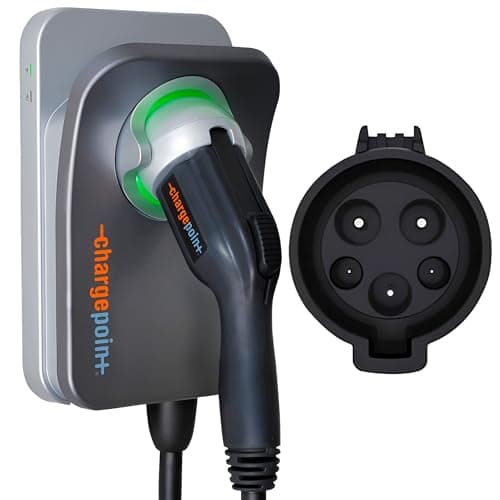
| 1 |  ChargePoint Home FlexHomes with an uncertain panel. J1772, 23 ft cable. ChargePoint Home FlexHomes with an uncertain panel. J1772, 23 ft cable. | Homes with an uncertain panel | 50 A12 kW | $549.00 · View on Amazon#ad how we are funded · price as of October 27, 2026 |
| 2 |  Wallbox Pulsar PlusTight wall space. J1772, 25 ft cable. Wallbox Pulsar PlusTight wall space. J1772, 25 ft cable. | Tight wall space | 48 A11.5 kW | $699.00 · View on Amazon#ad how we are funded · price as of October 27, 2026 |
| 3 |  Grizzl-E ClassicHarsh weather and no app. J1772, 24 ft cable. Grizzl-E ClassicHarsh weather and no app. J1772, 24 ft cable. | Harsh weather and no app | 40 A9.6 kW | $299.99 · View on Amazon#ad how we are funded · price as of October 27, 2026 |
What a smaller charger actually costs you
| Charger | Power | Miles per hour | Over 10 hours | Circuit |
|---|---|---|---|---|
| 16 A | 3.8 kW | about 13 | about 130 mi | 20 A |
| 24 A | 5.8 kW | about 20 | about 200 mi | 30 A |
| 32 A | 7.7 kW | about 27 | about 270 mi | 40 A |
| 40 A | 9.6 kW | about 34 | about 340 mi | 50 A |
Read the 24-amp row again. Two hundred miles overnight, on a 30-amp circuit that a 100-amp panel can very often accommodate. Unless you drive more than that in a day, the constraint is invisible.
The three ways to avoid an upgrade
- Ask for a load calculation based on measured demand. There is an accepted method that uses your actual peak usage from utility data rather than a theoretical total, and on an older home with a modest real load it frequently gives a more favorable answer. Load calculation.
- Fit a smaller charger. A 24 or 32-amp unit needs far less headroom, and the table above shows what it costs you.
- Use load management. A device that reduces charging when the rest of the house draws heavily lets you add a charger without adding service capacity. Load management explained.
Any of the three can turn a $4,000 project into a $1,200 one. Ask about all three explicitly -- a quote for a service upgrade is a bigger job, and the alternatives are not always volunteered.
Why an adjustable charger is the right buy here
On a tight panel you often do not know the answer until an electrician has done the calculation. An adjustable unit lets you buy before you know: install it at whatever the circuit supports, and raise the setting later if you upgrade the service.
The ChargePoint Home Flex spans 16 to 50 amps in six steps and the Wallbox Pulsar Plus is configurable from 6 to 48. Either can be dialed to fit. The Grizzl-E sets 16, 24, 32 or 40 amps with physical switches, which does the same job without an app.
When an upgrade genuinely is the answer
- Your panel is old or an obsolete brand with known safety issues -- worth replacing regardless of the EV.
- You are electrifying more than the car: a heat pump, an induction range, an electric water heater. Do it once.
- You are renovating anyway, so the marginal cost is much lower.
- The load calculation says no even with load management and a smaller charger.
Panel upgrades covers what that job involves and what it costs.
The chargers in detail
Three units that can be set down to fit a constrained circuit, each with the case against it.
1. Homes with an uncertain panel
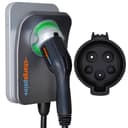
ChargePoint Home Flex
ChargePoint · J1772 · 50 A / 12 kW · 23 ft cable
The most adjustable unit here. It can be set anywhere from 16 A to 50 A, which makes it the one to buy when you do not yet know what your panel will allow.
What is good
- Six selectable amperage settings from 16 A to 50 A
- Sold in both hardwired and NEMA 14-50 versions
- Rated for indoor or outdoor installation
- The app is mature and does not require a subscription
What is not
- 23 ft is a foot shorter than the longest cables in this group
- The 50 A setting needs a bigger circuit than most panels have spare
| Maximum output | 50 A / 12 kW at 240 V |
|---|---|
| Amperage settings | 16, 24, 32, 40, 48 or 50 A |
| Connector | SAE J1772 |
| Cable | 23 ft |
| Installation | Hardwired or NEMA 14-50 |
| Certification | UL listed, Energy Star |
| Warranty | 3 years |
Skip this if: Skip it if your circuit is already fixed and you just want the cheapest safe 40 A unit. You are paying for flexibility you will not use.
Specifications above are the manufacturer’s published figures. Source: ChargePoint, ChargePoint. We have not tested this unit — see how we pick.
2. Tight wall space
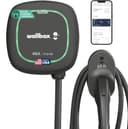
Wallbox Pulsar Plus
Wallbox · J1772 · 48 A / 11.5 kW · 25 ft cable
The smallest 48 A unit here at roughly 7.8 by 7.9 inches, which matters more than it sounds when the only free wall is beside a door.
What is good
- Smallest body of the 48 A units, under 8 inches square
- Current configurable in steps from 6 A to 48 A
- NEMA Type 4 enclosure, rated down to -22 F
- Weighs 4.4 lb without the cable, so mounting is simple
What is not
- Hardwired only at 48 A, with no plug-in version at full output
- Setup runs through the app, which some owners find fussy
| Maximum output | 48 A / 11.5 kW at 240 V |
|---|---|
| Configurable current | 6 A to 48 A |
| Connector | SAE J1772 |
| Cable | 25 ft |
| Body size | 7.8 x 7.9 x 3.9 inches without the cable |
| Operating temperature | -22 F to 104 F |
| Certification | UL 2594, UL 2231 |
| Warranty | 3 years |
Skip this if: Skip it if you want a plug-in unit you can take with you. The 48 A Pulsar Plus is hardwired.
Specifications above are the manufacturer’s published figures. Source: Wallbox, Wallbox. We have not tested this unit — see how we pick.
3. Harsh weather and no app
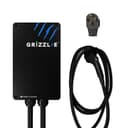
Grizzl-E Classic
United Chargers · J1772 · 40 A / 9.6 kW · 24 ft cable
A cast-aluminum box with no app, no account and no firmware to update. If you want a charger that behaves like an appliance, this is the one.
What is good
- Cast aluminum NEMA 4 / IP67 enclosure, built for outdoor mounting
- No app, no account, no network dependency
- Amperage is set with physical switches, not software
- Protections for over-current, over-voltage, ground fault and over-temperature
What is not
- 40 A ceiling, slower than the 48 A units if your panel can take more
- No scheduling, so off-peak charging has to be set in the car
- The cold-flexible 24 ft cable is only on the Extreme Edition
| Maximum output | 40 A / 9.6 kW at 240 V |
|---|---|
| Adjustable | 16, 24, 32 or 40 A |
| Connector | SAE J1772 |
| Cable | 24 ft on the Extreme Edition |
| Enclosure | Cast aluminum, NEMA 4 / IP67 |
| Certification | UL certified |
| Warranty | 3 years |
Skip this if: Skip it if you want scheduled charging or energy tracking in an app. The Classic deliberately has neither.
Specifications above are the manufacturer’s published figures. Source: United Chargers, InsideEVs. We have not tested this unit — see how we pick.
FAQ
Questions people actually ask
Can a 100 amp panel handle an EV charger?
What size EV charger for a 100 amp service?
How do I avoid upgrading my panel for an EV charger?
Should I buy an adjustable charger for a tight panel?
Sources
Where these numbers come from
- Level 2 EV charger installation cost in 2026 — SimpleSwitchPublished subpanel and service-upgrade cost ranges. Fetched 2026-09-10.
- NEC Article 625: EV charging equipment — WireRefContinuous-load rule and receptacle requirements.
Read next
Related reading
- Can your electrical panel take an EV charger?What a load calculation is, what goes into it, and how to get a rough answer yourself.
- Load management: charging without a panel upgradeHow load management avoids a panel upgrade, what it costs in speed, and when to use it.
- Do you need a panel upgrade for an EV charger?When a panel upgrade is genuinely needed, what it costs, and the cheaper alternatives.
- How many amps do you actually need?Three checks that determine your charger amperage, and why the smallest one wins.
- The best dryer outlet splitters for EV chargingCharge from your dryer outlet instead of adding a circuit, and the 24-amp limit that comes with it.
- Emporia Vue vs Sense for EV ownersCircuit-level sensors against machine-learning detection, judged on what an EV owner needs to know.
- The best EV chargers for a 200-amp panelWhy 200-amp service often supports a 48 A charger, what the load calculation decides, and three picks.
- The best EV chargers with load managementChargers that slow down when your house is busy, the two kinds of load management, and three picks.
- The best EV chargers for a 150-amp panelSizing the circuit to a 150-amp service, two adjustable picks, and load management when it is tight.