Decisions
Do you need a smart EV charger?
Nearly every charger sold today has an app. Before you pay for one, it is worth knowing which of its features your car already has.
By Sawyer V. · Published September 27, 2026
How this page is funded: we earn a commission if you buy through our Amazon links, at no extra cost to you. It does not change what we recommend, and we say plainly when the honest answer is to buy nothing. Full disclosure.
The word "smart" does a lot of work in charger marketing, and most of what it covers is genuinely useful to somebody. The question is whether it is useful to you, given what the car in your driveway already does.
What a smart charger actually adds
| Feature | What it does | Do you need it? |
|---|---|---|
| Scheduled charging | Starts charging in the cheap hours | Only if your car cannot -- nearly all can |
| Energy reporting | Shows kWh per session and over time | Useful; a whole-home monitor does it better |
| Remote start and stop | Control from your phone | Occasionally handy, rarely essential |
| Current adjustment | Changes the amperage in software | Useful on a shared or tight circuit |
| Access control | Stops other people using it | Only on an open driveway or shared space |
| Utility programs | Enroll for rebates or demand response | Worth real money where offered |
| Firmware updates | New features and fixes | Cuts both ways -- see below |
The case for a smart charger
- Utility programs. Some utilities pay for enrollment or offer cheaper EV rates that expect a connected charger. That can outweigh everything else on this page. Time-of-use charging.
- Several drivers, one charger. Per-user reporting and access control get genuinely useful.
- A tight panel. Adjusting current from an app beats calling an electrician to change a setting.
- You want the data. Some people check the numbers; most look twice and never again.
The case against
- Your car already schedules. Set a start time or a departure time once and the cheapest hours are covered.
- Wi-Fi is worst where chargers live -- an outside wall or the far corner of a garage, on 2.4 GHz.
- An app is a dependency. A charger with no network connection cannot lose a server, an account system or a company.
- Fewer parts, fewer faults. A unit with physical current switches has nothing to misconfigure remotely. The no-app roundup.
The middle route most people take
Buy a connected charger from a maker with a large installed base, use the schedule in whichever place you prefer -- car or charger, not both -- and ignore the rest of the app. That is what the Emporia Classic and the Grizzl-E Classic Connect are: ordinary chargers that happen to have software, at prices that do not punish you for ignoring it.
If the idea of an account for a wall appliance bothers you, the Grizzl-E Classic is the same hardware lineage with nothing to log into, and it is no worse at charging a car. Both positions are defensible; what is not defensible is paying a premium for connectivity you will never open.
One small factor on the other side: ENERGY STAR certified chargers are tested by a nationally recognized laboratory and use less energy when idle, which is most of the day for any home charger. Several connected units carry that certification.
Three ways to go
A connected default, a connected Grizzl-E, and the same Grizzl-E with no software at all.
1. A first charger, hardwired
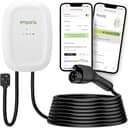
Emporia Level 2 EV Charger (Classic)
Emporia · J1772 · 48 A / 11.5 kW · 24 ft cable
The safe default for a first home charger: 48 amps hardwired, a genuinely long cable, a NEMA 4 outdoor-rated case, and no subscription attached to the app.
What is good
- 48 A hardwired is the fastest tier most homes can realistically support
- 24 ft of cable reaches across a two-car garage without a fight
- NEMA Type 4 enclosure is rated for outdoor mounting
- Energy monitoring in the app with no subscription
What is not
- Drops to 40 A if you use the NEMA 14-50 plug rather than hardwiring
- The app is the only way to change the amperage setting
| Maximum output | 48 A / 11.5 kW at 240 V (hardwired) |
|---|---|
| Plug-in output | 40 A with the NEMA 14-50 plug |
| Connector | SAE J1772 |
| Cable | 24 ft |
| Enclosure | NEMA Type 4, indoor or outdoor |
| Certification | UL listed, Energy Star |
| Warranty | 3 years |
Skip this if: Skip it if you want a unit with no app or network connection at all. The Grizzl-E Classic is the simpler machine.
Specifications above are the manufacturer’s published figures. Source: Emporia Energy. We have not tested this unit — see how we pick.
2. Grizzl-E toughness, with an app
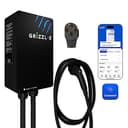
Grizzl-E Classic Connect
United Chargers · J1772 · 40 A / 9.6 kW · 25 ft cable
The next-generation Grizzl-E: 40 A on a NEMA 14-50, a 25 ft cable, a UL Type 4 indoor/outdoor rating -- and, unlike the Classic, Wi-Fi and the Grizzl-E Connect app. Sold with a J1772 or NACS cable.
What is good
- 25 ft cable, a foot longer than the Classic Extreme Edition's
- Wi-Fi app with schedules and charging statistics, which the Classic deliberately lacks
- UL/cUL listed, with a published file number
- Rated to run from -22 F to 122 F
What is not
- 40 A ceiling, with no hardwired 48 A version
- Sold with a NEMA 14-50 plug; the Classic's 6-50 option is not among the Connect listings we found
- The app needs 2.4 GHz Wi-Fi where the charger is mounted
| Maximum output | 40 A / 9.6 kW at 240 V (the maker lists 10 kW) |
|---|---|
| Adjustable | 16 A to 40 A |
| Connector | SAE J1772 or NACS, chosen at purchase |
| Cable | 25 ft (7.6 m) |
| Plug | NEMA 14-50 |
| Enclosure rating | UL Type 4, indoor and outdoor |
| Operating temperature | -22 F to 122 F |
| Size | 10.25 x 6.25 x 3.75 in |
| Connectivity | Wi-Fi (2.4 GHz) and the Grizzl-E Connect app |
| Certification | UL/cUL, file E510712 |
| Warranty | 3 years; 5-year warranty sold separately |
Skip this if: Skip it if you wanted a Grizzl-E precisely because it has no app -- the original Classic is still the no-software choice -- or if you want 48 A. The Classic Connect is a 40 A plug-in unit.
Specifications above are the manufacturer’s published figures. Source: United Chargers. We have not tested this unit — see how we pick.
3. Harsh weather and no app
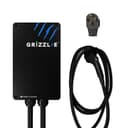
Grizzl-E Classic
United Chargers · J1772 · 40 A / 9.6 kW · 24 ft cable
A cast-aluminum box with no app, no account and no firmware to update. If you want a charger that behaves like an appliance, this is the one.
What is good
- Cast aluminum NEMA 4 / IP67 enclosure, built for outdoor mounting
- No app, no account, no network dependency
- Amperage is set with physical switches, not software
- Protections for over-current, over-voltage, ground fault and over-temperature
What is not
- 40 A ceiling, slower than the 48 A units if your panel can take more
- No scheduling, so off-peak charging has to be set in the car
- The cold-flexible 24 ft cable is only on the Extreme Edition
| Maximum output | 40 A / 9.6 kW at 240 V |
|---|---|
| Adjustable | 16, 24, 32 or 40 A |
| Connector | SAE J1772 |
| Cable | 24 ft on the Extreme Edition |
| Enclosure | Cast aluminum, NEMA 4 / IP67 |
| Certification | UL certified |
| Warranty | 3 years |
Skip this if: Skip it if you want scheduled charging or energy tracking in an app. The Classic deliberately has neither.
Specifications above are the manufacturer’s published figures. Source: United Chargers, InsideEVs. We have not tested this unit — see how we pick.
FAQ
Questions people actually ask
Do I need a smart charger to charge off-peak?
Does a smart charger charge faster?
What happens if the app or the company disappears?
Is a smart charger worth it for utility rebates?
Sources
Where these numbers come from
- Charging Electric Vehicles at Home — U.S. Department of Energy, Alternative Fuels Data CenterSmarter Level 2 units add charging timers, monitoring and displays; outdoor use is safe with outdoor-rated equipment; some utilities offer time-of-use rates. Read 2026-09-27.
- ENERGY STAR certified electric vehicle chargers — U.S. EPA, ENERGY STARCertified chargers are tested by a nationally recognized testing laboratory and use less energy when idle. Read 2026-09-27.
- Emporia Level 2 EV Charger product specifications — Emporia EnergyOutput, connector, cable length, enclosure rating, certification and warranty for the Emporia Classic.
- Grizzl-E Classic Connect 40A — United Chargers40 A output, 25 ft cable, UL Type 4 rating, Wi-Fi and app, UL/cUL file number, temperature range and warranty.
- Grizzl-E Classic product specifications — United ChargersOutput, adjustable settings, cable, enclosure and warranty for the no-app Grizzl-E Classic.
Read next
Related reading
- Smart EV chargers: which ones earn the appWhich Wi-Fi chargers earn their price, and why your car may already do the useful part.
- The best EV chargers with no app and no WiFiChargers with no app, no account and nothing to update, and why that is a feature.
- Charging at night on a time-of-use rateHow time-of-use rates work, how to schedule charging, and how to check the switch pays.
- What to look for in a Level 2 chargerSix questions in the order that matters, and the one spec you must not compromise on.