Head to head
16 A, 32 A or 40 A: portable charger amperage
Three tiers, three outlets, three very different overnight results -- and a rule that quietly caps all of them.
By Sawyer V. · Published September 27, 2026
How this page is funded: we earn a commission if you buy through our Amazon links, at no extra cost to you. It does not change what we recommend, and we say plainly when the honest answer is to buy nothing. Full disclosure.
Portable chargers are sold on amperage, and buyers reasonably assume more is better. It is -- up to the point where the outlet, the car or the circuit becomes the limit, which for most people happens sooner than the spec sheet suggests.
What each tier delivers
| Setting | Power | Outlet it needs | Ten hours |
|---|---|---|---|
| 16 A | About 3.8 kW | NEMA 6-20 or a 20 A circuit | About 38 kWh |
| 24 A | About 5.8 kW | NEMA 14-30 dryer circuit | About 58 kWh |
| 32 A | About 7.7 kW | NEMA 14-50 or a 40 A circuit | About 77 kWh |
| 40 A | About 9.6 kW | NEMA 14-50 on a 50 A circuit | About 96 kWh |
Look at the right-hand column before deciding you need 40 A. A typical EV uses somewhere around 10 to 15 kWh for a 40-mile day. Every tier in that table covers it overnight.
The rule that caps all of them
Why your charger draws less than the circuit
EV charging is a continuous load
A receptacle-connected charger may use 80% of the branch circuit
50 A circuit x 0.8 = 40 A -- the ceiling for any plug-in charger
30 A circuit x 0.8 = 24 A
20 A circuit x 0.8 = 16 A
This is why portable chargers are adjustable, and why the adjustment matters more than the headline number. Plugging a 40 A unit into a 30 A dryer circuit without turning it down is the one genuinely dangerous mistake in this category. Charging from a dryer outlet.
Three things that override the spec
- Your car's onboard charger. If it accepts 32 A, a 40 A unit delivers 32 A. How many amps you need.
- The outlet you will actually use, which on the road is rarely the best one.
- Heat. Cheap units and long thin cables both run warmer at the top of their range.
Which tier to buy
| If you | Buy |
|---|---|
| Have a 14-50 and want maximum speed | 40 A |
| Want one unit for home and travel | 40 A, adjustable |
| Mostly charge on a dryer circuit | A unit that adjusts to 24 A |
| Are covering a short commute | 32 A is plenty |
| Want an emergency cable only | The Level 1 cordset your car came with |
The three picks below cover the practical range: a 32 A unit with a 21 ft cable, a 40 A unit with interchangeable plugs, and a dual-voltage 40 A unit that also works on a household socket.
The three tiers
32 A, 40 A, and a dual-voltage unit that covers 120 V and 240 V.
1. Travel and rentals
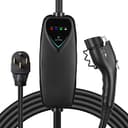
Lectron portable Level 2 charger
Lectron · J1772 · 32 A / 7.7 kW · 21 ft cable
A plug-in portable that runs at Level 2 speed from a NEMA 14-50 and drops to a standard wall outlet with the included adapter. The travel unit, not the garage unit.
What is good
- Level 2 speed from a NEMA 14-50 without an installed charger
- Falls back to a standard household outlet with the adapter
- Small enough to keep in the trunk
What is not
- 32 A ceiling, meaningfully slower than a 48 A wall unit
- Not weather-rated for permanent outdoor mounting
- Repeated plugging and unplugging wears a NEMA 14-50 receptacle faster than a hardwired unit
| Maximum output | 32 A / 7.7 kW at 240 V |
|---|---|
| Connector | SAE J1772 |
| Plug | NEMA 14-50, with an adapter for a standard outlet |
| Use | Portable. Lives in the car, not on the wall |
Skip this if: Skip it if this is your only charger and you have a garage. A wall unit is faster and does not live in your trunk.
Specifications above are the manufacturer’s published figures. Source: Lectron. We have not tested this unit — see how we pick.
2. The best portable overall
J+ Booster 2
J+ Americas · J1772 · 40 A / 9.6 kW · 25 ft cable
A 40 A portable in a military-grade aluminum body, ETL certified to UL standards and IP67 rated, weighing 2.2 lb without cables. The portable that behaves like a wall unit.
What is good
- 40 A, matching many wall-mounted units
- Eight amperage settings from 6 A to 40 A, so it fits almost any outlet
- Adapters for a wide range of outlets, including NEMA TT-30 for campgrounds
- IP67 and drive-over resistant, which portables usually are not
- 2.2 lb without cables, so it genuinely travels
What is not
- Costs more than most portables, and more than some wall units
- Every extra outlet adapter is a separate purchase
- Still a portable, so it is not rated for permanent outdoor mounting
| Maximum output | 40 A / 9.6 kW at 240 V |
|---|---|
| Adjustable | 6, 8, 12, 16, 20, 24, 32 or 40 A |
| Power range | 1.4 kW to 9.6 kW |
| Connector | SAE J1772 |
| Cable | 21 ft or 25 ft, depending on version |
| Adapters included | NEMA 14-50 and 5-15 |
| Further adapters available | 5-20, 6-15, 6-20, 6-50, TT-30 |
| Weight | 2.2 lb without cables; 7 lb with cables and adapters |
| Body | Military-grade aluminum, drive-over resistant to 6,600 lb wheel loads |
| Rating | IP67 waterproof and dustproof |
| Certification | ETL certified to UL standards |
Skip this if: Skip it if you only ever charge in one place. A hardwired wall unit is cheaper for a fixed installation.
Specifications above are the manufacturer’s published figures. Source: J+ Americas. We have not tested this unit — see how we pick.
3. Level 1 and Level 2 in one
Lectron Portable Level 1 & 2 Tesla NACS EV Charger
Lectron · NACS · 40 A / 9.6 kW · 20 ft cable
One NACS portable for a standard outlet and a 14-50: 8 to 12 A on 120 V, 16 to 40 A on 240 V, with switchable plugs. The most flexible single unit for a Tesla on the move.
What is good
- Runs from a standard outlet and a 14-50 with the same unit
- Adjustable current, so it can be turned down for a weaker circuit
- Published UL 2594 / UL 2231 certification
What is not
- NACS only -- a J1772 car needs an adapter
- On 120 V it is still Level 1: about 5 miles of range per hour at best
- 20 ft of cable, per Lectron's FAQ -- measure the run before relying on it
| Level 1 (120 V) | 8 to 12 A / 0.96 to 1.44 kW |
|---|---|
| Level 2 (240 V) | 16 to 40 A / 3.84 to 9.6 kW |
| Connector | NACS (Tesla) |
| Plugs | Switchable NEMA 5-15 and NEMA 14-50 |
| Cable | 20 ft, per Lectron's product FAQ |
| Certification | UL 2594 / UL 2231, per Lectron |
Skip this if: Skip it if a non-Tesla might use it -- it is NACS only -- or if you will only ever charge on 240 V.
Specifications above are the manufacturer’s published figures. Source: Lectron. We have not tested this unit — see how we pick.
FAQ
Questions people actually ask
Is a 40 amp portable charger better than 32 amp?
What outlet does a 40 A portable charger need?
Can I plug a 40 A charger into a dryer outlet?
Is 16 A enough?
Sources
Where these numbers come from
- NEC Article 625: EV charging equipment — WireRefContinuous-load rule: a receptacle-connected charger is limited to 80% of the branch circuit rating.
- Electric Vehicle Charging Infrastructure: charging levels — U.S. Department of Energy, Alternative Fuels Data CenterAC Level 1 about 5 miles of range per hour at 1.9 kW; AC Level 2 about 25 miles per hour, with equipment ranging from 2.9 to 19.2 kW. Read 2026-09-27.
- Lectron Level 2 EV chargers — LectronOutput, cable length and plug type for the Lectron portable Level 2 charger.
- Portable Level 2 EV charger 40A (UL) -- J+ Booster 2 — J+ Booster40 A portable output, 25 ft cable, interchangeable plugs and UL listing.
- Lectron Portable Level 1 & 2 Tesla NACS EV Charger, 120 V and 240 V, 8-40 A — LectronDual-voltage portable: 120 V and 240 V, adjustable 8-40 A, NEMA 5-15 and 14-50 plugs.
Read next
Related reading
- How to choose a portable EV chargerThe six checks that separate a portable charger you can trust from one you should not.
- The best portable EV chargersPortable Level 2 chargers for renters and travelers, with the honest case for buying none.
- The best dual-voltage portable EV chargersPortables that run from a standard outlet and a 240 V outlet, and how fast each one really is.
- How many amps do you actually need?Three checks that determine your charger amperage, and why the smallest one wins.