Existing circuits
Charging an EV from a dryer outlet
Your laundry room already has 240 volts. Whether you can share it with a car depends on one number, and the number is 24 amps.
By Sawyer V. · Published September 23, 2026
How this page is funded: we earn a commission if you buy through our Amazon links, at no extra cost to you. It does not change what we recommend, and we say plainly when the honest answer is to buy nothing. Full disclosure.
If your panel is full, or a new circuit means trenching to a detached garage, the 240-volt outlet behind the dryer starts to look attractive. It is a legitimate route, and there is listed equipment made for exactly this. What it is not is a way to get 40 amps.
The arithmetic of a 30-amp circuit
Why 24 A is the ceiling
EV charging is a continuous load under the NEC
A continuous load is limited to 80% of the branch circuit rating
30 A x 0.80 = 24 A
24 A x 240 V = 5,760 W = 5.76 kW
Overnight at 10 hours, that is about 57 kWh -- a full charge for most EVs
Twenty-four amps is roughly 20 miles of range an hour. Against a 40 A circuit's 30 to 35, that sounds like a real loss, and during the day it is. Overnight it rarely matters, because the car is parked for ten hours and almost nobody arrives home empty.
Know which outlet you have
| Outlet | Typical circuit | Continuous charging |
|---|---|---|
| NEMA 10-30 (older, three-prong dryer) | 30 A | 24 A |
| NEMA 14-30 (newer, four-prong dryer) | 30 A | 24 A |
| NEMA 10-50 (older range) | 50 A | 40 A |
| NEMA 6-50 (welder, some ranges) | 50 A | 40 A |
| NEMA 14-50 (range, and the EV standard) | 50 A | 40 A |
The older 10-30 has three prongs and no separate ground; the 14-30 has four. They are not interchangeable, and no adapter turns one safely into the other. The 14-50 outlet and the 6-50 cover the 50-amp pair.
Never a plain splitter
The listed products do two things a Y-adapter cannot: they make sure only one load runs at a time, and they hold the EV side to the circuit's continuous limit with an internal breaker. Both of the units below publish a third-party listing.
Automatic switching
The NeoCharge Smart Splitter plugs into the existing outlet and switches power between the dryer and the car automatically, with an internal software breaker enforcing the limit. It is UL listed and is sold in versions for the 10-30 and 14-30 at 24 A, and for the 14-50, 10-50 and 6-50 at 40 A. Full review.
Manual switching, on an older outlet
The Splitvolt Splitter Switch is the answer for a three-prong 10-30: 24 A at 240 V, an internal safety breaker, and a cETLus listing with the Intertek file number published. Note that this model's EV socket is itself a 10-30 -- Splitvolt sells a separate version with a 14-50 EV outlet.
Your charger has to cooperate
A charger plugged into a 30-amp circuit must be set to draw no more than 24 A. Most Level 2 units are adjustable: the Grizzl-E Classic sets 16, 24, 32 or 40 A with physical switches, and app-based chargers set it in software. A portable unit with a 14-30 plug is the other common route -- dual-voltage portables covers those.
Setting the charger low is not optional and it is not a suggestion. The splitter's internal breaker is a backstop, not the plan.
When a dedicated circuit wins
- You want more than 24 A. No splitter changes the circuit it plugs into.
- The laundry is nowhere near the car. A long cord run is not the answer. Where to mount.
- You do laundry at night. The car and the dryer take turns, so a late wash delays the charge.
- Your panel has room anyway. A dedicated circuit is simpler, faster and has one less device in the chain. Does a charger need its own circuit.
The splitter route earns its place when a new circuit would mean a panel upgrade. That is a four-figure job in most homes, and avoiding it is worth losing some charging speed. Panel upgrades has the numbers.
Listed devices for a dryer circuit
Both publish a third-party listing and hold the EV side to the circuit's continuous limit.
1. The broadest outlet range
NeoCharge Smart Splitter
NeoCharge · NEMA 14-50 · 40 A / 9.6 kW
Plugs into an existing 240-volt outlet and switches power between your dryer and your EV automatically, so you get Level 2 charging without a new circuit. UL listed, and sold in a version for each common dryer and range outlet.
What is good
- Avoids a new circuit, which can mean avoiding a panel upgrade
- Switches between the two loads automatically
- UL listed, with an internal breaker that enforces the circuit limit
- A version for every common dryer and range outlet type
What is not
- The dryer and the charger take turns on the circuit
- On a 30 A dryer circuit you are limited to 24 A of charging
- You must buy the version that matches your outlet exactly
| Output (14-50 version) | 40 A / 9.6 kW |
|---|---|
| Input (14-50 version) | NEMA 14-50P, 240 VAC single phase |
| Outputs (14-50 version) | 2 x NEMA 14-50R |
| Also sold for | NEMA 10-30 and 14-30 (24 A), NEMA 10-50 and 6-50 (40 A) |
| Protection | Internal software breaker |
| Weight | 2.5 lb |
| Certification | UL listed |
Skip this if: Skip it if your panel can take a new circuit. A dedicated EV circuit is simpler, charges while the dryer runs, and has one less device in the chain.
Specifications above are the manufacturer’s published figures. Source: NeoCharge. We have not tested this unit — see how we pick.
2. Older 10-30 dryer outlets
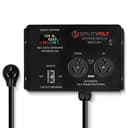
Splitvolt Splitter Switch (NEMA 10-30)
Splitvolt · NEMA 10-30 · 24 A / 5.8 kW
Shares an older three-prong 30-amp dryer outlet between the dryer and the charger, with an internal breaker holding charging to 24 A. This model's EV socket is also a NEMA 10-30; Splitvolt sells a separate version with a 14-50 EV outlet. cETLus listed with a published file number.
What is good
- cETLus listed, with the Intertek file number published
- Internal breaker keeps charging inside the 24 A limit of a 30 A circuit
- Plugs in -- the splitter itself needs no electrician installation
What is not
- Your charger must be able to limit itself to 24 A
- The EV socket is a NEMA 10-30; a 14-50 outlet means a different model
- 24 A is about 20 miles of range per hour -- slow for a big battery
| Rating | 24 A, 240 V |
|---|---|
| Plug | NEMA 10-30 |
| Sockets | NEMA 10-30 for the dryer, NEMA 10-30 for the EV |
| Certification | cETLus, Intertek 5021938, UL 60730-1 / CSA E60730-1 |
| Protection | Internal safety breaker |
| SKU | SPS-C1-011-30A |
| 14-50 EV outlet | A separate Splitvolt model |
Skip this if: Skip it if your dryer outlet is a four-prong 14-30 or a 14-50 -- buy the splitter version made for that outlet instead.
Specifications above are the manufacturer’s published figures. Source: Splitvolt. We have not tested this unit — see how we pick.
FAQ
Questions people actually ask
Can I plug my EV charger into a dryer outlet?
How fast is charging from a dryer outlet?
Is a dryer outlet splitter safe?
What if my dryer outlet is the old three-prong type?
Sources
Where these numbers come from
- NEC Article 625: EV charging equipment — WireRef625.41 continuous load rated at 125%, 625.42 dedicated branch circuit and the energy-management exception, 625.54 GFCI protection and the double-GFCI nuisance-tripping problem. Read 2026-09-23.
- NeoCharge Smart Splitter — NeoChargeAutomatic switching between a dryer and an EV, UL listing, and the versions sold for each outlet type with their current limits.
- Splitvolt Splitter Switch (NEMA 10-30, 240 V, 24 A), cETLus certified — Splitvolt24 A rating on a 30 A dryer circuit, internal safety breaker, and the Intertek file number.
- Charging Electric Vehicles at Home — U.S. Department of Energy, Alternative Fuels Data CenterOutdoor installation and use are safe with outdoor-rated equipment; EV charging is a continuous load under the NEC; permits may be required; an electrician can say whether a home has the capacity. Read 2026-09-23.
Read next
Related reading
- The best dryer outlet splitters for EV chargingCharge from your dryer outlet instead of adding a circuit, and the 24-amp limit that comes with it.
- NeoCharge Smart Splitter review24 A or 40 A versions, automatic switching and app scheduling: who a dryer-outlet splitter suits.
- Charging an EV when you live in an apartmentThe realistic options for apartment EV charging, ranked by how well they actually work.
- Does an EV charger need its own circuit?The dedicated-circuit rule, the energy-management exception, and what it means for your panel.