Buying guide
How to choose a portable EV charger
Portable chargers look alike and are not. Six checks separate a unit you can trust on a strange outlet from one you should not.
By Sawyer V. · Published September 10, 2026
How this page is funded: we earn a commission if you buy through our Amazon links, at no extra cost to you. It does not change what we recommend, and we say plainly when the honest answer is to buy nothing. Full disclosure.
A portable charger is a small box between a big car and an outlet you may never have seen before. That makes the specifications that sound boring -- the listing, the adjustability, the plugs -- the ones that matter most. Here are the six checks, in order, with a unit that gets each one right.
1. The connector
A J1772 portable charges nearly every EV sold in North America, including a Tesla through the adapter that comes with it. A NACS portable plugs straight into a Tesla or a native-NACS car but needs an adapter for a J1772 car. If more than one car in the family might use it, J1772 is the flexible choice. Plug types explained.
2. Current, and whether you can turn it down
On a NEMA 14-50 wired for 50 A, 40 A is the most a portable can use continuously -- 9.6 kW, about 34 miles of range per hour. Just as important is turning it down: the J+ Booster 2 offers settings from 6 A to 40 A, and Lectron's Level 1 & 2 unit runs 8 to 12 A on 120 V and 16 to 40 A on 240 V. That is how you charge safely on a weaker or unfamiliar circuit.
3. Plugs and adapters
At minimum you want a 14-50 for Level 2 and a standard outlet for Level 1. The J+ Booster 2 includes both adapters and sells 5-20, 6-15, 6-20, 6-50 and TT-30 adapters separately; Lectron's Level 1 & 2 unit has switchable 5-15 and 14-50 plugs; the Lectron J1772 portable comes with a 14-50 plug and a standard-outlet adapter. Travel outlet guide.
4. The safety listing
This is the check with no trade-off. Look for a listing from a recognized laboratory, stated plainly: the J+ Booster 2 publishes ETL certification to UL standards, and Lectron publishes UL 2594 / UL 2231 certification for its NACS portables. If a listing cannot be found, ask the seller before buying -- how to read certification wording.
5. Cable length
Outlets are rarely where the charge port is. The J+ Booster 2 comes in 21 ft and 25 ft versions; the Lectron J1772 portable has a 21 ft cable. Measure the real distance from outlet to port before you buy, and never bridge a gap with a household extension cord. Cable length guide.
6. Ruggedness
A portable gets dropped, rained on and occasionally driven over. The J+ Booster 2 publishes an IP67 rating and resistance to 6,600 lb wheel loads -- the kind of claim worth looking for if the charger will live outdoors or in a truck bed.
| Check | What to look for | Example |
|---|---|---|
| Connector | J1772 for flexibility; NACS for a Tesla-only household | J+ Booster 2 (J1772); Lectron Level 1 & 2 (NACS) |
| Current | Up to 40 A, and adjustable downward | J+ Booster 2: 6 A to 40 A |
| Plugs | 14-50 plus a standard outlet, at least | Lectron Level 1 & 2: switchable 5-15 and 14-50 |
| Listing | A recognized lab listing, stated plainly | J+ Booster 2: ETL to UL standards |
| Cable | Enough to reach your port, measured | J+ Booster 2: 21 or 25 ft |
| Ruggedness | A published IP rating | J+ Booster 2: IP67 |
Three portables that pass
Each gets the important checks right; each has its own case against it.
1. The best portable overall
J+ Booster 2
J+ Americas · J1772 · 40 A / 9.6 kW · 25 ft cable
A 40 A portable in a military-grade aluminum body, ETL certified to UL standards and IP67 rated, weighing 2.2 lb without cables. The portable that behaves like a wall unit.
What is good
- 40 A, matching many wall-mounted units
- Eight amperage settings from 6 A to 40 A, so it fits almost any outlet
- Adapters for a wide range of outlets, including NEMA TT-30 for campgrounds
- IP67 and drive-over resistant, which portables usually are not
- 2.2 lb without cables, so it genuinely travels
What is not
- Costs more than most portables, and more than some wall units
- Every extra outlet adapter is a separate purchase
- Still a portable, so it is not rated for permanent outdoor mounting
| Maximum output | 40 A / 9.6 kW at 240 V |
|---|---|
| Adjustable | 6, 8, 12, 16, 20, 24, 32 or 40 A |
| Power range | 1.4 kW to 9.6 kW |
| Connector | SAE J1772 |
| Cable | 21 ft or 25 ft, depending on version |
| Adapters included | NEMA 14-50 and 5-15 |
| Further adapters available | 5-20, 6-15, 6-20, 6-50, TT-30 |
| Weight | 2.2 lb without cables; 7 lb with cables and adapters |
| Body | Military-grade aluminum, drive-over resistant to 6,600 lb wheel loads |
| Rating | IP67 waterproof and dustproof |
| Certification | ETL certified to UL standards |
Skip this if: Skip it if you only ever charge in one place. A hardwired wall unit is cheaper for a fixed installation.
Specifications above are the manufacturer’s published figures. Source: J+ Americas. We have not tested this unit — see how we pick.
2. Level 1 and Level 2 in one
Lectron Portable Level 1 & 2 Tesla NACS EV Charger
Lectron · NACS · 40 A / 9.6 kW · 20 ft cable
One NACS portable for a standard outlet and a 14-50: 8 to 12 A on 120 V, 16 to 40 A on 240 V, with switchable plugs. The most flexible single unit for a Tesla on the move.
What is good
- Runs from a standard outlet and a 14-50 with the same unit
- Adjustable current, so it can be turned down for a weaker circuit
- Published UL 2594 / UL 2231 certification
What is not
- NACS only -- a J1772 car needs an adapter
- On 120 V it is still Level 1: about 5 miles of range per hour at best
- 20 ft of cable, per Lectron's FAQ -- measure the run before relying on it
| Level 1 (120 V) | 8 to 12 A / 0.96 to 1.44 kW |
|---|---|
| Level 2 (240 V) | 16 to 40 A / 3.84 to 9.6 kW |
| Connector | NACS (Tesla) |
| Plugs | Switchable NEMA 5-15 and NEMA 14-50 |
| Cable | 20 ft, per Lectron's product FAQ |
| Certification | UL 2594 / UL 2231, per Lectron |
Skip this if: Skip it if a non-Tesla might use it -- it is NACS only -- or if you will only ever charge on 240 V.
Specifications above are the manufacturer’s published figures. Source: Lectron. We have not tested this unit — see how we pick.
3. Travel and rentals
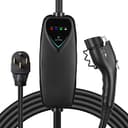
Lectron portable Level 2 charger
Lectron · J1772 · 32 A / 7.7 kW · 21 ft cable
A plug-in portable that runs at Level 2 speed from a NEMA 14-50 and drops to a standard wall outlet with the included adapter. The travel unit, not the garage unit.
What is good
- Level 2 speed from a NEMA 14-50 without an installed charger
- Falls back to a standard household outlet with the adapter
- Small enough to keep in the trunk
What is not
- 32 A ceiling, meaningfully slower than a 48 A wall unit
- Not weather-rated for permanent outdoor mounting
- Repeated plugging and unplugging wears a NEMA 14-50 receptacle faster than a hardwired unit
| Maximum output | 32 A / 7.7 kW at 240 V |
|---|---|
| Connector | SAE J1772 |
| Plug | NEMA 14-50, with an adapter for a standard outlet |
| Use | Portable. Lives in the car, not on the wall |
Skip this if: Skip it if this is your only charger and you have a garage. A wall unit is faster and does not live in your trunk.
Specifications above are the manufacturer’s published figures. Source: Lectron. We have not tested this unit — see how we pick.
FAQ
Questions people actually ask
What should I look for in a portable EV charger?
Is a 32 amp or 40 amp portable charger better?
Should a portable EV charger be UL listed?
Sources
Where these numbers come from
- J+ Booster 2 Level 2 portable EV charger — J+ Booster
- Lectron Level 2 EV chargers — Lectron
- Lectron Portable Level 1 & 2 Tesla NACS EV Charger, 120 V and 240 V, 8-40 A — Lectron
- NEC Article 625: EV charging equipment — WireRefContinuous-load rule behind every circuit figure on this page.
Read next
Related reading
- The best portable EV chargersPortable Level 2 chargers for renters and travelers, with the honest case for buying none.
- The best dual-voltage portable EV chargersPortables that run from a standard outlet and a 240 V outlet, and how fast each one really is.
- How to check an EV charger's safety certificationWhat UL, ETL and CSA marks mean, and the wording designed to look like certification.
- Outlet types for EV charging: a field guideEvery outlet you might charge from, what each delivers, and which adapters to carry.
- Grizzl-E Mini Connect reviewA 40 A portable with a 25 ft cable, four adapters and an app. Who should buy it over a wall unit.
- 16 A, 32 A or 40 A: portable charger amperageWhat 16 A, 32 A and 40 A deliver overnight, which outlet each needs, and how to choose.