First month
Can you leave an EV plugged in all the time?
Plugging in every night is the normal way to own an electric car. The charger stops when the car says stop -- here is what is actually happening.
By Sawyer V. · Published September 23, 2026
How this page is funded: we earn a commission if you buy through our Amazon links, at no extra cost to you. It does not change what we recommend, and we say plainly when the honest answer is to buy nothing. Full disclosure.
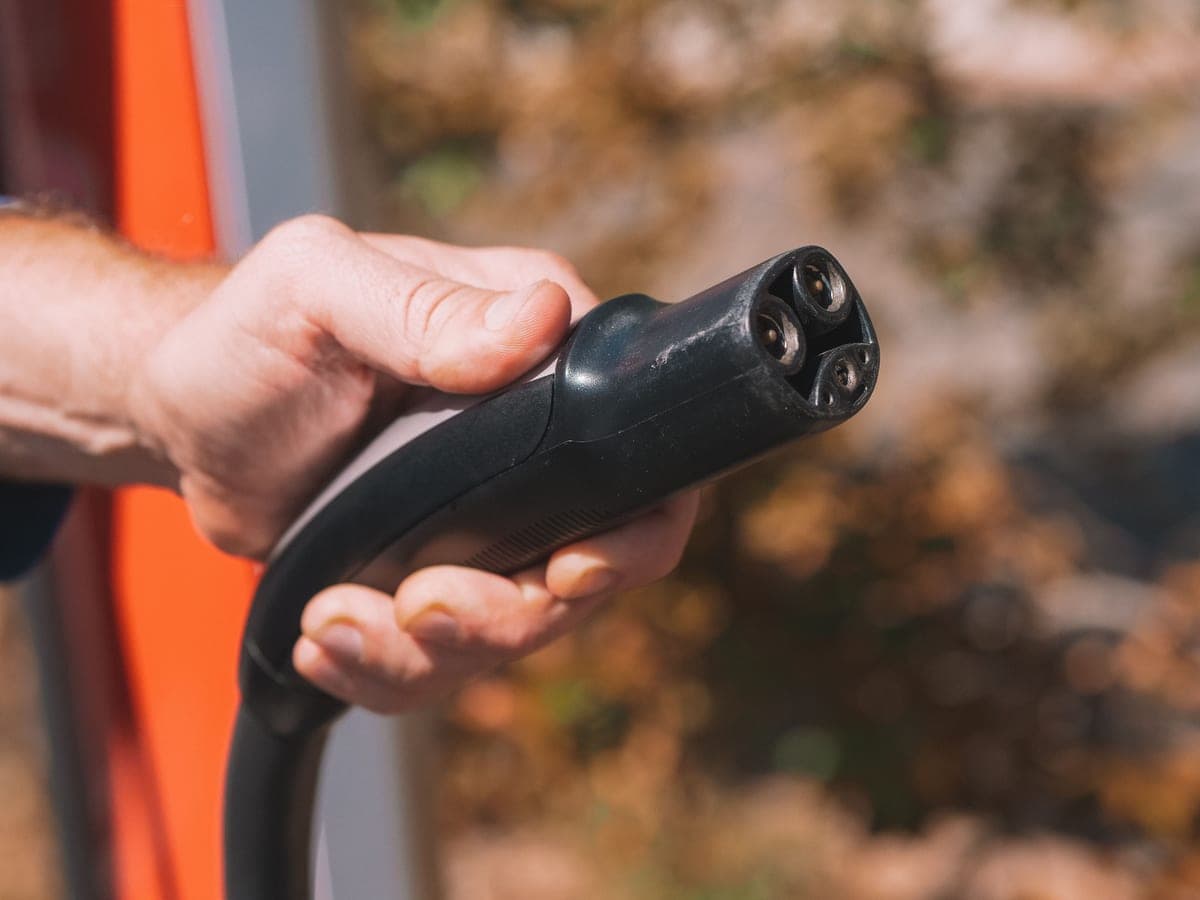
It is the question every new owner asks in week one, usually after leaving a phone on charge overnight for a decade and feeling faintly guilty about it. The short answer is that this is how the cars are designed to be used: the Department of Energy describes overnight home charging as what most drivers do.
What actually happens when the car is full
A Level 2 wall charger is not a battery charger in the sense a phone brick is. The charging electronics live in the car. The wall unit supplies 240-volt AC and a control signal telling the car the maximum current it may draw; the car's own onboard charger converts that to DC and manages the battery.
- You plug in. The two shake hands and agree on a current limit.
- The car draws what it wants, up to that limit.
- The battery reaches the car's target, and the car stops drawing.
- The cable stays energized and ready. Almost nothing flows.
- Overnight the car may sip a little to keep systems awake, or to warm or cool the pack in extreme weather.
Charge limits: the one thing to set
Nearly every EV lets you set a limit -- charge to 80%, or 90%, rather than 100% -- and schedule when charging happens. What limit to use for daily driving depends on your car's battery chemistry and on what the manufacturer recommends, so the answer is in your owner's manual rather than on a charger review site. We will not guess it for you.
What is safe to say generally: set the limit in the car once, plug in every night, and stop thinking about it. Arriving at a long trip with a full battery is a separate setting you raise for the day.
Leaving it plugged in for weeks
Going away is the case where people worry most, and it is usually the case where leaving it plugged in helps. A parked EV still uses a trickle of energy for its systems, and in very cold or very hot weather it may condition the battery. Plugged in, it can take that from the wall instead of from the pack.
- Set a moderate charge limit rather than 100% for a long sit, if your manual advises one.
- Leave it somewhere sheltered if you can -- heat is harder on a parked pack than cold.
- Check the car's app, if it has one, rather than worrying about the charger.
- Make sure the circuit is sound. A month unattended is a bad time for a marginal connection. The 14-50 outlet.
When to unplug
| Situation | Why |
|---|---|
| A damaged cable or connector | Stop using it until it is replaced |
| A fault light or repeated breaker trips | Something is wrong; work through it |
| An electrical storm, if that is your habit | The same reasoning as any other appliance |
| Work on the panel or the circuit | The electrician will ask anyway |
| Flooding, or water pooling at the charger | Outdoor-rated is not submersible |
Does leaving it plugged in cost anything?
A little, and less than it used to. A charger sitting idle draws standby power, which is exactly what ENERGY STAR certification measures: certified units are tested by a nationally recognized laboratory and use less energy when idle. Over a year the difference is small, but it is the sort of thing worth having for free when you are choosing between two units anyway.
The bigger cost question is when you charge, not whether you stay plugged in. If your utility charges less at night, a schedule is worth real money. Charging at night covers how to set one up, with or without an app.
Chargers that schedule for you
Both let you set charging hours from an app. Every EV we know of can also schedule in the car.
1. A first charger, hardwired
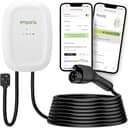
Emporia Level 2 EV Charger (Classic)
Emporia · J1772 · 48 A / 11.5 kW · 24 ft cable
The safe default for a first home charger: 48 amps hardwired, a genuinely long cable, a NEMA 4 outdoor-rated case, and no subscription attached to the app.
What is good
- 48 A hardwired is the fastest tier most homes can realistically support
- 24 ft of cable reaches across a two-car garage without a fight
- NEMA Type 4 enclosure is rated for outdoor mounting
- Energy monitoring in the app with no subscription
What is not
- Drops to 40 A if you use the NEMA 14-50 plug rather than hardwiring
- The app is the only way to change the amperage setting
| Maximum output | 48 A / 11.5 kW at 240 V (hardwired) |
|---|---|
| Plug-in output | 40 A with the NEMA 14-50 plug |
| Connector | SAE J1772 |
| Cable | 24 ft |
| Enclosure | NEMA Type 4, indoor or outdoor |
| Certification | UL listed, Energy Star |
| Warranty | 3 years |
Skip this if: Skip it if you want a unit with no app or network connection at all. The Grizzl-E Classic is the simpler machine.
Specifications above are the manufacturer’s published figures. Source: Emporia Energy. We have not tested this unit — see how we pick.
2. Grizzl-E toughness, with an app
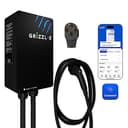
Grizzl-E Classic Connect
United Chargers · J1772 · 40 A / 9.6 kW · 25 ft cable
The next-generation Grizzl-E: 40 A on a NEMA 14-50, a 25 ft cable, a UL Type 4 indoor/outdoor rating -- and, unlike the Classic, Wi-Fi and the Grizzl-E Connect app. Sold with a J1772 or NACS cable.
What is good
- 25 ft cable, a foot longer than the Classic Extreme Edition's
- Wi-Fi app with schedules and charging statistics, which the Classic deliberately lacks
- UL/cUL listed, with a published file number
- Rated to run from -22 F to 122 F
What is not
- 40 A ceiling, with no hardwired 48 A version
- Sold with a NEMA 14-50 plug; the Classic's 6-50 option is not among the Connect listings we found
- The app needs 2.4 GHz Wi-Fi where the charger is mounted
| Maximum output | 40 A / 9.6 kW at 240 V (the maker lists 10 kW) |
|---|---|
| Adjustable | 16 A to 40 A |
| Connector | SAE J1772 or NACS, chosen at purchase |
| Cable | 25 ft (7.6 m) |
| Plug | NEMA 14-50 |
| Enclosure rating | UL Type 4, indoor and outdoor |
| Operating temperature | -22 F to 122 F |
| Size | 10.25 x 6.25 x 3.75 in |
| Connectivity | Wi-Fi (2.4 GHz) and the Grizzl-E Connect app |
| Certification | UL/cUL, file E510712 |
| Warranty | 3 years; 5-year warranty sold separately |
Skip this if: Skip it if you wanted a Grizzl-E precisely because it has no app -- the original Classic is still the no-software choice -- or if you want 48 A. The Classic Connect is a 40 A plug-in unit.
Specifications above are the manufacturer’s published figures. Source: United Chargers. We have not tested this unit — see how we pick.
FAQ
Questions people actually ask
Is it bad to leave an EV plugged in all night?
Can an EV charger overcharge my car?
Should I unplug when the car is full?
What charge limit should I use?
Is it safe to leave it plugged in while I am away for a month?
Sources
Where these numbers come from
- Charging Electric Vehicles at Home — U.S. Department of Energy, Alternative Fuels Data CenterMost drivers charge overnight at home; some utilities offer residential time-of-use rates or other rate incentives; smarter Level 2 units add charging timers and monitoring. Read 2026-09-23.
- Electric Vehicle Charging Infrastructure: AC Level 2 equipment — U.S. Department of Energy, Alternative Fuels Data CenterAC Level 2 runs at 240 V in homes and adds roughly 25 miles of range per hour of charging, using the J1772 or J3400 (NACS) connector. Read 2026-09-23.
- ENERGY STAR certified electric vehicle chargers — U.S. EPA, ENERGY STARCertified chargers are tested by a nationally recognized testing laboratory and use less energy when idle. Read 2026-09-23.
Read next
Related reading
- Charging at night on a time-of-use rateHow time-of-use rates work, how to schedule charging, and how to check the switch pays.
- How long does it take to charge an EV at home?The formula for your own charging time, and why empty-to-full is the wrong question.
- Your EV charger is not working: what to checkThe six usual causes of a charge that will not start, in the order worth checking them.
- Is home EV charging safe?The real risks in home charging, the things that are not risks, and the habits that matter.