Running costs
Do EV chargers use power when idle?
Yes, a little -- and that small number runs 20 hours a day, every day, which is exactly why there is a certification for it.
By Sawyer V. · Published September 27, 2026
How this page is funded: we earn a commission if you buy through our Amazon links, at no extra cost to you. It does not change what we recommend, and we say plainly when the honest answer is to buy nothing. Full disclosure.
The average home charger works for about four hours a day and waits for twenty. That ratio is what makes idle draw worth a paragraph at all: it is a small number multiplied by nearly all the hours in the year.
What it is doing while it waits
- Watching for a car. The control electronics stay alive to detect a connector being plugged in.
- Holding a network connection, on connected units -- a 2.4 GHz radio, awake, talking to your router.
- Running status lights, which are small but not zero.
- Keeping any internal protection circuitry live, including ground-fault detection.
None of that requires much power. It also never stops, which is the whole point of measuring it.
What ENERGY STAR actually certifies
This is the useful part of that badge on a charger box. ENERGY STAR certified chargers are tested by a nationally recognized testing laboratory and use less energy when idle than uncertified equipment. It is not a claim about charging speed or build quality -- it is specifically about the hours the unit spends doing nothing.
Several units on this site carry it, including the Emporia Classic, the Leviton EV480, the Lectron NEXUS and FLO's Home X3. UL listing and certification wording covers the safety side, which is a different question.
How to find your own number
Manufacturers rarely publish idle draw, and we will not estimate one. If you want the figure for your charger, measure the circuit: a whole-home energy monitor with a sensor on the EV circuit shows exactly what it draws between sessions, and it pays for itself in other ways. Emporia Vue 3 review.
A charger's own app reports charging sessions, which is not the same measurement -- that is energy delivered to the car, not energy consumed by the box while it waits.
Should this change what you buy?
| Situation | Does idle draw matter? |
|---|---|
| Choosing between two similar chargers | Use ENERGY STAR as the tiebreaker |
| Choosing between a connected and a plain unit | Marginally -- the app is the bigger decision |
| On a time-of-use rate | Idle hours are mostly off-peak anyway |
| Charger in a vacation home, rarely used | The most idle hours of any case here |
| Deciding whether to buy at all | No. This is not a reason to skip Level 2 |
The honest summary: idle draw is real, it is small, and the sensible response is to prefer an ENERGY STAR certified charger when you are otherwise undecided. Do you need a smart charger covers the connectivity side of the same trade.
A certified charger and a way to measure
One ENERGY STAR certified charger, and the monitor that shows what any circuit actually draws.
1. A first charger, hardwired
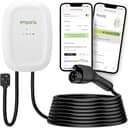
Emporia Level 2 EV Charger (Classic)
Emporia · J1772 · 48 A / 11.5 kW · 24 ft cable
The safe default for a first home charger: 48 amps hardwired, a genuinely long cable, a NEMA 4 outdoor-rated case, and no subscription attached to the app.
What is good
- 48 A hardwired is the fastest tier most homes can realistically support
- 24 ft of cable reaches across a two-car garage without a fight
- NEMA Type 4 enclosure is rated for outdoor mounting
- Energy monitoring in the app with no subscription
What is not
- Drops to 40 A if you use the NEMA 14-50 plug rather than hardwiring
- The app is the only way to change the amperage setting
| Maximum output | 48 A / 11.5 kW at 240 V (hardwired) |
|---|---|
| Plug-in output | 40 A with the NEMA 14-50 plug |
| Connector | SAE J1772 |
| Cable | 24 ft |
| Enclosure | NEMA Type 4, indoor or outdoor |
| Certification | UL listed, Energy Star |
| Warranty | 3 years |
Skip this if: Skip it if you want a unit with no app or network connection at all. The Grizzl-E Classic is the simpler machine.
Specifications above are the manufacturer’s published figures. Source: Emporia Energy. We have not tested this unit — see how we pick.
2. Circuit-level detail
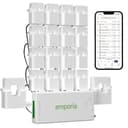
Emporia Vue 3 home energy monitor
Emporia · In-panel sensors
Clamps onto your mains and up to 16 individual circuits, so you can see exactly what the EV charger draws and how much headroom your panel really has. Pairs with Emporia's own charger to charge from surplus solar.
What is good
- Up to 16 circuit sensors, so the EV circuit gets its own exact reading
- Wired Ethernet as well as Wi-Fi, which matters inside a metal panel
- Pairs with the Emporia EV charger to charge from surplus solar
- Shows real panel headroom -- useful before deciding on a charger's amperage
What is not
- Sensors go inside the panel, which is electrician territory
- Routing up to 16 clamps is fiddly in a crowded panel
- Only as useful as the time you spend in the app
| Mains sensors | 2 x 200 A |
|---|---|
| Branch circuit sensors | Up to 16 x 50 A |
| Connectivity | 2.4 GHz Wi-Fi, plus 10/100 wired Ethernet |
| Solar | Monitors net metering without extra equipment |
| 3-phase homes | A separate 3-phase/4-wire model is sold |
| Certification | UL certified |
| Warranty | 1 year |
Skip this if: Skip it if you only want a whole-home total. Sixteen circuit sensors is a lot of hardware to route through a panel for one number.
Specifications above are the manufacturer’s published figures. Source: Emporia Energy, Emporia Energy, Excess Solar, Emporia Energy, 3-phase model. We have not tested this unit — see how we pick.
FAQ
Questions people actually ask
Do EV chargers use electricity when not in use?
Should I unplug or switch off my charger?
Does a smart charger use more standby power than a plain one?
How can I measure my charger's standby draw?
Sources
Where these numbers come from
- ENERGY STAR certified electric vehicle chargers — U.S. EPA, ENERGY STARCertified chargers are tested by a nationally recognized testing laboratory and use less energy when idle; driving on electricity typically costs less than half of gasoline. Read 2026-09-27.
- Charging Electric Vehicles at Home — U.S. Department of Energy, Alternative Fuels Data CenterMost drivers charge overnight at home; residential costs depend on equipment and time of day; some utilities offer time-of-use rates; outdoor use is safe with outdoor-rated equipment; smarter Level 2 units add timers and monitoring. Read 2026-09-27.
- Emporia Level 2 EV Charger product specifications — Emporia EnergyENERGY STAR certification, app energy monitoring with no subscription.
- Emporia Vue Energy Monitor — Emporia EnergyWhole-home and circuit-level energy monitoring from sensors installed in the panel.
Read next
Related reading
- How to check an EV charger's safety certificationWhat UL, ETL and CSA marks mean, and the wording designed to look like certification.
- The best ENERGY STAR certified EV chargersHome chargers checked against the EPA's certified list, and how to verify a model number yourself.
- Do you need a smart EV charger?What an app adds over a plain charger, which features your car already has, and when to skip it.
- Emporia Vue 3 review16 circuit sensors, Wi-Fi and Ethernet: what the Vue 3 tells an EV owner, and who should skip it.