Cadillac
The best home charger for a Cadillac EV
One question settles this, and it is not about the charger. Cadillac sells most of its EVs with either an 11 kW or a 19 kW onboard charger, and the answer changes what you should buy by a factor of two.
By Sawyer V. · Published October 7, 2026

How this page is funded: we earn a commission if you buy through our Amazon links, at no extra cost to you. It does not change what we recommend, and we say plainly when the honest answer is to buy nothing. Full disclosure.
Most pages about charging a Cadillac start with the charger. That is the wrong end. Cadillac offers two different onboard chargers across the Lyriq, Optiq and Vistiq, and the car -- not the wall unit -- sets the ceiling. Buy an 80-amp charger for an 11 kW car and you have paid for a 100-amp circuit that delivers 11 kW. Buy a 32-amp charger for a 19 kW car and you have thrown away most of what you paid for the option.
Which onboard charger does your Cadillac have?
The EPA rates the two versions as separate vehicles and names the charger in the trim, which makes this unusually easy to check. These are the published 2026 figures, with the consumption number that every calculation below uses:
| Trim | Onboard charger | kWh per 100 mi | EPA range |
|---|---|---|---|
| Optiq RWD | 11 kW or 19 kW | 32 | 317 mi |
| Optiq AWD | 11 kW or 19 kW | 34 | 303 mi |
| Lyriq | 11 kW or 19 kW | 37 | 326 mi |
| Lyriq PAWD | Not stated by the EPA | 38 | 319 mi |
| Lyriq AWD | Not stated by the EPA | 40 | 303 mi |
| Vistiq | 11 kW or 19 kW | 39 | 305 mi |
| Celestiq | Not stated by the EPA | 42 | 303 mi |
What each charger tier actually delivers
Miles of range added per hour of charging
Charger output in kW = amps x 240 V / 1,000. So 48 A = 11.5 kW and 80 A = 19.2 kW.
Miles per hour = charger kW / (kWh per 100 miles) x 100.
A Lyriq at 37 kWh/100 mi on an 11 kW onboard charger: 11 / 37 x 100 = about 30 miles per hour.
The same Lyriq with the 19 kW charger: 19 / 37 x 100 = about 51 miles per hour.
| Trim | With the 11 kW charger | With the 19 kW charger |
|---|---|---|
| Optiq RWD (32 kWh/100 mi) | about 34 mi/h | about 59 mi/h |
| Optiq AWD (34) | about 32 mi/h | about 56 mi/h |
| Lyriq (37) | about 30 mi/h | about 51 mi/h |
| Vistiq (39) | about 28 mi/h | about 49 mi/h |
| Lyriq AWD (40) | about 28 mi/h | about 48 mi/h |
| Celestiq (42) | about 26 mi/h | about 45 mi/h |
Read the 11 kW column again with a normal week in mind. Thirty miles per hour over a ten-hour overnight window is 300 miles, which is a full Lyriq battery. The faster column is not solving a problem most owners have. The Department of Energy puts typical Level 2 charging at roughly 25 miles of range per hour, and that is already enough for almost everyone.
The connector: CCS for most, NACS on the Optiq
The Lyriq, Vistiq and Escalade IQ carry a CCS inlet, and the top of a CCS inlet is a J1772 socket -- so an ordinary J1772 home charger plugs straight in with no adapter. The 2026 Optiq and Optiq-V are the first GM models to ship with a native NACS port as standard, and the Optiq comes with a CCS adapter. For NACS cars, either buy a NACS charger or use the adapter on a J1772 unit.
- Lyriq, Vistiq, Escalade IQ: CCS inlet. Buy a J1772 charger. No adapter.
- 2026 Optiq and Optiq-V: native NACS port. Buy a NACS charger, or a J1772 charger plus the CCS adapter that came with the car.
- Not sure? Look at your charge port to be sure -- it is the only authoritative answer for your car. Plug types.
Which charger to buy
| Your situation | Buy this | Circuit |
|---|---|---|
| 11 kW onboard charger (most Cadillacs) | A 48 A J1772 charger | 60 A |
| 19 kW onboard charger and a 200 A panel with room | An 80 A hardwired charger | 100 A |
| 19 kW charger but a 100 or 150 A panel | A 48 A charger. The panel decides. | 60 A |
| 2026 Optiq (NACS port) | A NACS charger, or J1772 plus the car's adapter | 60 A |
| Renting, or moving within two years | A 40 A plug-in charger on a 14-50 | 50 A |
Before you commit to the 80-amp tier, check the panel rather than the catalogue. A 100-amp continuous circuit is more than most houses can give up without a service upgrade, and the upgrade usually costs more than the charger. The 80 A roundup works through that properly.
Chargers for a Cadillac
A 48 A unit for the 11 kW cars, the 80 A unit for a 19 kW car with the panel to feed it, and a plug-in 40 A option for anyone who may move. Prices are live from Amazon and carry the date they were read.
1. A first charger, hardwired
Emporia Level 2 EV Charger (Classic)
Emporia · J1772 · 48 A / 11.5 kW · 25 ft cable
The safe default for a first home charger: 48 amps hardwired, a genuinely long cable, a NEMA 4 outdoor-rated case, and no subscription attached to the app.
What is good
- 48 A hardwired is the fastest tier most homes can realistically support
- 25 ft of cable reaches across a two-car garage without a fight
- NEMA Type 4 enclosure is rated for outdoor mounting
- Energy monitoring in the app with no subscription
What is not
- Drops to 40 A if you use the NEMA 14-50 plug rather than hardwiring
- The app is the only way to change the amperage setting
| Maximum output | 48 A / 11.5 kW at 240 V (hardwired) |
|---|---|
| Plug-in output | 40 A with the NEMA 14-50 plug |
| Connector | SAE J1772 |
| Cable | 25 ft |
| Enclosure | NEMA Type 4, indoor or outdoor |
| Certification | UL listed, Energy Star |
| Warranty | 3 years |
Skip this if: Skip it if you want a unit with no app or network connection at all. The Grizzl-E Classic is the simpler machine.
Specifications above are the manufacturer’s published figures. Source: Emporia Energy. We have not tested this unit — see how we pick.
2. A 19.2 kW car and a large service
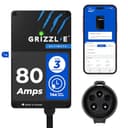
Grizzl-E Ultimate 80A
United Chargers · J1772 · 80 A / 19.2 kW · 25 ft cable
The top of AC Level 2: 80 A and 19.2 kW, hardwired, adjustable down through eight settings. The catch is the circuit -- 80 A continuous asks for a 100 A circuit, which most houses cannot spare.
What is good
- 80 A / 19.2 kW is the ceiling of AC Level 2 charging
- Eight current settings, from 80 A right down to 16 A, so one unit fits almost any circuit
- 25 ft cable and a cast-aluminum UL Type 4 enclosure rated -22 F to 122 F
- UL listed with a published file number, plus Energy Star certification
- OCPP support alongside the maker's own app, which is rare at this price
What is not
- 80 A continuous needs a 100 A circuit, which most homes cannot spare
- Very few cars accept more than 11.5 kW on AC, so the headline figure is unusable for most buyers
- Hardwired only -- there is no plug-in version
- Costs far more than the 48 A tier that most households will actually use
- 2.4 GHz Wi-Fi only, like the rest of the Grizzl-E Connect range
| Maximum output | 80 A / 19.2 kW |
|---|---|
| Adjustable | 80, 64, 56, 48, 40, 32, 24 or 16 A |
| Connector | SAE J1772 or NACS, chosen at purchase |
| Cable | 25 ft (7.6 m) |
| Installation | Hardwired only |
| Enclosure | Cast aluminum, UL Type 4 indoor/outdoor |
| Operating temperature | -30 C to +50 C (-22 F to 122 F) |
| Enclosure size | 10.25 x 6.25 x 3.75 in |
| Weight | 26.46 lb (12 kg), shipped |
| Connectivity | Wi-Fi (2.4 GHz), the Grizzl-E Connect app, and OCPP |
| Country of origin | Canada, per United Chargers |
| Certification | UL, file E510712; Energy Star |
| In the box | Charger, hardwire kit, mounting cradle, EasyEvPlug |
| Warranty | 3 years, or 5 years chosen at purchase |
Skip this if: Skip it unless your car actually accepts more than 11.5 kW and your panel can carry a 100 A circuit. Both have to be true, and for most homes neither is.
Specifications above are the manufacturer’s published figures. Source: United Chargers. We have not tested this unit — see how we pick.
3. Long reach outdoors
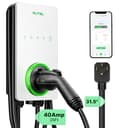
Autel MaxiCharger AC Home
Autel Energy · J1772 · 50 A / 12 kW · 25 ft cable
The 25 ft cable is the longest in this group, and the NEMA 4 case plus a cold-flexible cord make it the easiest unit to live with on an exposed outside wall.
What is good
- 25 ft cable, the longest of the wall units here
- Sold in NEMA 14-50, NEMA 6-50 and hardwired versions
- NEMA Type 4 enclosure rated for rain, snow, hail and sleet
- Wi-Fi and Bluetooth, so it still works if the Wi-Fi drops
What is not
- The 50 A version is hardwired only
- The app has more features than a first-time owner needs
| Maximum output | 50 A / 12 kW hardwired; 40 A / 9.6 kW plug-in |
|---|---|
| Connector | SAE J1772 |
| Cable | 25 ft |
| Enclosure | NEMA Type 4 |
| Certification | Tested to UL standards by CSA |
| Warranty | 3 years |
Skip this if: Skip it if your parking spot is right next to the panel. You are paying for cable you will coil up and never use.
Specifications above are the manufacturer’s published figures. Source: Autel Energy. We have not tested this unit — see how we pick.
FAQ
Questions people actually ask
What size home charger does a Cadillac Lyriq need?
How do I tell whether my Cadillac has the 11 kW or 19 kW onboard charger?
Does a Cadillac Lyriq need a NACS charger?
Is an 80 amp charger worth it for a Cadillac?
Sources
Where these numbers come from
- Fuel Economy of 2026 Cadillac vehicles — U.S. EPA and U.S. Department of Energy, fueleconomy.gov2026 Cadillac EV entries, with the onboard charger named in the trim: OPTIQ RWD (11 kW Charger) and (19 kW Charger) 32 kWh/100 mi, 317 mi; OPTIQ AWD both chargers 34 kWh/100 mi, 303 mi; LYRIQ (11 kW Charger) and (19 kW Charger) 37 kWh/100 mi, 326 mi; LYRIQ PAWD 38 kWh/100 mi, 319 mi; LYRIQ AWD 40 kWh/100 mi, 303 mi; VISTIQ (11 kW Charger) 39 kWh/100 mi, 305 mi and (19 kW Charger) 39 kWh/100 mi, 300 mi; CELESTIQ 42 kWh/100 mi, 303 mi. No ESCALADE IQ entry is published. Read 2026-10-07.
- All the EVs that use Tesla's NACS plug — CarGurusGM section: GM has the broadest EV lineup of any automaker, including the Cadillac Lyriq, Cadillac Escalade IQ, Chevrolet Blazer EV, Equinox EV, Silverado EV, GMC Hummer EV and GMC Sierra EV. The 2026 Cadillac Optiq and Optiq-V are the first GM models to come standard with a native NACS port; the Optiq has a CCS adapter. Read 2026-10-07.
- Electric Vehicle Charging Infrastructure: AC Level 2 equipment — U.S. Department of Energy, Alternative Fuels Data CenterAC Level 2 runs at 240 V in homes, delivers 2.9 to 19.2 kW, adds roughly 25 miles of range per hour of charging, and uses the J1772 or J3400 (NACS) connector. The CCS inlet accepts Level 1, Level 2 and DC fast charging. Read 2026-10-07.
Read next
Related reading
- The best home charger for a Cadillac LyriqConnector guidance and sizing for a large-battery luxury EV like the Lyriq.
- The best home charger for a Cadillac OptiqGM's first native-NACS model, and the home chargers that plug straight in.
- The best home charger for a Cadillac Escalade IQA J1772 charger for a CCS luxury SUV, and why a big battery justifies 48-50 A.
- The best 80-amp EV chargersThe chargers that reach 19.2 kW, the circuit they need, and the test for whether the tier helps you.
- The best 48-amp EV chargersThe fastest home tier: 48-amp picks, the 60-amp circuit they need, and who should skip it.