By vehicle
The best NACS adapter for a Hyundai EV
Most of the internet still tells Hyundai owners to claim a free adapter. Hyundai's own page gives the program a termination date in 2025, so this is a buying decision -- and which part you need depends on your model year, not your badge.
By Sawyer V. · Published November 7, 2026
How this page is funded: we earn a commission if you buy through our Amazon links, at no extra cost to you. It does not change what we recommend, and we say plainly when the honest answer is to buy nothing. Full disclosure.
The verdict: if your Hyundai has a CCS port -- which is every Kona EV, every Ioniq EV, every Ioniq 6 and every Ioniq 5 up to 2024 -- buy the Lectron Vortex Plus NACS-to-CCS1 adapter. It is the one in this category with a published UL 2252 certification and SGS testing, an interlock and an IP67 rating, and a UL certification is precisely the condition Hyundai states for using a non-Hyundai adapter at all. The A2Z Typhoon Pro is the alternative and publishes a longer per-model compatibility list, with the honest caveat that A2Z describes its own UL 2252 certificate as in progress. If you drive the native-NACS 2025 Ioniq 5, the adapter you need points the other way, and the part that matters most for home charging is a J1772-to-NACS AC adapter, not a DC one.
Hyundai adapter picks
Ranked for a first home charger. Every row jumps to the full write-up below.
| # | Product | Best for | Max output | Price |
|---|---|---|---|---|
| 1 |  Lectron Vortex Plus NACS to CCS1 adapterA certified third-party adapter. NACS to CCS1. | A certified third-party adapter | 500 A | $199.99 · View on Amazon#ad how we are funded · price as of November 8, 2026 |
| 2 |  A2Z EV Typhoon Pro NACS to CCS1 adapterA long published compatibility list. NACS to CCS1. | A long published compatibility list | 500 A | $169.99 · View on Amazon#ad how we are funded · price as of November 8, 2026 |
| 3 |  Lectron CCS1 to Tesla (NACS) adapterA Tesla at CCS1 fast chargers. CCS1 to NACS. | A Tesla at CCS1 fast chargers | 500 A | $189.97 · View on Amazon#ad how we are funded · price as of November 8, 2026 |
| 4 |  Lectron J1772 to Tesla (NACS) adapterNACS car, J1772 charger. J1772 to NACS. | NACS car, J1772 charger | 80 A19.2 kW | $39.99 · View on Amazon#ad how we are funded · price as of November 8, 2026 |
| 5 |  Emporia Level 2 EV Charger (Classic)A first charger, hardwired. J1772, 25 ft cable. | A first charger, hardwired | 48 A11.5 kW | $449.00 · View on Amazon#ad how we are funded · price as of November 8, 2026 |
| 6 |  Grizzl-E ClassicHarsh weather and no app. J1772, 24 ft cable. | Harsh weather and no app | 40 A9.6 kW | $299.99 · View on Amazon#ad how we are funded · price as of November 8, 2026 |
Find your car in this table first
| Your Hyundai | Port | For a Tesla Supercharger | For a CCS network | At home |
|---|---|---|---|---|
| Kona EV, Ioniq EV | CCS1 | A NACS-to-CCS1 DC adapter | Nothing -- plugs in directly | Nothing -- a J1772 charger plugs in directly |
| Ioniq 5, up to 2024 | CCS1 | A NACS-to-CCS1 DC adapter | Nothing | Nothing |
| Ioniq 6 | CCS1 | A NACS-to-CCS1 DC adapter | Nothing | Nothing |
| Ioniq 5, 2025 (native NACS) | NACS | Nothing -- plugs in directly | A CCS1-to-NACS DC adapter (one came with the car) | A J1772-to-NACS AC adapter |
| Ioniq 5 N | CCS1 -- Hyundai states it has no native NACS port | A NACS-to-CCS1 DC adapter | Nothing | Nothing |
What happened to the free adapter
This is the part worth getting right, because almost every article about this question was written in early 2025 and is now wrong. Hyundai did run a complimentary NACS adapter program: from March 2025, eligible owners of a Kona EV, Ioniq EV, Ioniq 5, Ioniq 6 or 2025 Ioniq 5 N with a CCS port could request one, provided the car was purchased or leased on or before January 31, 2025. The same page sets the end: "Notwithstanding the foregoing, the NACS Adapter program termination date is September 30, 2025."
And the FAQ closes the back door. Asked about an owner who bought an adapter from a dealer without knowing a free one existed, Hyundai's published answer is "We are unable to provide reimbursement." So in late 2026 a Hyundai owner who wants Supercharger access buys an adapter -- from a dealer, or from the certified third-party market this page ranks.
The two directions, and the mistake that voids a warranty
Hyundai's FAQ lays out both parts plainly. A NACS adapter "enables non-Tesla EVs to use Tesla Superchargers" -- that is the one a CCS Hyundai needs. A CCS adapter "enables Tesla EVs to use CCS chargers" -- that is the one a native-NACS car needs, and the 2025 Ioniq 5 came with one from the factory. If you lose it, Hyundai's answer is to buy a replacement through a dealer.
The dangerous confusion is between DC and AC. Hyundai writes it as clearly as anyone has: "The L3 CCS adapter cannot be used with AC level 2 or level 1 J1772 inlets (as in home chargers). Do not attempt to use a J1772 AC level 2 charger with a CCS adapter. Failure to follow these instructions may result in vehicle damage not covered by the vehicle warranty." A DC fast-charging adapter is not a home-charging part. If you have a native-NACS Ioniq 5 and a J1772 charger on the wall, the part you want is a J1772-to-NACS AC adapter -- Lectron's publishes UL 2252, an 80 A rating at 240 V and temperature monitoring in the body.
What speed to expect, in Hyundai's numbers
Superchargers advertise 250 kW on V3 and 350 kW on V4. Hyundai publishes what its cars actually take there: "Hyundai EVs will charge at between 95kW and 125kW at V3 Tesla Superchargers," and for the 2025 Ioniq 5 specifically, "125kW at this time." That is a useful expectation to set before a road trip, and it is not a criticism of either party -- it is what an 800-volt car does on a 400-volt station architecture. DC fast charging explained covers why.
The practical note from the same page: a CCS Hyundai at a Supercharger uses the Tesla app to find a stall and start the session, while a native-NACS Hyundai can use the MyHyundai app. Hyundai also describes the physical sequence -- take the cable off the post, fit the adapter to the cable, then plug the cable into the car -- which is the right order and not the one people guess.
Home charging is the part that matters more
An adapter changes where you can charge on four or five trips a year. The charger on your wall changes every night. For a CCS Hyundai no adapter is involved at all: a J1772 Level 2 charger plugs straight in, and the Department of Energy puts Level 2 at roughly 25 miles of range per hour. The Emporia is this site's safe default for a first charger -- 48 A hardwired, a 25-foot cable, a NEMA Type 4 case, UL listed and Energy Star -- and the Grizzl-E Classic is the pick if you would rather have no app at all.
Model-specific home charging guidance lives on the car pages: Hyundai Ioniq 5, Ioniq 6 and Ioniq 9. If your household also has a J1772 car alongside a native-NACS one, the best EV charger for a NACS and J1772 garage is the page for that.
The six picks
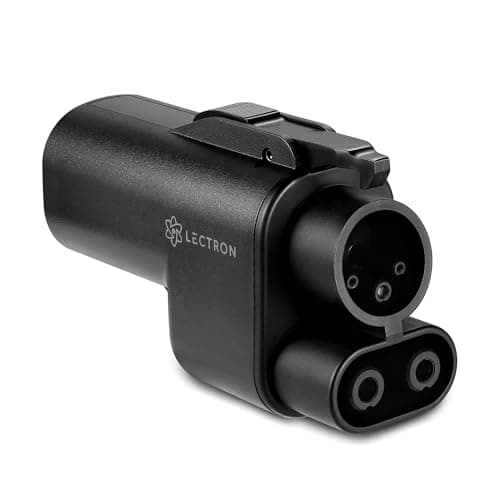
1. A certified third-party adapter
Lectron Vortex Plus NACS to CCS1 adapter
Lectron · NACS to CCS1 · 500 A
A NACS-to-CCS1 DC adapter with an interlock, certified to UL 2252 and tested by SGS, per Lectron. Rated 500 A and 1,000 V, IP67, for V3 and V4 Superchargers -- and only for cars whose automaker has approved Supercharger access.
What is good
- Certified to UL 2252, the standard written for EV adapters, per Lectron
- Interlock keeps the connection secure during DC charging
- IP67 dust and water rating
- Two-year warranty
What is not
- Only for cars whose automaker has approved Supercharger access
- V3 and V4 Superchargers only -- not V2, and not AC chargers
- Your automaker's own adapter, if it offers one, is the first choice
| Rating | 500 A / 1,000 V / 500 kW |
|---|---|
| Direction | NACS DC charger to a CCS1 port |
| Chargers | V3 and V4 Tesla Superchargers; not V2, not AC chargers |
| Vehicles | CCS1 EVs with approved automaker Supercharger access |
| Interlock | Built in |
| Heat | May reduce or pause charging in very hot conditions |
| Weather rating | IP67 |
| Certification | UL 2252, tested by SGS, per Lectron |
| Warranty | 2 years |
Skip this if: Skip it if your automaker supplies or sells its own NACS adapter for your car -- that part comes first -- or if your car already has a NACS port.
Specifications above are the manufacturer’s published figures. Source: Lectron. We have not tested this unit — see how we pick.
2. A long published compatibility list
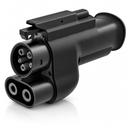
A2Z EV Typhoon Pro NACS to CCS1 adapter
A2Z EV · NACS to CCS1 · 500 A
A NACS-to-CCS1 DC adapter rated 1,000 V and up to 500 A on liquid-cooled cables (400 A otherwise), with two temperature sensors, an interlock and a hard case. A2Z says its UL 2252 certificate is still pending.
What is good
- Two temperature sensors: one slows charging, the other stops it
- Interlock, and a hard case in the box
- Assembled and tested in North America, per A2Z
What is not
- UL 2252 certificate still pending, per A2Z
- A2Z says third-party adapters are not officially authorized for Tesla Superchargers
- Full 500 A only on liquid-cooled charger cables; 400 A otherwise
| Voltage | 1,000 V DC |
|---|---|
| Current | Up to 500 A with liquid-cooled cables; 400 A without |
| Over boost | 600 A for 15 minutes, per A2Z |
| Chargers | V3 and V4 Superchargers and other NACS DC chargers |
| Temperature | Two over-temperature sensor switches |
| Interlock | Yes |
| Weather rating | IP54 mated, IP67 enclosure |
| In the box | Hard case |
| Certification | UL 2252 in progress; FCC certified |
| Warranty | 12 months |
Skip this if: Skip it until A2Z publishes the UL 2252 certificate it describes as pending -- and note that A2Z itself says third-party adapters are not officially authorized for Tesla Superchargers.
Specifications above are the manufacturer’s published figures. Source: A2Z EV. We have not tested this unit — see how we pick.
3. A Tesla at CCS1 fast chargers
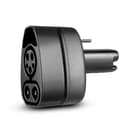
Lectron CCS1 to Tesla (NACS) adapter
Lectron · CCS1 to NACS · 500 A
Lets a Tesla or another NACS car use CCS1 fast chargers. 500 A and 1,000 V, UL 2252 certified per Lectron, IP67 and tested from -22 F to 122 F, with a thermal cutoff at 185 F -- but check whether your Tesla needs a CCS retrofit first.
What is good
- Opens CCS1 fast chargers to a Tesla, per Lectron
- UL 2252 certification stated by Lectron
- Thermal cutoff at 185 F, and IP67
What is not
- Lectron's Amazon listing states it is not compatible with the Tesla Cybertruck
- Some Teslas need a CCS retrofit before it works
- Warranty term not stated on the product page we read
- DC only -- it plays no part in home charging
| Rating | 500 A / 1,000 V / 500 kW |
|---|---|
| Direction | CCS1 DC charger to a NACS port |
| Vehicles | Tesla Model S, 3, X and Y, and other NACS (J3400) EVs |
| Thermal protection | Shuts off at 185 F |
| Weather rating | IP67; tested -22 F to 122 F |
| Certification | UL 2252, per Lectron |
Skip this if: Skip it until you have checked your Tesla's CCS support -- Lectron says some need a retrofit, shown under Controls > Software > Additional Vehicle Information.
Specifications above are the manufacturer’s published figures. Source: Lectron. We have not tested this unit — see how we pick.
4. NACS car, J1772 charger
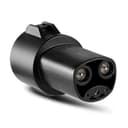
Lectron J1772 to Tesla (NACS) adapter
Lectron · J1772 to NACS · 80 A / 19.2 kW
Lets a Tesla or any NACS-port car charge from a J1772 charger. Rated to 80 A, certified to UL 2252, with temperature monitoring built into the body.
What is good
- Certified to UL 2252, which is the standard written for exactly this device
- Rated well above any home circuit at 80 A, so it is never the limiting part
- Temperature monitoring in the body, the failure mode that matters on an adapter
- Works on any J1772 Level 1 or Level 2 charger
What is not
- Most owners already have one in the car and do not need to buy anything
- AC only -- it is not a DC fast-charging adapter
- One more loose item to keep track of, unless it lives clipped to the cable
| Direction | J1772 charger to a NACS (Tesla) port |
|---|---|
| Maximum current | 80 A |
| Voltage | 240 V AC |
| Certification | UL 2252 |
| Safety | Built-in temperature monitoring |
| Use | AC charging (Level 1 and Level 2) |
Skip this if: Skip it if your car came with one. Every Tesla ships with a J1772 adapter, and cars sold with a native NACS port ship with one too -- check the trunk before buying.
Specifications above are the manufacturer’s published figures. Source: Lectron. We have not tested this unit — see how we pick.
5. A first charger, hardwired
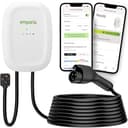
Emporia Level 2 EV Charger (Classic)
Emporia · J1772 · 48 A / 11.5 kW · 25 ft cable
The safe default for a first home charger: 48 amps hardwired, a genuinely long cable, a NEMA 4 outdoor-rated case, and no subscription attached to the app.
What is good
- 48 A hardwired is the fastest tier most homes can realistically support
- 25 ft of cable reaches across a two-car garage without a fight
- NEMA Type 4 enclosure is rated for outdoor mounting
- Energy monitoring in the app with no subscription
What is not
- Drops to 40 A if you use the NEMA 14-50 plug rather than hardwiring
- The app is the only way to change the amperage setting
| Maximum output | 48 A / 11.5 kW at 240 V (hardwired) |
|---|---|
| Plug-in output | 40 A with the NEMA 14-50 plug |
| Connector | SAE J1772 |
| Cable | 25 ft |
| Enclosure | NEMA Type 4, indoor or outdoor |
| Certification | UL listed, Energy Star |
| Warranty | 3 years |
Skip this if: Skip it if you want a unit with no app or network connection at all. The Grizzl-E Classic is the simpler machine.
Specifications above are the manufacturer’s published figures. Source: Emporia Energy. We have not tested this unit — see how we pick.
6. Harsh weather and no app
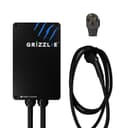
Grizzl-E Classic
United Chargers · J1772 · 40 A / 9.6 kW · 24 ft cable
A cast-aluminum box with no app, no account and no firmware to update. If you want a charger that behaves like an appliance, this is the one.
What is good
- Cast aluminum NEMA 4 / IP67 enclosure, built for outdoor mounting
- No app, no account, no network dependency
- Amperage is set with physical switches, not software
- Protections for over-current, over-voltage, ground fault and over-temperature
What is not
- 40 A ceiling, slower than the 48 A units if your panel can take more
- No scheduling, so off-peak charging has to be set in the car
- The cold-flexible 24 ft cable is only on the Extreme Edition
| Maximum output | 40 A / 9.6 kW at 240 V |
|---|---|
| Adjustable | 16, 24, 32 or 40 A |
| Connector | SAE J1772 |
| Cable | 24 ft on the Extreme Edition |
| Enclosure | Cast aluminum, NEMA 4 / IP67 |
| Certification | UL certified |
| Warranty | 3 years |
Skip this if: Skip it if you want scheduled charging or energy tracking in an app. The Classic deliberately has neither.
Specifications above are the manufacturer’s published figures. Source: United Chargers, InsideEVs. We have not tested this unit — see how we pick.
Genesis owners, and what we did not rank
Hyundai's FAQ covers Genesis in the same answer: eligible Hyundai and Genesis EV owners and lessees with native CCS ports were given access to NACS adapters under the same arrangement. So the direction logic on this page applies to a Genesis GV60 or GV70 Electrified as well, and the termination date applies to them too.
We have not ranked Hyundai's own adapter, for two reasons: it is a dealer part rather than a retail one, and we would earn nothing on it and could not price it honestly. If your dealer will sell you one, that is the part with no warranty argument attached and it is a perfectly good answer -- Hyundai's own accessory is always the safest choice on paper. What this page adds is the certified third-party option for everybody whose dealer says no, plus the one sentence of Hyundai's own guidance that makes such a purchase defensible.
FAQ
Questions people actually ask
Can I still get a free NACS adapter from Hyundai?
Which NACS adapter does an Ioniq 5 need?
Does the Ioniq 5 N have a NACS port?
Can I use a CCS to NACS adapter on my home charger?
How fast does a Hyundai charge at a Tesla Supercharger?
Will a third-party adapter void my Hyundai warranty?
Sources
Where these numbers come from
- Hyundai NACS charging information — Hyundai Motor AmericaStarting March 2025, Hyundai offered eligible owners a complimentary North American Charging Standard (NACS) adapter, giving access to over 20,000 Tesla Superchargers that support NACS charging for a total of 45,000+ CCS fast chargers across the U.S. Eligible models: KONA EV, IONIQ EV, IONIQ 5, IONIQ 6, 2025 IONIQ 5N; the vehicle must have been purchased or leased on or before January 31, 2025. "Notwithstanding the foregoing, the NACS Adapter program termination date is September 30, 2025. Any outstanding offers must be redeemed by eligible owners on or before September 30, 2025." Hyundai EVs will charge at between 95kW and 125kW at V3 Tesla Superchargers. If driving a NACS Hyundai EV use the MyHyundai app; if driving a CCS Hyundai, use the Tesla app to find a station and select the stall number. To use a NACS adapter: remove the charging cable from the Supercharger post, connect the adapter to the cable, then plug the cable into the vehicle's charge port. Read 2026-11-07.
- Hyundai NACS adapter FAQs — Hyundai Motor AmericaPublished Q&A. On the two adapter types: a CCS adapter enables Tesla EVs to use CCS chargers, a NACS adapter enables non-Tesla EVs to use Tesla Superchargers. On third-party parts: "HMA warranty will not cover damage caused by non-Hyundai accessories. Only use adapters with CSA or UL Certification." On AC use of a DC adapter: "The L3 CCS adapter cannot be used with AC level 2 or level 1 J1772 inlets (as in home chargers). Do not attempt to use a J1772 AC level 2 charger with a CCS adapter. Failure to follow these instructions may result in vehicle damage not covered by the vehicle warranty. HMA does not guarantee compatibility with aftermarket charging adapters." On reimbursement: "We are unable to provide reimbursement" for an adapter bought through a dealer. On the 2025 Ioniq 5: it is the first Hyundai model with a native NACS port, comes standard with a complimentary CCS adapter for public fast charging, and its maximum charge rate at a Tesla Supercharger station is "125kW at this time"; IONIQ 5 N vehicles do not have a native NACS port. Replacement CCS adapters are purchased through a local dealer. Adapters for new NACS-port models are provided with vehicle delivery from the factory. Legacy Hyundai and Genesis EVs with native CCS ports were covered by the same adapter access. Read 2026-11-07.
- Lectron Vortex Plus NACS to CCS1 adapter — LectronNACS-to-CCS1 DC adapter with an interlock, UL 2252 certified and tested by SGS per Lectron, rated 500 A and 1,000 V, IP67, for V3 and V4 Superchargers, 2-year manufacturer warranty.
- A2Z EV Typhoon Pro NACS to CCS1 adapter — A2Z EVNACS-to-CCS1 DC adapter rated 1,000 V and up to 500 A on liquid-cooled cables (400 A otherwise), two over-temperature sensor switches, an interlock and a hard case; IP54 mated and IP67 enclosure; FCC certified; A2Z states its UL 2252 certificate is in progress; 12-month warranty; A2Z publishes a per-model compatibility list.
- Lectron CCS to Tesla (NACS) EV Adapter -- UL 2252 certified — Lectron500 A / 1,000 V / 500 kW rating, CCS1 DC charger to a NACS port, thermal shutoff at 185 F, IP67 and tested -22 F to 122 F, UL 2252 per Lectron.
- Lectron J1772 to Tesla (NACS) EV adapter, UL 2252 certified, 240 V 80 A — LectronLets a NACS-port car charge from a J1772 AC charger; rated to 80 A at 240 V; UL 2252 certified; temperature monitoring built into the body.
- Emporia Level 2 EV Charger product specifications — Emporia Energy48 A / 11.5 kW hardwired or 40 A on a NEMA 14-50, SAE J1772 connector, 25 ft cable, NEMA Type 4 enclosure, UL listed and Energy Star certified, 3-year warranty.
- Electric Vehicle Charging Stations: AC Level 2 equipment — U.S. Department of Energy, Alternative Fuels Data CenterAC Level 2 equipment offers charging through 240 V (typical in residential applications); a Level 2 unit can range from 2.9 to 19.2 kW output and adds roughly 25 miles of range per hour. Read 2026-11-07.
Read next
Related reading
- The best NACS to CCS adapters for Tesla SuperchargersWhat to check before buying a Supercharger adapter, why UL 2252 matters, and two options compared.
- The best home charger for a Hyundai Ioniq 5Which charger fits an Ioniq 5, and why the model year decides your connector.
- EV charging adapters, sorted outWhich charging adapters you need, which came free with the car, and the safety rules.
- GM's charging adapters, sorted outGM's four adapters by part number, which inlet each one needs, the 2027 changeover, and the two that matter for home charging.