Charging levels
DC fast charging, explained
The charging you do on a road trip works nothing like the charging you do at home, and knowing the difference stops you buying the wrong thing.
By Sawyer V. · Published September 27, 2026
How this page is funded: we earn a commission if you buy through our Amazon links, at no extra cost to you. It does not change what we recommend, and we say plainly when the honest answer is to buy nothing. Full disclosure.
Every EV owner ends up using two different charging systems, and the marketing for both uses the same word. Level 1 and Level 2 charging at home feed AC to the car, which converts it. DC fast charging skips that conversion entirely. That single difference explains nearly everything else.
Why it is faster
Your car contains an onboard charger that turns AC from the wall into DC for the battery, and it is sized for a car, not a substation -- that is the ceiling on home charging speed. A DC fast charger puts the conversion in the roadside cabinet instead and sends DC to the battery directly, so the car's own converter is no longer the limit.
| Level | Typical speed | Connectors |
|---|---|---|
| AC Level 1 (120 V) | About 5 miles of range per hour | J1772, J3400 (NACS) |
| AC Level 2 (240 V) | About 25 miles of range per hour | J1772, J3400 (NACS) |
| DC fast charging | About 100 to 200+ miles per 30 minutes | CCS, CHAdeMO, J3400 (NACS) |
Why you cannot have it at home
- The power. A home service is measured in tens of amps at 240 V; DC fast charging equipment operates at commercial power levels.
- The equipment. These are cabinets with liquid-cooled cables and their own service connections, not wall boxes.
- The economics. The hardware and the utility service behind it are commercial-scale costs.
- You would not use it. A car parked for ten hours does not need to be filled in twenty minutes.
The fastest home charging available is 48 A on a 60 A circuit, about 11.5 kW. The 60-amp circuit is the real ceiling for a house, and it is plenty.
Connectors, and the adapter question
DC fast charging uses CCS, CHAdeMO or the J3400 (NACS) connector. This is where adapters matter on the road: a NACS car at a CCS station, or a CCS car at a Tesla Supercharger, needs a DC-rated adapter -- and a DC adapter is a different, more demanding part than the little J1772 adapter that came with your car.
The site covers those separately: NACS to CCS adapters, charging a Tesla at a non-Tesla station, and whether a non-Tesla can use a Tesla charger.
What this means for your home setup
- Buy your home charger on home terms: amperage your panel supports, cable that reaches, a connector that matches the car. How to choose.
- Do not pay for speed you cannot use. The car's onboard charger caps AC charging whatever the wall unit offers.
- Keep the road-trip parts separate: the adapters and cables that live in the trunk. Road trip kit.
- Charge at home to a daily limit, and use DC fast charging for trips. Can you leave it plugged in.
The road-trip part most people need
A DC-rated adapter is the one piece of fast-charging hardware that belongs in a private car.
1. A certified third-party adapter
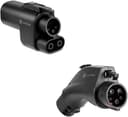
Lectron Vortex Plus NACS to CCS1 adapter
Lectron · NACS to CCS1 · 500 A
A NACS-to-CCS1 DC adapter with an interlock, certified to UL 2252 and tested by SGS, per Lectron. Rated 500 A and 1,000 V, IP67, for V3 and V4 Superchargers -- and only for cars whose automaker has approved Supercharger access.
What is good
- Certified to UL 2252, the standard written for EV adapters, per Lectron
- Interlock keeps the connection secure during DC charging
- IP67 dust and water rating
- Two-year warranty
What is not
- Only for cars whose automaker has approved Supercharger access
- V3 and V4 Superchargers only -- not V2, and not AC chargers
- Your automaker's own adapter, if it offers one, is the first choice
| Rating | 500 A / 1,000 V / 500 kW |
|---|---|
| Direction | NACS DC charger to a CCS1 port |
| Chargers | V3 and V4 Tesla Superchargers; not V2, not AC chargers |
| Vehicles | CCS1 EVs with approved automaker Supercharger access |
| Interlock | Built in |
| Heat | May reduce or pause charging in very hot conditions |
| Weather rating | IP67 |
| Certification | UL 2252, tested by SGS, per Lectron |
| Warranty | 2 years |
Skip this if: Skip it if your automaker supplies or sells its own NACS adapter for your car -- that part comes first -- or if your car already has a NACS port.
Specifications above are the manufacturer’s published figures. Source: Lectron. We have not tested this unit — see how we pick.
FAQ
Questions people actually ask
How fast is DC fast charging?
Can I install a DC fast charger at home?
What connector does DC fast charging use?
Is DC fast charging bad for the battery?
Sources
Where these numbers come from
- Electric Vehicle Charging Infrastructure: charging levels and connectors — U.S. Department of Energy, Alternative Fuels Data CenterAC Level 1 about 5 miles of range per hour at 1.9 kW; AC Level 2 about 25 miles per hour, 2.9 to 19.2 kW, on J1772 or J3400 (NACS); DC fast charging about 100 to 200+ miles per 30 minutes on CCS, CHAdeMO or J3400; CCS accepts Level 1, Level 2 and DC fast charging. Read 2026-09-27.
- Charging Electric Vehicles at Home — U.S. Department of Energy, Alternative Fuels Data CenterMost drivers charge overnight at home; residential costs depend on equipment and time of day; some utilities offer time-of-use rates; outdoor use is safe with outdoor-rated equipment; smarter Level 2 units add timers and monitoring. Read 2026-09-27.
- Lectron NACS to CCS Adapter with Interlock -- Vortex Plus, 500 A, 1,000 V, UL 2252 certified — LectronNACS-to-CCS1 DC fast charging adapter: 500 A, 1,000 V and UL 2252 certification.
Read next
Related reading
- Level 1, Level 2 and DC fast charging: which one you needLevel 1, Level 2 and DC fast charging with real speeds, and which you need at home.
- EV plug types, explainedJ1772, NACS, CCS and CHAdeMO: which plug your car has and which matters at home.
- The best NACS to CCS adapters for Tesla SuperchargersWhat to check before buying a Supercharger adapter, why UL 2252 matters, and two options compared.
- Home charging vs public chargingSpeed, cost and convenience compared, plus when public charging is genuinely the better plan.