Breakers
The best 50-amp breaker for an EV charger
Fifty amps is the circuit behind every NEMA 14-50 and every 40-amp charger. The right breaker is the one your panel accepts -- here is how to find it.
By Sawyer V. · Published September 10, 2026
How this page is funded: we earn a commission if you buy through our Amazon links, at no extra cost to you. It does not change what we recommend, and we say plainly when the honest answer is to buy nothing. Full disclosure.
Most home EV circuits are 50 amps, because that is what a NEMA 14-50 receptacle and a 40 A charger both call for. As with the 60-amp breaker, the best one is not a product you rank on features: it is the one your panel is built and listed to take.
What a 50-amp circuit is for
The sizing rule
An EV charger is a continuous load, so the circuit is rated at 125% of it
40 A x 1.25 = 50 A -- a standard breaker size
A 50 A receptacle circuit allows 50 x 0.8 = 40 A of continuous charging
The charger's installation manual states the required circuit and governs
| Setup | Circuit |
|---|---|
| A 40 A hardwired charger | 50 A |
| A NEMA 14-50 receptacle for a plug-in charger | 50 A |
| A NEMA 6-50 receptacle | 50 A |
| A 48 A hardwired charger | 60 A -- see the 60-amp breaker |
How to find the breaker your panel takes
- Find the label inside the panel door -- not behind the cover.
- Note the brand and the breaker families it lists. One brand can make several families that do not interchange.
- Check there is room for a two-pole breaker; capacity and a free slot are different things. Load calculation.
- Photograph the label and send it with your quote request. Hiring an electrician.
GFCI and the 14-50
A receptacle for a plug-in charger generally needs ground-fault protection under current code, and a GFCI breaker is one way to provide it. Many hardwired chargers carry their own ground-fault detection. Which your installation needs depends on how the charger connects and on the code edition your area enforces -- that is your electrician's decision.
If a GFCI breaker and a charger's own protection disagree, the result can be nuisance tripping. GFCI nuisance tripping covers how to work through it -- never by removing the protection.
A worked example: Square D QO
If your panel is a Square D QO load center, the 50-amp, two-pole GFCI part is the QO250GFI: Class A 6 mA ground-fault protection, 120/240 V, a 10 kA interrupting rating at 120 V, plug-in mounting, UL listed and CSA approved, per the distributor listing cited below.
If your panel is anything else, this part is wrong for it, however good it is. Every major panel family has its own 50 A two-pole equivalent, and the label tells your electrician which.
The Square D QO example
The 50 A breaker we can cite in full. It is only correct for a Square D QO panel.
1. Square D QO panels
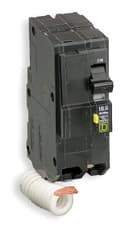
Square D QO250GFI 50 A GFCI breaker
Square D (Schneider Electric) · Panel breaker · 50 A
A 50-amp, two-pole GFCI breaker for Square D QO load centers -- the circuit a 40-amp charger or a NEMA 14-50 outlet needs, with Class A 6 mA ground-fault protection. Only correct if your panel is a QO.
What is good
- The circuit rating a 40 A charger or a NEMA 14-50 receptacle requires
- Ground-fault protection built into the breaker
- UL listed and CSA approved, per the distributor listing
What is not
- Only for Square D QO load centers
- A GFCI breaker plus a charger's own ground-fault detection can nuisance-trip
- Panel work is licensed -- not a part to fit yourself
| Rating | 50 A, 2-pole, 120/240 V |
|---|---|
| Ground-fault protection | Class A, 6 mA |
| Interrupting rating | 10 kA at 120 V |
| Mounting | Plug-in, Square D QO load centers |
| Size | 4.12 x 1.5 x 2.91 in |
| Listings | UL listed, CSA approved |
Skip this if: Skip it if your panel is not a Square D QO. A breaker has to be one your panel is listed to accept, and a QO breaker in another brand's panel is the wrong part.
Specifications above are the manufacturer’s published figures. Source: SimplyBreakers (distributor listing). We have not tested this unit — see how we pick.
FAQ
Questions people actually ask
What breaker does a NEMA 14-50 outlet need?
What size breaker does a 40 amp EV charger need?
Is a 50 amp breaker enough for a 48 amp charger?
Sources
Where these numbers come from
- QO250GFI - Square D - 50 Amp GFCI Circuit Breaker — SimplyBreakers (distributor listing)50 A, 2-pole, 120/240 V, 10 kA at 120 V interrupting rating, Class A 6 mA ground-fault protection, plug-in mounting for Square D QO load centers, dimensions, UL listed and CSA approved. Read 2026-09-10.
- NEC Article 625: EV charging equipment — WireRefContinuous-load rule behind every circuit figure on this page.
Read next
Related reading
- The best 60-amp breaker for an EV chargerWhy the best breaker is the one your panel is listed for, with a worked Square D QO example.
- The NEMA 14-50 outlet, explainedWhat a NEMA 14-50 is, the circuit it needs, its 40-amp charging limit, and what to specify.
- Why your EV charger keeps tripping the GFCI breakerWhy GFCI breakers trip on EV chargers and the safe sequence for diagnosing it.
- The best 40-amp EV chargersWhy 40 A is the sweet spot for most homes, and the units that do it well.