Breakers
The best 60-amp breaker for an EV charger
There is no universally best breaker. There is the one your panel is listed to accept, in the rating your charger needs. Here is how to find it.
By Sawyer V. · Published September 10, 2026
How this page is funded: we earn a commission if you buy through our Amazon links, at no extra cost to you. It does not change what we recommend, and we say plainly when the honest answer is to buy nothing. Full disclosure.
People search for "the best 60-amp breaker" expecting a ranking. The honest answer is shorter: the best one is the one your panel accepts. A breaker is not a free-standing product you choose on features -- it is a part of your panel, and a panel is listed to work with specific breakers.
Why 60 amps
The sizing rule
An EV charger is a continuous load, so the circuit is rated at 125% of it
48 A x 1.25 = 60 A -- a standard breaker size
40 A x 1.25 = 50 A; 32 A x 1.25 = 40 A
The charger's installation manual states the required circuit and governs
| Charger | Breaker |
|---|---|
| 32 A | 40 A |
| 40 A | 50 A |
| 48 A | 60 A |
| 50 A | 70 A |
How to find the breaker your panel takes
- Open the panel door -- not the cover -- and find the label, usually inside the door.
- Read the brand and model. The label lists the breaker types the panel is listed to accept.
- Note that one brand can make several incompatible families. The label, not the brand name, tells you which one yours takes.
- Photograph the label and send it with your quote request -- what to send an electrician.
GFCI or not
A receptacle for a plug-in charger generally needs ground-fault protection under current code. Many hardwired chargers include their own ground-fault detection. Which your installation needs depends on how the charger connects and on which edition of the electrical code your area enforces -- that is your electrician's call.
One practical consequence: a GFCI breaker plus a charger's own ground-fault detection can nuisance-trip. GFCI nuisance tripping covers how to work through it -- never by removing the protection.
A worked example: Square D QO
If your panel is a Square D QO, the 60-amp, two-pole GFCI part is the QO260GFI: 6 mA ground-fault protection, 120/240 V, a 10 kA interrupting rating, plug-on mounting and a pigtail neutral. The bolt-on version is the QOB260GFI.
If your panel is anything else, this part is wrong for it, however good it is. The equivalent exists for other panel families -- your electrician will know it from the label.
The Square D QO example
The one breaker we can cite fully. It is only correct for a Square D QO panel.
1. Square D QO panels
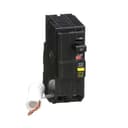
Square D QO260GFI 60 A GFCI breaker
Square D (Schneider Electric) · Panel breaker · 60 A
A 60-amp, two-pole GFCI breaker for Square D QO panels -- the circuit a 48-amp charger needs, with 6 mA ground-fault protection built in. Only correct if your panel is a QO.
What is good
- The exact circuit rating a 48 A charger requires
- Ground-fault protection built into the breaker
- A bolt-on version, the QOB260GFI, is listed for QOB panelboards
What is not
- Only for Square D QO panels
- A GFCI breaker plus a charger's own ground-fault detection can nuisance-trip
- Panel work is licensed -- not a part to fit yourself
| Rating | 60 A, 2-pole, 120/240 VAC |
|---|---|
| Ground-fault protection | GFCI, 6 mA |
| Interrupting rating | 10 kA |
| Mounting | Plug-on, Square D QO |
| Neutral | Pigtail |
| Bolt-on version | QOB260GFI |
Skip this if: Skip it if your panel is not a Square D QO. A breaker has to be one your panel is listed for, and a QO breaker in another brand's panel is the wrong part.
Specifications above are the manufacturer’s published figures. Source: GMES (distributor listing), SimplyBreakers (distributor listing). We have not tested this unit — see how we pick.
FAQ
Questions people actually ask
What is the best 60 amp breaker for an EV charger?
Does an EV charger need a GFCI breaker?
What size breaker does a 48 amp charger need?
Can I use any brand of breaker in my panel?
Sources
Where these numbers come from
- Square D QO260GFI 60A 2-pole GFCI 6mA 120/240V 10kA plug-on QO circuit breaker — GMES (distributor listing)Rating, poles, 6 mA trip level, voltage, 10 kA interrupting rating, plug-on QO mounting and pigtail neutral. Fetched 2026-09-10.
- Square D QOB260GFI 60 A GFCI circuit breaker — SimplyBreakers (distributor listing)The bolt-on QO variant. Fetched 2026-09-10.
- NEC Article 625: EV charging equipment — WireRefContinuous-load rule behind every circuit figure on this page.
Read next
Related reading
- What size breaker and wire does an EV charger need?Breaker and wire size for every charger amperage, with the 125% rule worked through.
- Why your EV charger keeps tripping the GFCI breakerWhy GFCI breakers trip on EV chargers and the safe sequence for diagnosing it.
- Hiring an electrician for your EV chargerThe questions to ask, what a comparable quote contains, and the red flags.
- The best 48-amp EV chargersThe fastest home tier: 48-amp picks, the 60-amp circuit they need, and who should skip it.
- The best 50-amp breaker for an EV chargerThe breaker behind a 14-50 or a 40 A charger: why your panel decides, and a Square D QO example.
- 50 or 60 amp breaker for an EV charger?40 A chargers and 14-50 outlets take 50 A; 48 A units take 60 A. What the extra 10 amps buys.
- The best EV chargers for a 60-amp circuitThe 48 A chargers that use a full 60 A circuit, and what that circuit asks of your panel.