Load calculation
Can your electrical panel take an EV charger?
The arithmetic that decides whether your install is straightforward or expensive. Here is what it involves and how to get a rough answer before you call anyone.
By Sawyer V. · Published September 8, 2026
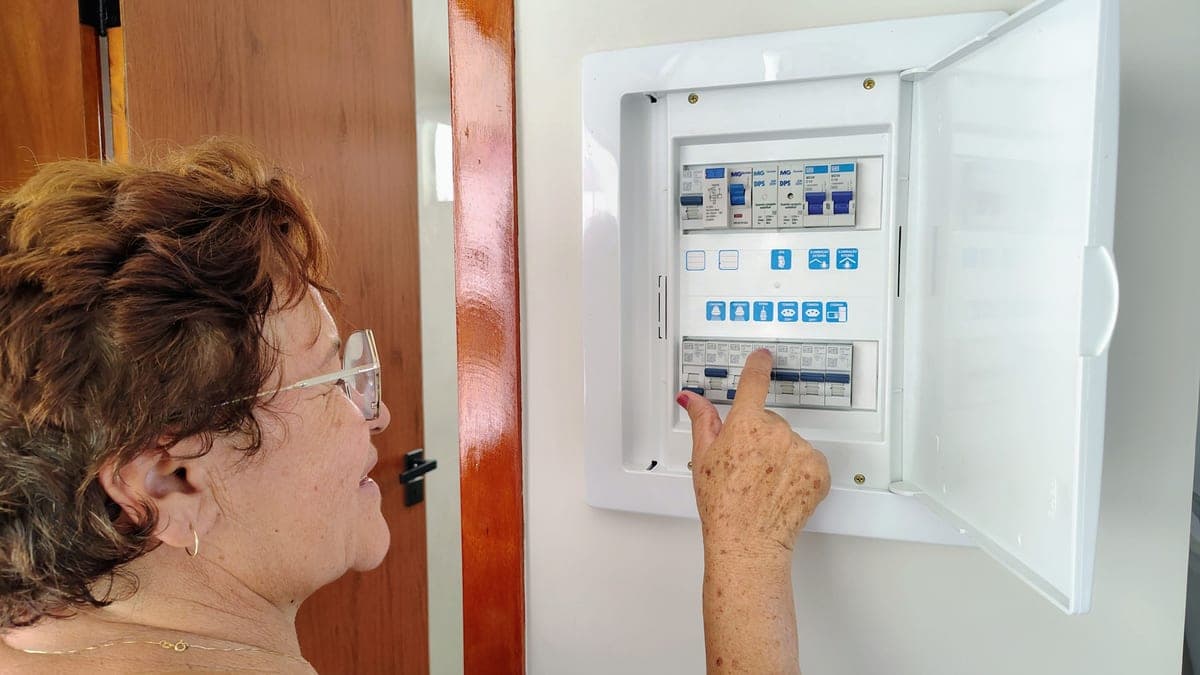
A load calculation works out how much electrical demand your home already has, so an electrician can tell whether adding a 40- or 60-amp circuit will exceed your service. It is the single most consequential piece of arithmetic in this whole project, because its answer determines whether you spend $1,200 or $5,000.
The first thing to check: free slots
Open the panel door. A double-pole breaker for a charger needs two adjacent free slots. If there are none, you are looking at a subpanel or a panel replacement regardless of what the calculation says -- published figures put a subpanel at $500 to $1,500.
Tandem or half-height breakers can sometimes free up space, but not every panel accepts them and not in every position. Your electrician will know.
The second thing: your service size
The main breaker at the top of the panel is labeled with your service size. In practical terms:
| Service | Typical outlook |
|---|---|
| 200 A | Usually fine. Most homes with 200 A service and gas heat can add a 48 A charger without difficulty. |
| 150 A | Often fine, depending on what else is electric. Worth a calculation. |
| 100 A | Frequently tight, especially with electric heat, an electric range, an electric water heater or air conditioning. A calculation is essential, and load management may be the answer. |
| 60 A or less | An upgrade is very likely required. |
What goes into the calculation
In outline, an electrician accounts for:
- The general lighting and receptacle load, derived from your home's square footage.
- Fixed appliances -- range, dryer, water heater, dishwasher, disposal.
- Heating and cooling, taking the larger of the two, since you do not run both at once.
- The new EV charger at 125% of its rating, because it is a continuous load.
- Demand factors from the code, which recognize that not everything runs at once.
There is also an accepted method based on your actual measured peak demand from utility data, which often gives a more favorable answer than the standard calculation on an older home with a modest real load. Ask about it if the standard method says you need an upgrade -- it is sometimes the difference between a $1,200 job and a $4,000 one.
The alternative to upgrading
If the calculation says your service cannot carry a full-rate charger, you have options short of a service upgrade:
- Install a smaller charger. A 32-amp unit on a 40-amp circuit adds about 270 miles overnight and needs far less headroom.
- Use load management. A device that sheds charging when the rest of the house draws heavily lets you add a charger without adding capacity -- load management explained.
- Charge on a schedule that avoids your household's peak, which is good practice anyway.
All three are cheaper than an upgrade. Ask your electrician about them explicitly, because a quote for a service upgrade is a bigger job and it will not always be offered as an alternative unprompted.
FAQ
Questions people actually ask
What is an electrical load calculation for an EV charger?
Can a 100-amp panel handle an EV charger?
What if my panel has no free breaker slots?
Is there a way to avoid a service upgrade?
Sources
Where these numbers come from
- How to size an EV charger circuit, NEC 220.57 and Article 625 — TestTalk HQPublished overview of the load-calculation methods referenced above. Fetched 2026-09-08.
- Level 2 EV charger installation cost in 2026 — SimpleSwitchPublished subpanel and service-upgrade cost ranges. Fetched 2026-09-08.
Read next
Related reading
- Do you need a panel upgrade for an EV charger?When a panel upgrade is genuinely needed, what it costs, and the cheaper alternatives.
- Load management: charging without a panel upgradeHow load management avoids a panel upgrade, what it costs in speed, and when to use it.
- How many amps do you actually need?Three checks that determine your charger amperage, and why the smallest one wins.
- What size breaker and wire does an EV charger need?Breaker and wire size for every charger amperage, with the 125% rule worked through.
- The best EV chargers for a 100-amp panelChargers that fit a 100-amp service, and the three ways to avoid an upgrade.
- The best EV chargers for a 200-amp panelWhy 200-amp service often supports a 48 A charger, what the load calculation decides, and three picks.
- The best EV chargers for a 150-amp panelSizing the circuit to a 150-amp service, two adjustable picks, and load management when it is tight.