Plug-in picks
The best plug-in EV chargers
If you rent, might move, or already have a 240-volt outlet in the garage, a plug-in charger is the sensible buy. Here are the ones worth plugging in.
By Sawyer V. · Published September 10, 2026
How this page is funded: we earn a commission if you buy through our Amazon links, at no extra cost to you. It does not change what we recommend, and we say plainly when the honest answer is to buy nothing. Full disclosure.
There is a persistent internet opinion that hardwiring is simply correct and plugging in is a compromise. It is not that simple. A plug-in charger you can take to your next house, or swap yourself when it fails outside warranty, has real value that does not appear on a spec sheet.
Plug-in picks
Ranked for a first home charger. Every row jumps to the full write-up below.
| # | Product | Best for | Max output | Price |
|---|---|---|---|---|
| 1 |  ChargePoint Home FlexHomes with an uncertain panel. J1772, 23 ft cable. ChargePoint Home FlexHomes with an uncertain panel. J1772, 23 ft cable. | Homes with an uncertain panel | 50 A12 kW | $549.00 · View on Amazon#ad how we are funded · price as of October 27, 2026 |
| 2 |  Grizzl-E ClassicHarsh weather and no app. J1772, 24 ft cable. Grizzl-E ClassicHarsh weather and no app. J1772, 24 ft cable. | Harsh weather and no app | 40 A9.6 kW | $299.99 · View on Amazon#ad how we are funded · price as of October 27, 2026 |
| 3 |  Autel MaxiCharger AC HomeLong reach outdoors. J1772, 25 ft cable. Autel MaxiCharger AC HomeLong reach outdoors. J1772, 25 ft cable. | Long reach outdoors | 50 A12 kW | $470.00 · View on Amazon#ad how we are funded · price as of October 27, 2026 |
The 40-amp ceiling, and why it exists
Where the limit comes from
A NEMA 14-50 receptacle sits on a 50 A circuit
The code limits a continuous load to 80% of its circuit
50 x 0.8 = 40 A = 9.6 kW
About 34 miles of range per hour, or 340 miles over a ten-hour night.
That is not a product limitation any manufacturer can engineer around -- it applies to every plug-in unit sold. If you need more, you are hardwiring: the hardwired picks.
Who should plug in
- Renters. You are not paying to improve someone else's property, and the charger leaves with you.
- Anyone who might move within a few years. The unit is an asset, not a fixture.
- Homes with an existing 240 V outlet in reach of the car -- a dryer, workshop or RV socket. Have an electrician confirm the circuit first.
- Anyone who wants to swap the charger later without booking an electrician.
The one thing to get right
The receptacle. A NEMA 14-50 was designed for appliances that get plugged in once and left, not for a device drawing 40 amps continuously for hours, repeatedly. Builder-grade receptacles are a known failure point in this application.
Two more habits: do not treat the charger as something to unplug daily -- these receptacles are rated for a limited number of insertion cycles -- and check the faceplate occasionally. Warm is a warning.
The plug-in chargers in detail
Three units sold in plug-in configurations, each with the case against it.
1. Homes with an uncertain panel
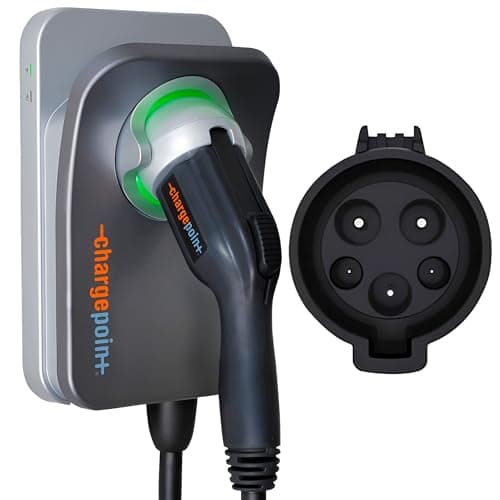
ChargePoint Home Flex
ChargePoint · J1772 · 50 A / 12 kW · 23 ft cable
The most adjustable unit here. It can be set anywhere from 16 A to 50 A, which makes it the one to buy when you do not yet know what your panel will allow.
What is good
- Six selectable amperage settings from 16 A to 50 A
- Sold in both hardwired and NEMA 14-50 versions
- Rated for indoor or outdoor installation
- The app is mature and does not require a subscription
What is not
- 23 ft is a foot shorter than the longest cables in this group
- The 50 A setting needs a bigger circuit than most panels have spare
| Maximum output | 50 A / 12 kW at 240 V |
|---|---|
| Amperage settings | 16, 24, 32, 40, 48 or 50 A |
| Connector | SAE J1772 |
| Cable | 23 ft |
| Installation | Hardwired or NEMA 14-50 |
| Certification | UL listed, Energy Star |
| Warranty | 3 years |
Skip this if: Skip it if your circuit is already fixed and you just want the cheapest safe 40 A unit. You are paying for flexibility you will not use.
Specifications above are the manufacturer’s published figures. Source: ChargePoint, ChargePoint. We have not tested this unit — see how we pick.
2. Harsh weather and no app
Grizzl-E Classic
United Chargers · J1772 · 40 A / 9.6 kW · 24 ft cable
A cast-aluminum box with no app, no account and no firmware to update. If you want a charger that behaves like an appliance, this is the one.
What is good
- Cast aluminum NEMA 4 / IP67 enclosure, built for outdoor mounting
- No app, no account, no network dependency
- Amperage is set with physical switches, not software
- Protections for over-current, over-voltage, ground fault and over-temperature
What is not
- 40 A ceiling, slower than the 48 A units if your panel can take more
- No scheduling, so off-peak charging has to be set in the car
- The cold-flexible 24 ft cable is only on the Extreme Edition
| Maximum output | 40 A / 9.6 kW at 240 V |
|---|---|
| Adjustable | 16, 24, 32 or 40 A |
| Connector | SAE J1772 |
| Cable | 24 ft on the Extreme Edition |
| Enclosure | Cast aluminum, NEMA 4 / IP67 |
| Certification | UL certified |
| Warranty | 3 years |
Skip this if: Skip it if you want scheduled charging or energy tracking in an app. The Classic deliberately has neither.
Specifications above are the manufacturer’s published figures. Source: United Chargers, InsideEVs. We have not tested this unit — see how we pick.
3. Long reach outdoors
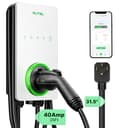
Autel MaxiCharger AC Home
Autel Energy · J1772 · 50 A / 12 kW · 25 ft cable
The 25 ft cable is the longest in this group, and the NEMA 4 case plus a cold-flexible cord make it the easiest unit to live with on an exposed outside wall.
What is good
- 25 ft cable, the longest of the wall units here
- Sold in NEMA 14-50, NEMA 6-50 and hardwired versions
- NEMA Type 4 enclosure rated for rain, snow, hail and sleet
- Wi-Fi and Bluetooth, so it still works if the Wi-Fi drops
What is not
- The 50 A version is hardwired only
- The app has more features than a first-time owner needs
| Maximum output | 50 A / 12 kW hardwired; 40 A / 9.6 kW plug-in |
|---|---|
| Connector | SAE J1772 |
| Cable | 25 ft |
| Enclosure | NEMA Type 4 |
| Certification | Tested to UL standards by CSA |
| Warranty | 3 years |
Skip this if: Skip it if your parking spot is right next to the panel. You are paying for cable you will coil up and never use.
Specifications above are the manufacturer’s published figures. Source: Autel Energy. We have not tested this unit — see how we pick.
What we would do
ChargePoint Home Flex if you may hardwire it later or your circuit is uncertain -- it is sold both ways. Grizzl-E if you want a metal box with no app that you can unplug and carry. Autel if your run is long and the 25-foot cable is what decides it.
FAQ
Questions people actually ask
What is the best plug-in EV charger?
Why do plug-in EV chargers max out at 40 amps?
Can I install a plug-in EV charger myself?
Is it safe to plug an EV charger into a dryer outlet?
Sources
Where these numbers come from
- ChargePoint Home Flex specifications and ordering information — ChargePoint
- Grizzl-E Classic product specifications — United Chargers
- MaxiCharger AC Elite Home 40A specifications — Autel Energy
- NEC Article 625: EV charging equipment — WireRefContinuous-load rule behind every circuit figure on this page.
Read next
Related reading
- Hardwired or plug-in: which EV charger install is right?NEMA 14-50 or hardwired: amperage limits, cost, portability and what inspectors prefer.
- The best NEMA 14-50 outlet for EV chargingWhich NEMA 14-50 receptacle to specify, and why the cheap one is a false economy.
- The best hardwired EV chargersHardwired chargers compared: why they reach 48 A, and which unit suits which garage.
- The NEMA 14-50 outlet, explainedWhat a NEMA 14-50 is, the circuit it needs, its 40-amp charging limit, and what to specify.
- The best EV chargers for a NEMA 6-50 outletChargers sold with a 6-50 plug, the portable that reaches one, and the 40 A the circuit allows.