Hardwired picks
The best hardwired EV chargers
Hardwiring is the only way to get past 40 amps at home, and it removes the one component most likely to overheat. Here is what to bolt to the wall.
By Sawyer V. · Published September 10, 2026
How this page is funded: we earn a commission if you buy through our Amazon links, at no extra cost to you. It does not change what we recommend, and we say plainly when the honest answer is to buy nothing. Full disclosure.
If you own the home and the charger is going to live on that wall for a decade, hardwire it. That is the short version, and the reasoning below is mostly about how much the extra amperage is actually worth to you.
Hardwired picks
Ranked for a first home charger. Every row jumps to the full write-up below.
| # | Product | Best for | Max output | Price |
|---|---|---|---|---|
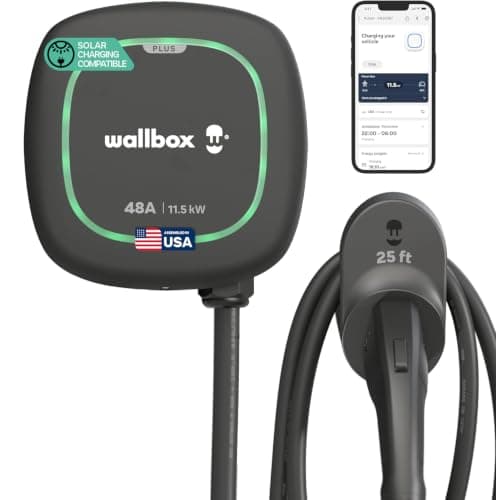
| 1 |  Wallbox Pulsar PlusTight wall space. J1772, 25 ft cable. Wallbox Pulsar PlusTight wall space. J1772, 25 ft cable. | Tight wall space | 48 A11.5 kW | $699.00 · View on Amazon#ad how we are funded · price as of October 27, 2026 |
| 2 | Emporia Level 2 EV Charger (Classic)A first charger, hardwired. J1772, 25 ft cable. | A first charger, hardwired | 48 A11.5 kW | Check price on Amazon#ad how we are funded |
| 3 | Tesla Wall Connector (Gen 3)Tesla owners. NACS, 24 ft cable. | Tesla owners | 48 A11.5 kW | Check price on Amazon#ad how we are funded |
| 4 |  Autel MaxiCharger AC HomeLong reach outdoors. J1772, 25 ft cable. Autel MaxiCharger AC HomeLong reach outdoors. J1772, 25 ft cable. | Long reach outdoors | 50 A12 kW | $470.00 · View on Amazon#ad how we are funded · price as of October 27, 2026 |
Why hardwiring gets you 48 amps and a plug does not
A NEMA 14-50 receptacle sits on a 50-amp circuit, and the electrical code limits a continuous load to 80% of its circuit. That puts a hard ceiling of 40 amps on anything plugged into one, no matter what the charger is capable of.
The ceiling, both ways
Plug-in on a 50 A circuit: 50 x 0.8 = 40 A = 9.6 kW
Hardwired on a 60 A circuit: 60 x 0.8 = 48 A = 11.5 kW
At 3.5 mi/kWh that is about 34 vs about 40 miles of range per hour
Over a ten-hour night: roughly 340 miles against 400.
Both numbers are far beyond a normal day's driving. The honest case for 48 amps is a large battery, regular towing, or two cars sharing one charger -- not a general preference for bigger numbers. Work it through in how many amps do you need.
The reason electricians quietly prefer it
A plug and receptacle is a mechanical joint carrying 40 amps continuously for hours, night after night. It is the part of a plug-in installation that fails, and it fails slowly: the terminal loosens, resistance rises, heat builds, and the first sign is a warm faceplate.
A hardwired unit has no such joint. The conductors land directly on the charger's terminals and are torqued to the manufacturer's specification once. If you are going plug-in anyway, at least specify a proper receptacle -- the ones worth asking for.
What your panel has to give up
| Charger | Circuit | Panel implication |
|---|---|---|
| 40 A | 50 A | Comfortable on a healthy 150-200 A service |
| 48 A | 60 A | Needs genuine headroom; a full 100 A panel will struggle |
| 50 A | 70 A | Uncommon at home, and rarely worth the circuit |
The hardwired chargers in detail
Four units, three of which are hardwired-capable and one hardwired-only. Each entry ends with the case against it.
1. Tight wall space

Wallbox Pulsar Plus
Wallbox · J1772 · 48 A / 11.5 kW · 25 ft cable
The smallest 48 A unit here at roughly 7.8 by 7.9 inches, which matters more than it sounds when the only free wall is beside a door.
What is good
- Smallest body of the 48 A units, under 8 inches square
- Current configurable in steps from 6 A to 48 A
- NEMA Type 4 enclosure, rated down to -22 F
- Weighs 4.4 lb without the cable, so mounting is simple
What is not
- Hardwired only at 48 A, with no plug-in version at full output
- Setup runs through the app, which some owners find fussy
| Maximum output | 48 A / 11.5 kW at 240 V |
|---|---|
| Configurable current | 6 A to 48 A |
| Connector | SAE J1772 |
| Cable | 25 ft |
| Body size | 7.8 x 7.9 x 3.9 inches without the cable |
| Operating temperature | -22 F to 104 F |
| Certification | UL 2594, UL 2231 |
| Warranty | 3 years |
Skip this if: Skip it if you want a plug-in unit you can take with you. The 48 A Pulsar Plus is hardwired.
Specifications above are the manufacturer’s published figures. Source: Wallbox, Wallbox. We have not tested this unit — see how we pick.
2. A first charger, hardwired
Emporia Level 2 EV Charger (Classic)
Emporia · J1772 · 48 A / 11.5 kW · 25 ft cable
The safe default for a first home charger: 48 amps hardwired, a genuinely long cable, a NEMA 4 outdoor-rated case, and no subscription attached to the app.
What is good
- 48 A hardwired is the fastest tier most homes can realistically support
- 25 ft of cable reaches across a two-car garage without a fight
- NEMA Type 4 enclosure is rated for outdoor mounting
- Energy monitoring in the app with no subscription
What is not
- Drops to 40 A if you use the NEMA 14-50 plug rather than hardwiring
- The app is the only way to change the amperage setting
| Maximum output | 48 A / 11.5 kW at 240 V (hardwired) |
|---|---|
| Plug-in output | 40 A with the NEMA 14-50 plug |
| Connector | SAE J1772 |
| Cable | 25 ft |
| Enclosure | NEMA Type 4, indoor or outdoor |
| Certification | UL listed, Energy Star |
| Warranty | 3 years |
Skip this if: Skip it if you want a unit with no app or network connection at all. The Grizzl-E Classic is the simpler machine.
Specifications above are the manufacturer’s published figures. Source: Emporia Energy. We have not tested this unit — see how we pick.
3. Tesla owners
Tesla Wall Connector (Gen 3)
Tesla · NACS · 48 A / 11.5 kW · 24 ft cable
48 A, a 24 ft cable and a four-year warranty, the longest in this group. The catch is the connector: Gen 3 is NACS, so a J1772 car needs an adapter.
What is good
- Four-year warranty, longer than the three-year standard here
- Up to six units can share one circuit for a two-EV household
- Wi-Fi with over-the-air firmware updates
- Scheduled departure and charge stats live in the Tesla app
What is not
- NACS connector, so a J1772 car needs an adapter on every charge
- Hardwired only
| Maximum output | 48 A / 11.5 kW at 240 V |
|---|---|
| Connector | NACS (Tesla) |
| Cable | 24 ft |
| Installation | Hardwired |
| Power sharing | Up to six units can be linked |
| Warranty | 4 years |
Skip this if: Skip it if you drive a J1772 car and do not want to keep an adapter on the cable. Buy a J1772 unit instead.
Specifications above are the manufacturer’s published figures. Source: Tesla, Tesla. We have not tested this unit — see how we pick.
4. Long reach outdoors
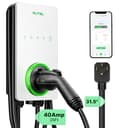
Autel MaxiCharger AC Home
Autel Energy · J1772 · 50 A / 12 kW · 25 ft cable
The 25 ft cable is the longest in this group, and the NEMA 4 case plus a cold-flexible cord make it the easiest unit to live with on an exposed outside wall.
What is good
- 25 ft cable, the longest of the wall units here
- Sold in NEMA 14-50, NEMA 6-50 and hardwired versions
- NEMA Type 4 enclosure rated for rain, snow, hail and sleet
- Wi-Fi and Bluetooth, so it still works if the Wi-Fi drops
What is not
- The 50 A version is hardwired only
- The app has more features than a first-time owner needs
| Maximum output | 50 A / 12 kW hardwired; 40 A / 9.6 kW plug-in |
|---|---|
| Connector | SAE J1772 |
| Cable | 25 ft |
| Enclosure | NEMA Type 4 |
| Certification | Tested to UL standards by CSA |
| Warranty | 3 years |
Skip this if: Skip it if your parking spot is right next to the panel. You are paying for cable you will coil up and never use.
Specifications above are the manufacturer’s published figures. Source: Autel Energy. We have not tested this unit — see how we pick.
What we would do
Wallbox Pulsar Plus if wall space is tight -- it is hardwired-only at 48 amps and the smallest body here. Emporia if you want 48 amps and a long cable without the premium. Tesla Wall Connector if every car that will ever use it is a Tesla, for the four-year warranty. Autel if your run is long and the 25-foot cable decides it.
If any of that made you reconsider, hardwired vs plug-in argues the other side properly, and the best plug-in chargers covers the alternative.
FAQ
Questions people actually ask
Is a hardwired EV charger better than a plug-in one?
Why can a hardwired charger reach 48 amps?
Do I need an electrician to hardwire an EV charger?
Can I convert a plug-in charger to hardwired later?
Sources
Where these numbers come from
- Pulsar Plus datasheet — Wallbox
- Emporia Level 2 EV Charger specifications — Emporia Energy
- Wall Connector support page — Tesla
- MaxiCharger AC Elite Home 40A specifications — Autel Energy
- NEC Article 625: EV charging equipment — WireRefContinuous-load rule behind every circuit figure on this page.
Read next
Related reading
- Hardwired or plug-in: which EV charger install is right?NEMA 14-50 or hardwired: amperage limits, cost, portability and what inspectors prefer.
- The best plug-in EV chargersPlug-in chargers for a NEMA 14-50: portable, swappable, and capped at 40 amps.
- The best 48-amp EV chargersThe fastest home tier: 48-amp picks, the 60-amp circuit they need, and who should skip it.
- What size breaker and wire does an EV charger need?Breaker and wire size for every charger amperage, with the 125% rule worked through.
- Leviton EV Series review48 A hardwired, an 18 ft cord, NEMA Type 3R and optional RFID: who Leviton's charger suits.
- Leviton EV480 vs Emporia ClassicRFID access control and a 122 F rating, against a longer cable and a plug-in option.
- Grizzl-E Ultimate 80A review80 A and 19.2 kW, hardwired and adjustable in eight steps. What it asks of your panel and your car.
- DEWALT 48 A EV charger review48 A hardwired with a 25 ft cable, an LCD screen and an app. What DEWALT publishes, and what it omits.