Receptacles
The best NEMA 14-50 outlet for EV charging
The cheapest part of a plug-in installation is also the one that fails. Spending twenty more dollars here is the best value in the whole project.
By Sawyer V. · Published September 10, 2026
How this page is funded: we earn a commission if you buy through our Amazon links, at no extra cost to you. It does not change what we recommend, and we say plainly when the honest answer is to buy nothing. Full disclosure.
A NEMA 14-50 was designed for an electric range: a device plugged in once when the kitchen was fitted and left alone for fifteen years. An EV charger asks something completely different of the same socket -- 40 amps continuously, for hours, night after night, plus the occasional unplugging.
That mismatch is why melted 14-50 receptacles are a recurring topic in EV owner forums, and why every electrician who has fitted a few of these has an opinion about which one to use.
Receptacles worth specifying
Ranked for a first home charger. Every row jumps to the full write-up below.
| # | Product | Best for | Max output | Price |
|---|---|---|---|---|
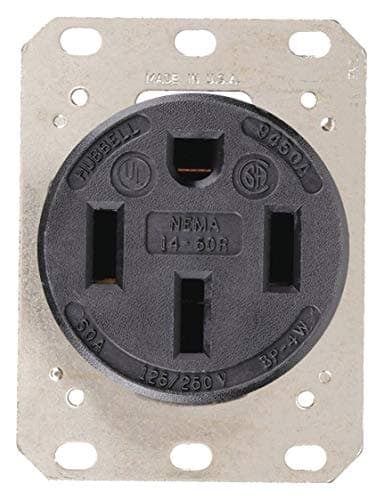
| 1 |  Hubbell HBL9450A NEMA 14-50 receptacleThe receptacle to specify. NEMA 14-50. Hubbell HBL9450A NEMA 14-50 receptacleThe receptacle to specify. NEMA 14-50. | The receptacle to specify | 50 A12 kW | $63.99 · View on Amazon#ad how we are funded · price as of October 27, 2026 |
| 2 |  Leviton 1450R EV charging receptacleThe EV-specific alternative. NEMA 14-50. Leviton 1450R EV charging receptacleThe EV-specific alternative. NEMA 14-50. | The EV-specific alternative | 50 A12 kW | $42.50 · View on Amazon#ad how we are funded · price as of October 27, 2026 |
What actually fails, and why
Not the plastic, and not the rating. The terminal -- the point where your 6 AWG conductor is clamped to the receptacle's contact.
- A light-duty terminal makes a smaller contact patch with the conductor.
- Under 40 amps continuous, that patch runs warmer than a large one would.
- Warm metal oxidizes; oxidized contacts have more resistance; more resistance means more heat.
- This runs away over months, which is exactly why nobody notices until the faceplate is discolored.
Industrial-grade receptacles address it directly: full-size brass contacts and a clamping or compression terminal that grips the whole conductor. The Leviton 1450R publishes a 75 in-lb termination torque, which is the kind of number that only appears on a part designed to stay tight.
What to tell your electrician
| Ask for | Why |
|---|---|
| Industrial or heavy-duty grade 14-50 | Full-size contacts and a clamping terminal, not a builder-grade screw. |
| Torqued to the manufacturer's spec | Loose terminations are the single most common cause of heating. |
| A weather-rated box with an in-use cover, outdoors | The bubble-style cover that closes over a plugged-in cord, not the flap kind. |
| GFCI protection where the code requires it | Standard for these circuits. If it nuisance-trips. |
| A cover plate that matches the opening | The 1450R uses a wider 2.465-inch opening than some older plates. |
Watch the model number, not the brand
This matters more than usual here. Manufacturers sell both builder-grade and industrial-grade 14-50s, and the model numbers are the only thing distinguishing them on a listing. Leviton's heavy-duty EV receptacle is the 1450R; its older, much lighter-duty 279 series is a different part with a different construction. Buying "a Leviton 14-50" is not a specification.
Signs to act on
- A warm or hot faceplate or plug after a charging session.
- Discoloration or scorching around the slots.
- A burning or hot-plastic smell near the outlet.
- A plug that has become loose in the socket.
Any of these means stop using the circuit and call an electrician. Charging safety covers the rest.
The receptacles in detail
Two industrial-grade options. Both are wired in by an electrician -- neither is a part you fit yourself.
1. The receptacle to specify
Hubbell HBL9450A NEMA 14-50 receptacle
Hubbell Wiring Device-Kellems · NEMA 14-50 · 50 A / 12 kW
The industrial-grade 14-50 electricians specify when they know the circuit will feed an EV charger every night. Full-size brass contacts and a clamping terminal, not the stab-and-hope design of a builder-grade outlet.
What is good
- Industrial grade, with the clamping terminal design that keeps a high-current connection tight
- Accepts 10 through 4 AWG, so it fits whatever conductor your run needs
- UL listed and CSA certified, with a published file number you can look up
- Weather-resistant rated, which matters for a garage or an outdoor box
What is not
- Costs several times a builder-grade 14-50, which is the entire point
- Installation is licensed electrical work -- this is not a part you fit yourself
- No cover plate included on the single pack
| Rating | 50 A, 125/250 V, 12,500 W maximum |
|---|---|
| Configuration | NEMA 14-50R, 3-pole, 4-wire grounding |
| Wire range | 10 to 4 AWG |
| Grade | Industrial |
| Certification | UL listed (file E2186), CSA certified |
| Standard | NEMA WD-6 compliant |
Skip this if: Skip it only if your charger is being hardwired -- then you do not need a receptacle at all, and hardwiring is the more durable answer.
Specifications above are the manufacturer’s published figures. Source: Hubbell Wiring Device-Kellems. We have not tested this unit — see how we pick.
2. The EV-specific alternative
Leviton 1450R EV charging receptacle
Leviton · NEMA 14-50 · 50 A / 12 kW
Leviton's heavy-duty 14-50 designed specifically for EV duty -- long charge sessions and repeated insertions -- rather than for a range that gets plugged in once a decade.
What is good
- Marketed and built specifically for EV duty rather than adapted from an appliance outlet
- Heavy-gauge copper contacts with pressure-wire terminals
- High termination torque spec (75 in-lb), which is what keeps the joint cool
- Same compression-type connectors as the other industrial receptacles
What is not
- Not the same product as Leviton's cheaper 279 series -- check the model number before buying
- Uses the wider 2.465-inch cover plate opening, so your plate has to match
- Installation is licensed electrical work
| Rating | 50 A, 125/250 V |
|---|---|
| Configuration | NEMA 14-50R, 3-pole, 4-wire |
| Contacts | Heavy-gauge copper, pressure-wire terminals |
| Termination torque | 75 in-lb |
| Cover plate opening | 2.465" |
| Designed for | Extended charge times and frequent insertions |
Skip this if: Skip it if your electrician already stocks and prefers the Hubbell. Both are industrial-grade; there is no reason to argue them out of the one they torque correctly by habit.
Specifications above are the manufacturer’s published figures. Source: Leviton. We have not tested this unit — see how we pick.
FAQ
Questions people actually ask
What is the best NEMA 14-50 outlet for an EV charger?
Why do NEMA 14-50 outlets melt with EV chargers?
Is an expensive 14-50 receptacle worth it?
Can I install a NEMA 14-50 outlet myself?
What is the difference between the Leviton 279 and the 1450R?
Sources
Where these numbers come from
- HBL9450A straight blade receptacle, industrial grade, 50 A 125/250 V 14-50R — Hubbell Wiring Device-KellemsRating, configuration, wire range and certifications. Fetched 2026-09-10.
- 50 Amp EV charging receptacle/outlet, heavy duty, 1450R — LevitonRating, contact construction, termination torque and EV-duty design intent. Fetched 2026-09-10.
- NEC Article 625: EV charging equipment — WireRefContinuous-load rule and receptacle requirements.
Read next
Related reading
- Outdoor EV charging: what needs a coverWhy a plug-in outdoor install needs an extra-duty 2-gang while-in-use cover, why a 1-gang bubble cover will not fit, and what the charger itself needs.
- The NEMA 14-50 outlet, explainedWhat a NEMA 14-50 is, the circuit it needs, its 40-amp charging limit, and what to specify.
- Hardwired or plug-in: which EV charger install is right?NEMA 14-50 or hardwired: amperage limits, cost, portability and what inspectors prefer.
- The best plug-in EV chargersPlug-in chargers for a NEMA 14-50: portable, swappable, and capped at 40 amps.
- What size breaker and wire does an EV charger need?Breaker and wire size for every charger amperage, with the 125% rule worked through.
- EV charger accessories: worth it, or skip itWhich EV accessories earn their place, which are situational, and which to skip.
- The best NEMA 6-50 outlets for EV chargingIndustrial-grade 6-50 receptacles, the chargers that use them, and the circuit behind them.
- The best 50-amp breaker for an EV chargerThe breaker behind a 14-50 or a 40 A charger: why your panel decides, and a Square D QO example.
- Leviton EV Series review48 A hardwired, an 18 ft cord, NEMA Type 3R and optional RFID: who Leviton's charger suits.