Start here
Your EV charging starter kit
Three purchases cover almost every first home charging setup, and one of them you may already own. Here is the short shopping list, in order.
By Sawyer V. · Published September 10, 2026
How this page is funded: we earn a commission if you buy through our Amazon links, at no extra cost to you. It does not change what we recommend, and we say plainly when the honest answer is to buy nothing. Full disclosure.
The EV accessory aisle is long, and a new owner can easily spend several hundred dollars on things they do not need. The genuine starter kit is short. This is the shopping list, in the order to think about it. For the order to *do* things in -- panel check, quotes, permit -- see first home charging setup.
The three items
Ranked for a first home charger. Every row jumps to the full write-up below.
| # | Product | Best for | Max output | Price |
|---|---|---|---|---|
| 1 | Emporia Level 2 EV Charger (Classic)A first charger, hardwired. J1772, 25 ft cable. | A first charger, hardwired | 48 A11.5 kW | Check price on Amazon#ad how we are funded |
| 2 | 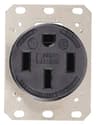 Hubbell HBL9450A NEMA 14-50 receptacleThe receptacle to specify. NEMA 14-50. Hubbell HBL9450A NEMA 14-50 receptacleThe receptacle to specify. NEMA 14-50. | The receptacle to specify | 50 A12 kW | $63.99 · View on Amazon#ad how we are funded · price as of October 26, 2026 |
| 3 |  Lectron J1772 to Tesla (NACS) adapterNACS car, J1772 charger. J1772 to NACS. Lectron J1772 to Tesla (NACS) adapterNACS car, J1772 charger. J1772 to NACS. | NACS car, J1772 charger | 80 A19.2 kW | $39.99 · View on Amazon#ad how we are funded · price as of October 26, 2026 |
Step zero: what you already own
- A Level 1 charging cable. It plugs into a normal outlet and adds roughly 40 to 60 miles overnight. For many households that is the whole kit -- the honest test.
- Possibly an adapter. Teslas ship with a J1772 adapter, and many cars with a native NACS port include one too -- look before you buy.
1. A charger
If Level 1 does not keep up, a Level 2 wall unit is the core of the kit. The safe default for a first-time buyer is the Emporia Level 2: 48 A hardwired, a 25-foot cable, NEMA 4, UL listed. The full roundup explains when something else is the better buy.
2. The connection
A charger connects one of two ways. Hardwired means the electrician wires it directly -- nothing extra to buy. Plug-in means a 240-volt receptacle, and that receptacle is the one place worth spending a little more: builder-grade 14-50s are a known failure point under a charger's continuous load. The Hubbell HBL9450A is the industrial-grade part to ask for. Hardwired vs plug-in.
3. An adapter, only if needed
If your car and your charger use different connectors, you need an adapter -- but check the trunk first, because it often came with the car. If you genuinely need one, buy a certified unit: the Lectron J1772-to-NACS adapter publishes UL 2252 certification. Which adapter direction you need.
| Item | Buy it if | Skip it if |
|---|---|---|
| Level 2 charger | Level 1 cannot keep up with your driving | Level 1 keeps up -- try it for a month |
| Industrial 14-50 receptacle | You are installing a plug-in charger | You are hardwiring |
| Connector adapter | Car and charger differ, and none came with the car | It is already in your trunk |
The starter kit in detail
The charger, the receptacle and the adapter, each with the case against it.
1. A first charger, hardwired
Emporia Level 2 EV Charger (Classic)
Emporia · J1772 · 48 A / 11.5 kW · 25 ft cable
The safe default for a first home charger: 48 amps hardwired, a genuinely long cable, a NEMA 4 outdoor-rated case, and no subscription attached to the app.
What is good
- 48 A hardwired is the fastest tier most homes can realistically support
- 25 ft of cable reaches across a two-car garage without a fight
- NEMA Type 4 enclosure is rated for outdoor mounting
- Energy monitoring in the app with no subscription
What is not
- Drops to 40 A if you use the NEMA 14-50 plug rather than hardwiring
- The app is the only way to change the amperage setting
| Maximum output | 48 A / 11.5 kW at 240 V (hardwired) |
|---|---|
| Plug-in output | 40 A with the NEMA 14-50 plug |
| Connector | SAE J1772 |
| Cable | 25 ft |
| Enclosure | NEMA Type 4, indoor or outdoor |
| Certification | UL listed, Energy Star |
| Warranty | 3 years |
Skip this if: Skip it if you want a unit with no app or network connection at all. The Grizzl-E Classic is the simpler machine.
Specifications above are the manufacturer’s published figures. Source: Emporia Energy. We have not tested this unit — see how we pick.
2. The receptacle to specify
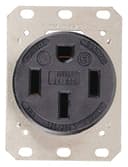
Hubbell HBL9450A NEMA 14-50 receptacle
Hubbell Wiring Device-Kellems · NEMA 14-50 · 50 A / 12 kW
The industrial-grade 14-50 electricians specify when they know the circuit will feed an EV charger every night. Full-size brass contacts and a clamping terminal, not the stab-and-hope design of a builder-grade outlet.
What is good
- Industrial grade, with the clamping terminal design that keeps a high-current connection tight
- Accepts 10 through 4 AWG, so it fits whatever conductor your run needs
- UL listed and CSA certified, with a published file number you can look up
- Weather-resistant rated, which matters for a garage or an outdoor box
What is not
- Costs several times a builder-grade 14-50, which is the entire point
- Installation is licensed electrical work -- this is not a part you fit yourself
- No cover plate included on the single pack
| Rating | 50 A, 125/250 V, 12,500 W maximum |
|---|---|
| Configuration | NEMA 14-50R, 3-pole, 4-wire grounding |
| Wire range | 10 to 4 AWG |
| Grade | Industrial |
| Certification | UL listed (file E2186), CSA certified |
| Standard | NEMA WD-6 compliant |
Skip this if: Skip it only if your charger is being hardwired -- then you do not need a receptacle at all, and hardwiring is the more durable answer.
Specifications above are the manufacturer’s published figures. Source: Hubbell Wiring Device-Kellems. We have not tested this unit — see how we pick.
3. NACS car, J1772 charger
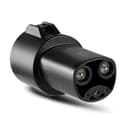
Lectron J1772 to Tesla (NACS) adapter
Lectron · J1772 to NACS · 80 A / 19.2 kW
Lets a Tesla or any NACS-port car charge from a J1772 charger. Rated to 80 A, certified to UL 2252, with temperature monitoring built into the body.
What is good
- Certified to UL 2252, which is the standard written for exactly this device
- Rated well above any home circuit at 80 A, so it is never the limiting part
- Temperature monitoring in the body, the failure mode that matters on an adapter
- Works on any J1772 Level 1 or Level 2 charger
What is not
- Most owners already have one in the car and do not need to buy anything
- AC only -- it is not a DC fast-charging adapter
- One more loose item to keep track of, unless it lives clipped to the cable
| Direction | J1772 charger to a NACS (Tesla) port |
|---|---|
| Maximum current | 80 A |
| Voltage | 240 V AC |
| Certification | UL 2252 |
| Safety | Built-in temperature monitoring |
| Use | AC charging (Level 1 and Level 2) |
Skip this if: Skip it if your car came with one. Every Tesla ships with a J1772 adapter, and cars sold with a native NACS port ship with one too -- check the trunk before buying.
Specifications above are the manufacturer’s published figures. Source: Lectron. We have not tested this unit — see how we pick.
FAQ
Questions people actually ask
What do I need to charge an EV at home?
What should be in an EV charging starter kit?
Do I need to buy an adapter for my EV?
Sources
Where these numbers come from
- Emporia Level 2 EV Charger specifications — Emporia Energy
- HBL9450A straight blade receptacle, industrial grade, 50 A 125/250 V 14-50R — Hubbell Wiring Device-Kellems
- Lectron J1772 to Tesla (NACS) EV adapter, 240 V, 80 A, UL 2252 certified — Lectron
Read next
Related reading
- Gifts for EV ownersSeven gifts an EV owner will keep, by budget, with live prices -- and the three that get returned.
- Setting up home charging for the first timeThe whole home charging project in the right order, from decision to first charge.
- How to choose an EV chargerThe beginner's route to choosing a home charger: three questions, no assumed knowledge.
- The best home EV chargers, for people buying their first oneSix Level 2 chargers ranked for a first-time buyer, with an honest reason to skip each one.
- EV charger accessories: worth it, or skip itWhich EV accessories earn their place, which are situational, and which to skip.