Accessories
EV charger accessories: worth it, or skip it
Once the charger is on the wall, a whole aisle of add-ons appears. A few genuinely earn their place. Most solve problems you do not have.
By Sawyer V. · Published September 10, 2026
How this page is funded: we earn a commission if you buy through our Amazon links, at no extra cost to you. It does not change what we recommend, and we say plainly when the honest answer is to buy nothing. Full disclosure.
Accessories are where affiliate sites make the most money for the least value, so we will be direct: most of this aisle is optional, and some of it is actively bad. Here is how to tell which is which.
The verdicts
| Accessory | Worth it when | Skip it when |
|---|---|---|
| Whole-home surge protector | Your panel has none | You already have one -- one is enough |
| Energy monitor | Your panel is tight, or you want to see what charging really costs | Your panel is healthy and the car's own reporting is enough |
| Dryer outlet splitter | A dryer outlet is near your parking and the panel has no room | Your panel can take a dedicated circuit |
| Industrial 14-50 receptacle | You are installing a plug-in charger | You are hardwiring |
| Rated J1772 extension | You genuinely cannot move the charger closer | You can move the charger -- always the better fix |
| Connector adapter | Car and charger differ, and none came with the car | It is already in your trunk |
The one most people should consider
A whole-home surge protector. The charger and the car plugged into it are expensive electronics connected to the grid for hours every night, and surge damage is not something to assume a charger's warranty covers. If your panel has no protection, add it on the same visit as the charger installation.
Skip these entirely
- Household extension cords and power strips. Not rated for hours of continuous high current. A genuine fire risk -- why.
- Anything claiming to make charging faster. Charging speed is set by your circuit and your car's onboard charger. No accessory changes either.
- Portable battery packs for range. A pack that could add meaningful range would be the size of a car battery. What actually helps.
- A second surge protector. One at the panel covers every circuit.
The accessories in detail
One from each category that is genuinely worth considering, each with its own case against.
1. Highest surge rating
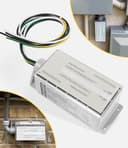
Siemens FS140 whole-home surge protector
Siemens · Panel-mounted
The highest surge-current rating of the three here at 140 kA per phase, in a NEMA 4X enclosure. Mounted at the panel, it protects every circuit in the house -- the EV charger included.
What is good
- 140 kA per phase, the highest rating here
- Three status indicators, including an audible alarm
- NEMA 4X enclosure, rated for outdoor mounting
- Protects every circuit, not just the charger
What is not
- Installation is licensed electrical work
- No surge protector is a guarantee against every event
- Overkill if a lower-rated unit covers your service
| Type | Type 2 surge protective device |
|---|---|
| Surge current | 140 kA per phase |
| Breaker | 30 A or smaller, 2-pole |
| System | 120/240 V, 60 Hz split-phase |
| Status indicators | Audible alarm, protection LED, service LED |
| Enclosure | NEMA 4X, outdoor-rated |
| Warranty | 10 years, as published |
Skip this if: Skip it if you already have a whole-home surge protector at your panel. One is enough; a second adds nothing.
Specifications above are the manufacturer’s published figures. Source: Crosswyre Electric. We have not tested this unit — see how we pick.
2. Circuit-level detail
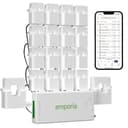
Emporia Vue 3 home energy monitor
Emporia · In-panel sensors
Clamps onto your mains and up to 16 individual circuits, so you can see exactly what the EV charger draws and how much headroom your panel really has. Pairs with Emporia's own charger to charge from surplus solar.
What is good
- Up to 16 circuit sensors, so the EV circuit gets its own exact reading
- Wired Ethernet as well as Wi-Fi, which matters inside a metal panel
- Pairs with the Emporia EV charger to charge from surplus solar
- Shows real panel headroom -- useful before deciding on a charger's amperage
What is not
- Sensors go inside the panel, which is electrician territory
- Routing up to 16 clamps is fiddly in a crowded panel
- Only as useful as the time you spend in the app
| Mains sensors | 2 x 200 A |
|---|---|
| Branch circuit sensors | Up to 16 x 50 A |
| Connectivity | 2.4 GHz Wi-Fi, plus 10/100 wired Ethernet |
| Solar | Monitors net metering without extra equipment |
| 3-phase homes | A separate 3-phase/4-wire model is sold |
| Certification | UL certified |
| Warranty | 1 year |
Skip this if: Skip it if you only want a whole-home total. Sixteen circuit sensors is a lot of hardware to route through a panel for one number.
Specifications above are the manufacturer’s published figures. Source: Emporia Energy, Emporia Energy, Excess Solar, Emporia Energy, 3-phase model. We have not tested this unit — see how we pick.
3. The broadest outlet range
NeoCharge Smart Splitter
NeoCharge · NEMA 14-50 · 40 A / 9.6 kW
Plugs into an existing 240-volt outlet and switches power between your dryer and your EV automatically, so you get Level 2 charging without a new circuit. UL listed, and sold in a version for each common dryer and range outlet.
What is good
- Avoids a new circuit, which can mean avoiding a panel upgrade
- Switches between the two loads automatically
- UL listed, with an internal breaker that enforces the circuit limit
- A version for every common dryer and range outlet type
What is not
- The dryer and the charger take turns on the circuit
- On a 30 A dryer circuit you are limited to 24 A of charging
- You must buy the version that matches your outlet exactly
| Output (14-50 version) | 40 A / 9.6 kW |
|---|---|
| Input (14-50 version) | NEMA 14-50P, 240 VAC single phase |
| Outputs (14-50 version) | 2 x NEMA 14-50R |
| Also sold for | NEMA 10-30 and 14-30 (24 A), NEMA 10-50 and 6-50 (40 A) |
| Protection | Internal software breaker |
| Weight | 2.5 lb |
| Certification | UL listed |
Skip this if: Skip it if your panel can take a new circuit. A dedicated EV circuit is simpler, charges while the dryer runs, and has one less device in the chain.
Specifications above are the manufacturer’s published figures. Source: NeoCharge. We have not tested this unit — see how we pick.
4. Extra reach, done properly
Lectron J1772 extension cable
Lectron · J1772 · 40 A / 9.6 kW · 20 ft cable
A purpose-built 40 A J1772 extension -- silver-plated contacts, temperature monitoring, IP66 -- which is a completely different object from a household extension cord. Sold in 20 ft and 40 ft.
What is good
- Rated for 40 A continuous, which a household extension cord is not
- Silver-plated power and signal contacts with temperature monitoring at the joint
- IP66, so it can sit on a wet driveway
- Two lengths, so you can buy the reach you actually measured
What is not
- Every extra connection is one more place to heat up -- moving the charger is still the better fix
- We could not verify a UL listing from published sources; see the note on the page
- 40 ft of EV cable is heavy and awkward to coil
| Maximum current | 40 A |
|---|---|
| Length | 20 ft (6 m) or 40 ft (12 m) |
| Compatibility | Level 1 and Level 2 J1772 chargers |
| Contacts | Silver-plated, with temperature monitoring |
| Rating | IP66 weatherproof |
| Body | High-strength ABS |
Skip this if: Skip it if you can simply move the charger. Relocating a wall unit a few feet along the wall is usually cheaper and always more robust than adding a connection to the chain.
Specifications above are the manufacturer’s published figures. Source: Lectron. We have not tested this unit — see how we pick.
FAQ
Questions people actually ask
What EV charger accessories do I actually need?
Are EV charging accessories worth it?
Can any accessory make my EV charge faster?
Sources
Where these numbers come from
- Best whole house surge protectors of 2026 — Crosswyre Electric
- Emporia Vue Energy Monitor — Emporia Energy
- NeoCharge Smart Splitter — NeoCharge
- Lectron J1772 extension cable, 20 ft / 6 m — LectronUL listing not stated on the pages accessible 2026-09-10.
Read next
Related reading
- Gifts for EV ownersSeven gifts an EV owner will keep, by budget, with live prices -- and the three that get returned.
- Your EV charging starter kitThe short shopping list for a first home charging setup, and what you already own.
- The best surge protector for an EV chargerWhole-home surge protectors that cover the charger and the car, with the ratings explained.
- Emporia Vue vs Sense for EV ownersCircuit-level sensors against machine-learning detection, judged on what an EV owner needs to know.
- The best dryer outlet splitters for EV chargingCharge from your dryer outlet instead of adding a circuit, and the 24-amp limit that comes with it.
- The best EV charger holsters and cable organizersHolsters and hooks that keep the connector off the floor and the cable out from under the wheels.