Gift guide
Gifts for EV owners
Most EV gifts are solving a problem the car does not have. These seven are the ones owners actually keep, sorted by budget, with the things to avoid at the end.
By Sawyer V. · Published October 11, 2026
How this page is funded: we earn a commission if you buy through our Amazon links, at no extra cost to you. It does not change what we recommend, and we say plainly when the honest answer is to buy nothing. Full disclosure.
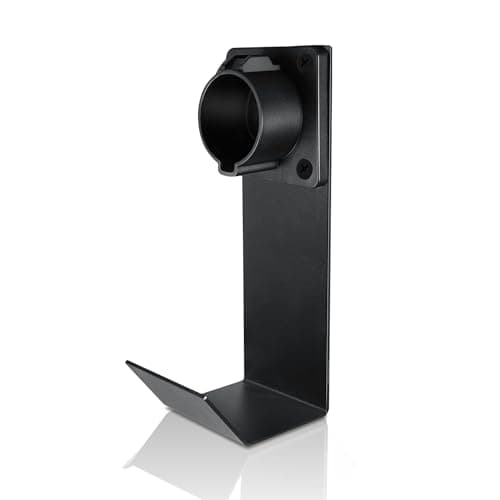
The verdict, if you only read one line: buy the $20 wall holster. It is the single most-used, least-bought EV accessory there is -- the thing that stops a heavy charging cable living in a coil on a cold garage floor. If you want to spend more, a home energy monitor or a portable Level 2 charger are the two gifts that change how someone lives with the car. If you want to spend less, a decent set of gloves is a better gift than most EV gadgets, and we are not going to pretend otherwise.
One warning before the list. Do not buy a wall-mounted charger as a surprise. Which charger someone needs depends on their electrical panel, their outlet, their car's onboard charger and where they park -- four things you probably cannot check without ruining the surprise. How to choose an EV charger shows why. Everything below is either connector-agnostic or flagged.
The seven, by budget
| Gift | Budget | Best for | Who should skip it |
|---|---|---|---|
| A J1772 wall holster and cable hook | Under $25 | Anyone who already has a charger on the wall | A NACS-connector household -- buy the NACS version instead |
| A heavy-duty NEMA 14-50 receptacle | Under $100 | Someone with an install booked -- hand it to the electrician | Anyone already hardwired, or with no install planned |
| A home energy monitor | Around $200 | The owner who keeps asking what charging costs | Renters who cannot work inside the panel |
| A portable Level 2 charger | Around $270 | Apartment dwellers, renters, second homes, road trips | Someone who already has a wall charger and never travels |
| A no-app 40 A wall charger | Around $300 | A household that has chosen 40 A and hates apps | Anyone who has not yet checked their panel -- see the warning above |
| A dryer-outlet splitter switch | Around $390 | A full electrical panel and a 240 V dryer outlet | Anyone with panel space for a dedicated circuit |
| A whole-home surge protector | Under $100 | The practical gift: it protects the charger and the car | Renters; this is panel work for an electrician |
Why the $20 holster is the pick
A Level 2 charging cable is thick, heavy and, in winter, stiff. Without somewhere to put it, it ends up looped over the charger body or coiled on the floor where it gets driven over, swept up with the snow shovel, and stepped on. A wall dock holds the connector at hand height and a J-hook takes the weight of the cable. It costs less than a bottle of wine and it is the accessory owners most often say they wish they had bought on day one.
The one thing to check: connectors are not interchangeable. A J1772 dock will not hold a Tesla NACS connector. Look at the plug on the end of their charging cable -- J1772 is the round five-pin one with a flat top, NACS is the smaller, sleeker one. Plug types explained has pictures of both.
The gift that answers their actual question
Every new EV owner asks what charging costs, and the car cannot tell them -- it reports energy delivered to the battery, not energy drawn from the wall or the price of it. A whole-home energy monitor with a sensor on the EV circuit does. It is the gift that turns a vague worry into a number, and it keeps earning after the novelty of the car wears off. Cost to charge at home is the method; the monitor is the measurement.
If you want to spend real money
Buy a portable Level 2 charger rather than a wall unit. It plugs into a 240-volt outlet, needs no electrician, works at a relative's house over the holidays, and comes with them if they move. It is a gift you can give without knowing their panel. The Department of Energy puts Level 2 charging at roughly 25 miles of range per hour, against about 5 for the Level 1 cord that came with the car -- which is the whole point of the upgrade.
Three gifts to avoid
- An "EV power bank" or portable battery jump pack for an EV. These do not meaningfully charge a car. What actually helps when you are running low covers why, and what to do instead.
- A magnetic charge-port cover. They are cheap and widely sold, but no maker in that category publishes a test showing it keeps a port clear, and the port door is already designed to seal. We do not recommend one, and we do not sell one. What to do about a frozen charge port has the methods that do work.
- A charging-cable extension, as a surprise. Extensions are a real product but a specific one -- the wrong gauge or length is a safety problem, not an inconvenience. EV charger extension cords explains what is actually safe.
Buying for a brand-new owner
If they took delivery this year and have not set up home charging yet, the most useful thing you can give is not hardware. Send them the order to do it in and buy the holster -- they will need it whatever charger they end up with. The EV charging starter kit is the shopping list they will work through, and winter charging is the one that matters between now and March.
The seven gifts
In budget order, with live Amazon prices and the date they were read. Every link resolves to a specific product.
1. J1772 connectors
Lectron J1772 holster dock and J-hook
Lectron · J1772
A steel dock that latches a J1772 connector and a hook for the cable, rated by Lectron for indoor and outdoor use. Fits all J1772 connectors.
What is good
- Anti-corrosive steel rather than plastic
- Latches the connector so it stays put
- Hook keeps the cable off the ground
What is not
- J1772 only
- No holder for a portable's control box -- see the holder set
- Check your charger does not already have a holster
| Fits | All J1772 connectors |
|---|---|
| Material | Anti-corrosive steel |
| Use | Indoor or outdoor |
| In the box | Dock and J-hook, with mounting hardware |
Skip this if: Skip it if your connector is a Tesla (NACS) -- this dock is shaped for J1772.
Specifications above are the manufacturer’s published figures. Source: Lectron. We have not tested this unit — see how we pick.
2. The receptacle to specify
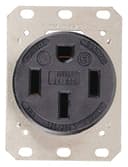
Hubbell HBL9450A NEMA 14-50 receptacle
Hubbell Wiring Device-Kellems · NEMA 14-50 · 50 A / 12 kW
The industrial-grade 14-50 electricians specify when they know the circuit will feed an EV charger every night. Full-size brass contacts and a clamping terminal, not the stab-and-hope design of a builder-grade outlet.
What is good
- Industrial grade, with the clamping terminal design that keeps a high-current connection tight
- Accepts 10 through 4 AWG, so it fits whatever conductor your run needs
- UL listed and CSA certified, with a published file number you can look up
- Weather-resistant rated, which matters for a garage or an outdoor box
What is not
- Costs several times a builder-grade 14-50, which is the entire point
- Installation is licensed electrical work -- this is not a part you fit yourself
- No cover plate included on the single pack
| Rating | 50 A, 125/250 V, 12,500 W maximum |
|---|---|
| Configuration | NEMA 14-50R, 3-pole, 4-wire grounding |
| Wire range | 10 to 4 AWG |
| Grade | Industrial |
| Certification | UL listed (file E2186), CSA certified |
| Standard | NEMA WD-6 compliant |
Skip this if: Skip it only if your charger is being hardwired -- then you do not need a receptacle at all, and hardwiring is the more durable answer.
Specifications above are the manufacturer’s published figures. Source: Hubbell Wiring Device-Kellems. We have not tested this unit — see how we pick.
3. Circuit-level detail
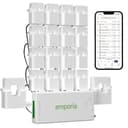
Emporia Vue 3 home energy monitor
Emporia · In-panel sensors
Clamps onto your mains and up to 16 individual circuits, so you can see exactly what the EV charger draws and how much headroom your panel really has. Pairs with Emporia's own charger to charge from surplus solar.
What is good
- Up to 16 circuit sensors, so the EV circuit gets its own exact reading
- Wired Ethernet as well as Wi-Fi, which matters inside a metal panel
- Pairs with the Emporia EV charger to charge from surplus solar
- Shows real panel headroom -- useful before deciding on a charger's amperage
What is not
- Sensors go inside the panel, which is electrician territory
- Routing up to 16 clamps is fiddly in a crowded panel
- Only as useful as the time you spend in the app
| Mains sensors | 2 x 200 A |
|---|---|
| Branch circuit sensors | Up to 16 x 50 A |
| Connectivity | 2.4 GHz Wi-Fi, plus 10/100 wired Ethernet |
| Solar | Monitors net metering without extra equipment |
| 3-phase homes | A separate 3-phase/4-wire model is sold |
| Certification | UL certified |
| Warranty | 1 year |
Skip this if: Skip it if you only want a whole-home total. Sixteen circuit sensors is a lot of hardware to route through a panel for one number.
Specifications above are the manufacturer’s published figures. Source: Emporia Energy, Emporia Energy, Excess Solar, Emporia Energy, 3-phase model. We have not tested this unit — see how we pick.
4. Travel and rentals
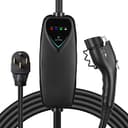
Lectron portable Level 2 charger
Lectron · J1772 · 32 A / 7.7 kW · 21 ft cable
A plug-in portable that runs at Level 2 speed from a NEMA 14-50 and drops to a standard wall outlet with the included adapter. The travel unit, not the garage unit.
What is good
- Level 2 speed from a NEMA 14-50 without an installed charger
- Falls back to a standard household outlet with the adapter
- Small enough to keep in the trunk
What is not
- 32 A ceiling, meaningfully slower than a 48 A wall unit
- Not weather-rated for permanent outdoor mounting
- Repeated plugging and unplugging wears a NEMA 14-50 receptacle faster than a hardwired unit
| Maximum output | 32 A / 7.7 kW at 240 V |
|---|---|
| Connector | SAE J1772 |
| Plug | NEMA 14-50, with an adapter for a standard outlet |
| Use | Portable. Lives in the car, not on the wall |
Skip this if: Skip it if this is your only charger and you have a garage. A wall unit is faster and does not live in your trunk.
Specifications above are the manufacturer’s published figures. Source: Lectron. We have not tested this unit — see how we pick.
5. Harsh weather and no app
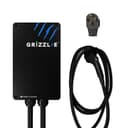
Grizzl-E Classic
United Chargers · J1772 · 40 A / 9.6 kW · 24 ft cable
A cast-aluminum box with no app, no account and no firmware to update. If you want a charger that behaves like an appliance, this is the one.
What is good
- Cast aluminum NEMA 4 / IP67 enclosure, built for outdoor mounting
- No app, no account, no network dependency
- Amperage is set with physical switches, not software
- Protections for over-current, over-voltage, ground fault and over-temperature
What is not
- 40 A ceiling, slower than the 48 A units if your panel can take more
- No scheduling, so off-peak charging has to be set in the car
- The cold-flexible 24 ft cable is only on the Extreme Edition
| Maximum output | 40 A / 9.6 kW at 240 V |
|---|---|
| Adjustable | 16, 24, 32 or 40 A |
| Connector | SAE J1772 |
| Cable | 24 ft on the Extreme Edition |
| Enclosure | Cast aluminum, NEMA 4 / IP67 |
| Certification | UL certified |
| Warranty | 3 years |
Skip this if: Skip it if you want scheduled charging or energy tracking in an app. The Classic deliberately has neither.
Specifications above are the manufacturer’s published figures. Source: United Chargers, InsideEVs. We have not tested this unit — see how we pick.
6. A 14-30 dryer outlet and a charger with a 14-50 plug
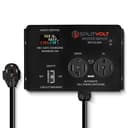
Splitvolt Splitter Switch (NEMA 14-30 to 14-50)
Splitvolt · NEMA 14-50 · 24 A / 5.8 kW
The one most people need: it plugs into a four-prong 14-30 dryer outlet and gives the charger a NEMA 14-50 socket, which is the plug nearly every plug-in EV charger ships with. Still 24 A, because the dryer circuit is still 30 A.
What is good
- A 14-50 EV socket, which is the plug most plug-in chargers already have
- Fits the four-prong 14-30 dryer outlet modern circuits use
- Automated switching, full-color metering display and an easy-reset 24 A breaker
- cETLus listed with the Intertek file number published
- No new circuit, so no panel upgrade
What is not
- A 14-50 socket that still only delivers 24 A -- the outlet looks faster than it is
- The dryer and the charger take turns; they cannot run together
- Indoor use only
- 1-year warranty
| Rating | 240 V ~ 60 Hz, 24 A AC maximum load |
|---|---|
| Wall plug | NEMA 14-30 male, on a 4 ft pigtail |
| Dryer socket | NEMA 14-30 female |
| EV socket | NEMA 14-50 female |
| Switching | Automated between the dryer and EV sockets |
| Display | Full-color screen: real-time kWh, amps, volts and status |
| Protection | Integrated 24 A circuit breaker with easy reset |
| Manual override | Optional manual power-off switch |
| Circuit | Standard 30 A dryer circuits; 24 A max for the NEC safe charging rate |
| Mounting | Integrated wall-mount screw holes |
| Use | Indoor use only |
| Size and weight | 12 x 8.5 x 4 in, 6.7 lb |
| Certification | cETLus, Intertek 5021938, UL 60730-1 / CSA E60730-1 |
| Warranty | 1 year limited |
| SKU | SPS-C2-032-30A |
Skip this if: Skip it if your dryer outlet is the older three-prong 10-30, or if your panel has room for a dedicated circuit -- a real 14-50 circuit charges at 40 A instead of 24 A.
Specifications above are the manufacturer’s published figures. Source: Splitvolt. We have not tested this unit — see how we pick.
7. Highest surge rating
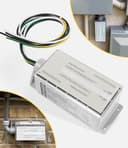
Siemens FS140 whole-home surge protector
Siemens · Panel-mounted
The highest surge-current rating of the three here at 140 kA per phase, in a NEMA 4X enclosure. Mounted at the panel, it protects every circuit in the house -- the EV charger included.
What is good
- 140 kA per phase, the highest rating here
- Three status indicators, including an audible alarm
- NEMA 4X enclosure, rated for outdoor mounting
- Protects every circuit, not just the charger
What is not
- Installation is licensed electrical work
- No surge protector is a guarantee against every event
- Overkill if a lower-rated unit covers your service
| Type | Type 2 surge protective device |
|---|---|
| Surge current | 140 kA per phase |
| Breaker | 30 A or smaller, 2-pole |
| System | 120/240 V, 60 Hz split-phase |
| Status indicators | Audible alarm, protection LED, service LED |
| Enclosure | NEMA 4X, outdoor-rated |
| Warranty | 10 years, as published |
Skip this if: Skip it if you already have a whole-home surge protector at your panel. One is enough; a second adds nothing.
Specifications above are the manufacturer’s published figures. Source: Crosswyre Electric. We have not tested this unit — see how we pick.
FAQ
Questions people actually ask
What is the best gift for a new EV owner?
Should I buy someone an EV charger as a gift?
What EV gifts should I avoid?
What is a good EV gift under $100?
How do I know which connector their car uses?
Sources
Where these numbers come from
- Electric Vehicle Charging Infrastructure: charging levels — U.S. Department of Energy, Alternative Fuels Data CenterAC Level 1 adds approximately 5 miles of range per hour of charging at 1.9 kW. AC Level 2 runs at 240 V, delivers 2.9 to 19.2 kW, and adds approximately 25 miles of range per hour, on the J1772 or J3400 (NACS) connector. Read 2026-10-11.
- Charging Electric Vehicles at Home — U.S. Department of Energy, Alternative Fuels Data CenterMost drivers charge overnight at home; residential charging costs depend on equipment and time of day; outdoor use is safe with outdoor-rated equipment; smarter Level 2 units add timers and monitoring. Read 2026-10-11.
- Lectron J1772 EV charger J-hook nozzle holster dock — LectronWall-mounted J1772 connector holster dock with a cable J-hook, anti-corrosive steel, for indoor or outdoor mounting. Read via the product record.
- Grizzl-E Classic product specifications — United Chargers40 A / 9.6 kW, NEMA 14-50 plug, 24 ft cable, cast-aluminum NEMA 4 / IP67 enclosure, UL certified, no app. Read via the product record.
Read next
Related reading
- EV charger accessories: worth it, or skip itWhich EV accessories earn their place, which are situational, and which to skip.
- Your EV charging starter kitThe short shopping list for a first home charging setup, and what you already own.
- Your winter EV charging kitFive winter purchases in priority order, plus the four habits that matter more than any of them.
- The best EV charger holsters and cable organizersHolsters and hooks that keep the connector off the floor and the cable out from under the wheels.
- Running low with nowhere to chargeWhat genuinely helps if you run low, and why emergency battery packs are not the answer.