Breakers
50 or 60 amp breaker for an EV charger?
You do not pick the breaker and then find a charger to match. The charger's current sets the breaker, and your panel decides which charger you can have.
By Sawyer V. · Published September 10, 2026
How this page is funded: we earn a commission if you buy through our Amazon links, at no extra cost to you. It does not change what we recommend, and we say plainly when the honest answer is to buy nothing. Full disclosure.
"50 or 60 amp breaker" is one of the questions buyers type most often, and it has a short answer: whichever your charger's installation manual specifies. The longer answer is about whether the bigger circuit -- and the bigger charger behind it -- is worth asking your panel for.
The arithmetic
Charger current sets the circuit
40 A charger: 40 x 1.25 = 50 A circuit; 40 x 240 = 9.6 kW
48 A charger: 48 x 1.25 = 60 A circuit; 48 x 240 = 11.5 kW
Difference: 8 A, about 1.9 kW, roughly 7 miles of range per hour at 3.5 mi/kWh
| 50 A breaker | 60 A breaker | |
|---|---|---|
| Charger | 40 A, or any plug-in unit on a 14-50 or 6-50 | 48 A, hardwired |
| Power at 240 V | 9.6 kW | 11.5 kW |
| Miles per hour at 3.5 mi/kWh | About 34 | About 40 |
| Installation | Plug-in or hardwired | Hardwired |
| Square D QO GFCI example | QO250GFI | QO260GFI |
When 50 amps is the right answer
- A plug-in charger. A NEMA 14-50 or 6-50 sits on a 50 A circuit, so a plug-in unit tops out at 40 A anyway. Hardwired vs plug-in.
- A tight panel. The load calculation may only allow 50 A. Load calculation.
- A car that accepts 9.6 kW or less. It charges no faster on a bigger circuit.
When 60 amps earns its circuit
- A car whose onboard charger accepts about 11 kW or more. The AC rate is in the manual.
- A big battery or two EVs sharing one charger overnight. Chargers for two EVs.
- A hardwired install with real headroom in the panel. The 48-amp picks.
Two Square D QO examples
The 50 A and 60 A GFCI breakers we can cite in full. Both are only correct for a Square D QO panel.
1. Square D QO panels
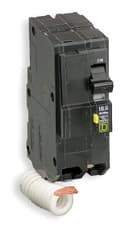
Square D QO250GFI 50 A GFCI breaker
Square D (Schneider Electric) · Panel breaker · 50 A
A 50-amp, two-pole GFCI breaker for Square D QO load centers -- the circuit a 40-amp charger or a NEMA 14-50 outlet needs, with Class A 6 mA ground-fault protection. Only correct if your panel is a QO.
What is good
- The circuit rating a 40 A charger or a NEMA 14-50 receptacle requires
- Ground-fault protection built into the breaker
- UL listed and CSA approved, per the distributor listing
What is not
- Only for Square D QO load centers
- A GFCI breaker plus a charger's own ground-fault detection can nuisance-trip
- Panel work is licensed -- not a part to fit yourself
| Rating | 50 A, 2-pole, 120/240 V |
|---|---|
| Ground-fault protection | Class A, 6 mA |
| Interrupting rating | 10 kA at 120 V |
| Mounting | Plug-in, Square D QO load centers |
| Size | 4.12 x 1.5 x 2.91 in |
| Listings | UL listed, CSA approved |
Skip this if: Skip it if your panel is not a Square D QO. A breaker has to be one your panel is listed to accept, and a QO breaker in another brand's panel is the wrong part.
Specifications above are the manufacturer’s published figures. Source: SimplyBreakers (distributor listing). We have not tested this unit — see how we pick.
2. Square D QO panels
Square D QO260GFI 60 A GFCI breaker
Square D (Schneider Electric) · Panel breaker · 60 A
A 60-amp, two-pole GFCI breaker for Square D QO panels -- the circuit a 48-amp charger needs, with 6 mA ground-fault protection built in. Only correct if your panel is a QO.
What is good
- The exact circuit rating a 48 A charger requires
- Ground-fault protection built into the breaker
- A bolt-on version, the QOB260GFI, is listed for QOB panelboards
What is not
- Only for Square D QO panels
- A GFCI breaker plus a charger's own ground-fault detection can nuisance-trip
- Panel work is licensed -- not a part to fit yourself
| Rating | 60 A, 2-pole, 120/240 VAC |
|---|---|
| Ground-fault protection | GFCI, 6 mA |
| Interrupting rating | 10 kA |
| Mounting | Plug-on, Square D QO |
| Neutral | Pigtail |
| Bolt-on version | QOB260GFI |
Skip this if: Skip it if your panel is not a Square D QO. A breaker has to be one your panel is listed for, and a QO breaker in another brand's panel is the wrong part.
Specifications above are the manufacturer’s published figures. Source: GMES (distributor listing), SimplyBreakers (distributor listing). We have not tested this unit — see how we pick.
FAQ
Questions people actually ask
Should I use a 50 or 60 amp breaker for my EV charger?
Can I put a 48 amp charger on a 50 amp breaker?
Is a 60 amp breaker worth it?
Sources
Where these numbers come from
- QO250GFI - Square D - 50 Amp GFCI Circuit Breaker — SimplyBreakers (distributor listing)50 A, 2-pole, 120/240 V, 10 kA at 120 V interrupting rating, Class A 6 mA ground-fault protection, plug-in mounting for Square D QO load centers, dimensions, UL listed and CSA approved. Read 2026-09-10.
- Square D QO260GFI 60A 2-pole GFCI 6mA 120/240V 10kA plug-on QO circuit breaker — GMES (distributor listing)The 60 A QO GFCI breaker: rating, 6 mA trip level, 10 kA interrupting rating and plug-on QO mounting.
- NEC Article 625: EV charging equipment — WireRefContinuous-load rule behind every circuit figure on this page.
Read next
Related reading
- The best 50-amp breaker for an EV chargerThe breaker behind a 14-50 or a 40 A charger: why your panel decides, and a Square D QO example.
- The best 60-amp breaker for an EV chargerWhy the best breaker is the one your panel is listed for, with a worked Square D QO example.
- 32 A vs 40 A vs 48 A: how many amps do you actually need?What each amperage tier delivers in miles per hour, and the circuit each one requires.
- What size breaker and wire does an EV charger need?Breaker and wire size for every charger amperage, with the 125% rule worked through.