Small circuits
The best EV chargers for a 30-amp circuit
Plenty of houses already have a 30-amp, 240-volt circuit -- usually for an old dryer. It will not run a 48-amp charger, but set up properly it covers most people's daily driving.
By Sawyer V. · Published September 10, 2026
How this page is funded: we earn a commission if you buy through our Amazon links, at no extra cost to you. It does not change what we recommend, and we say plainly when the honest answer is to buy nothing. Full disclosure.
Before paying for a new 50 or 60 amp circuit, look at what you already have. A spare 30 amp, 240 volt circuit -- often left behind when a dryer moved or went gas -- can run a Level 2 charger at a rate that covers most commutes overnight.
Picks for a 30-amp circuit
Ranked for a first home charger. Every row jumps to the full write-up below.
| # | Product | Best for | Max output | Price |
|---|---|---|---|---|
| 1 |  ChargePoint Home FlexHomes with an uncertain panel. J1772, 23 ft cable. ChargePoint Home FlexHomes with an uncertain panel. J1772, 23 ft cable. | Homes with an uncertain panel | 50 A12 kW | $549.00 · View on Amazon#ad how we are funded · price as of October 26, 2026 |
| 2 |  Wallbox Pulsar PlusTight wall space. J1772, 25 ft cable. Wallbox Pulsar PlusTight wall space. J1772, 25 ft cable. | Tight wall space | 48 A11.5 kW | $699.00 · View on Amazon#ad how we are funded · price as of October 26, 2026 |
What 30 amps actually gives you
A 30 A circuit
The code limits a continuous load to 80% of its circuit: 30 x 0.8 = 24 A
24 A x 240 V = 5.8 kW
At 3.5 mi/kWh, about 20 miles of range per hour
Over a ten-hour night, about 200 miles
Set it, and label it
A charger that can draw 40 or 48 amps must be configured by the installer to draw no more than the circuit allows. That is why adjustable units are the right buy here: the Home Flex has a 24 A setting, and the Pulsar Plus adjusts in 1 A steps up to 48 A. If you add capacity later, the same charger can be turned up. How many amps you need.
When 30 amps is not enough
- A very large battery that you regularly run low -- trucks and big SUVs. Chargers for an electric truck.
- Two EVs sharing one overnight window.
- Long daily drives beyond what 200 miles a night covers.
The picks in detail
Two adjustable chargers that can be set to 24 A, each with the case against it.
1. Homes with an uncertain panel
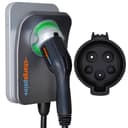
ChargePoint Home Flex
ChargePoint · J1772 · 50 A / 12 kW · 23 ft cable
The most adjustable unit here. It can be set anywhere from 16 A to 50 A, which makes it the one to buy when you do not yet know what your panel will allow.
What is good
- Six selectable amperage settings from 16 A to 50 A
- Sold in both hardwired and NEMA 14-50 versions
- Rated for indoor or outdoor installation
- The app is mature and does not require a subscription
What is not
- 23 ft is a foot shorter than the longest cables in this group
- The 50 A setting needs a bigger circuit than most panels have spare
| Maximum output | 50 A / 12 kW at 240 V |
|---|---|
| Amperage settings | 16, 24, 32, 40, 48 or 50 A |
| Connector | SAE J1772 |
| Cable | 23 ft |
| Installation | Hardwired or NEMA 14-50 |
| Certification | UL listed, Energy Star |
| Warranty | 3 years |
Skip this if: Skip it if your circuit is already fixed and you just want the cheapest safe 40 A unit. You are paying for flexibility you will not use.
Specifications above are the manufacturer’s published figures. Source: ChargePoint, ChargePoint. We have not tested this unit — see how we pick.
2. Tight wall space
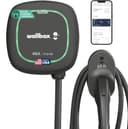
Wallbox Pulsar Plus
Wallbox · J1772 · 48 A / 11.5 kW · 25 ft cable
The smallest 48 A unit here at roughly 7.8 by 7.9 inches, which matters more than it sounds when the only free wall is beside a door.
What is good
- Smallest body of the 48 A units, under 8 inches square
- Current configurable in steps from 6 A to 48 A
- NEMA Type 4 enclosure, rated down to -22 F
- Weighs 4.4 lb without the cable, so mounting is simple
What is not
- Hardwired only at 48 A, with no plug-in version at full output
- Setup runs through the app, which some owners find fussy
| Maximum output | 48 A / 11.5 kW at 240 V |
|---|---|
| Configurable current | 6 A to 48 A |
| Connector | SAE J1772 |
| Cable | 25 ft |
| Body size | 7.8 x 7.9 x 3.9 inches without the cable |
| Operating temperature | -22 F to 104 F |
| Certification | UL 2594, UL 2231 |
| Warranty | 3 years |
Skip this if: Skip it if you want a plug-in unit you can take with you. The 48 A Pulsar Plus is hardwired.
Specifications above are the manufacturer’s published figures. Source: Wallbox, Wallbox. We have not tested this unit — see how we pick.
FAQ
Questions people actually ask
Can I charge an EV on a 30 amp circuit?
What EV charger can I use on a 30 amp breaker?
Is 24 amps enough to charge an EV?
Sources
Where these numbers come from
- ChargePoint Home Flex specifications and ordering information — ChargePoint
- Pulsar Plus datasheet — Wallbox
- NEC Article 625: EV charging equipment — WireRefContinuous-load rule behind every circuit figure on this page.
Read next
Related reading
- NEMA 14-30 vs NEMA 14-5024 amps from the dryer outlet against 40 from a dedicated 50-amp circuit, converted into miles per night -- and why a plain 14-30 to 14-50 adapter is not safe.
- The best dryer outlet splitters for EV chargingCharge from your dryer outlet instead of adding a circuit, and the 24-amp limit that comes with it.
- How many amps do you actually need?Three checks that determine your charger amperage, and why the smallest one wins.
- What size breaker and wire does an EV charger need?Breaker and wire size for every charger amperage, with the 125% rule worked through.
- 32 A vs 40 A vs 48 A: how many amps do you actually need?What each amperage tier delivers in miles per hour, and the circuit each one requires.
- The best EV chargers for a 40-amp circuitWhat a 40-amp circuit gives you, and three chargers with a 32 A setting.
- NeoCharge Smart Splitter review24 A or 40 A versions, automatic switching and app scheduling: who a dryer-outlet splitter suits.