120 V charging
The best outlet for Level 1 EV charging
A Level 1 cord draws about 12 amps continuously, all night, every night, from a receptacle that was probably the cheapest part in the house. That is the part worth twenty dollars of attention.
By Sawyer V. · Published November 7, 2026
How this page is funded: we earn a commission if you buy through our Amazon links, at no extra cost to you. It does not change what we recommend, and we say plainly when the honest answer is to buy nothing. Full disclosure.
The verdict: if the garage is unheated -- which is most garages -- buy the Leviton 5362-SG. It is the only receptacle here published to -40 C and up to 75 C, it uses a brass strap rather than plated steel, it can be back-wired for a tidier joint, and it carries tamper-resistant shutters and a 10-year warranty. If the outlet is indoors and warm and you want the cheap-but-correct answer, the CR020 is commercial specification grade with brass line contacts for the price of a coffee. If an inspector or the code requires ground-fault protection at the receptacle, the GFTR2 is the self-test, Class A device to use -- and then do not also put a GFCI breaker behind it.
Level 1 outlet picks
Ranked for a first home charger. Every row jumps to the full write-up below.
| # | Product | Best for | Max output | Price |
|---|---|---|---|---|
| 1 |  Leviton 5362-SG 20 A extra heavy-duty industrial tamper-resistant receptacleAn unheated garage or a cold outbuilding. NEMA 5-20. | An unheated garage or a cold outbuilding | 20 A2.4 kW | $35.04 · View on Amazon#ad how we are funded · price as of November 8, 2026 |
| 2 |  Leviton GFTR2 20 A SmartlockPro self-test hospital grade GFCI receptacleA garage 120 V outlet that needs GFCI protection. NEMA 5-20. | A garage 120 V outlet that needs GFCI protection | 20 A2.4 kW | $34.25 · View on Amazon#ad how we are funded · price as of November 8, 2026 |
| 3 |  Leviton Decora Plus 16342 20 A spec grade duplex receptacleA garage or utility outlet where the face plate matters. NEMA 5-20. | A garage or utility outlet where the face plate matters | 20 A2.4 kW | $6.40 · View on Amazon#ad how we are funded · price as of November 8, 2026 |
| 4 |  Leviton CR020 20 A commercial spec grade duplex receptacleReplacing a worn garage outlet used for Level 1 charging. NEMA 5-20. | Replacing a worn garage outlet used for Level 1 charging | 20 A2.4 kW | $3.98 · View on Amazon#ad how we are funded · price as of November 8, 2026 |
| 5 |  Lectron portable Level 2 chargerTravel and rentals. J1772, 21 ft cable. | Travel and rentals | 32 A7.7 kW | $269.99 · View on Amazon#ad how we are funded · price as of November 8, 2026 |
Why a builder-grade outlet is the weak link
This site has made the same argument about the NEMA 14-50 receptacle, and it is more true at 120 V, not less. A charging cord holds its plug in one receptacle under load for most of the night. Cheap receptacles use thin plated contacts that relax over time; a relaxed contact is a resistive contact, and a resistive contact under a continuous load gets warm. Warm is how a receptacle dies, and occasionally how something worse happens.
The useful thing about specification-grade parts is that the maker publishes the test. Leviton states a temperature rise of no more than 30 C after 100 cycles at 150% of rated current for the commercial part, and after 250 cycles at 200% for the industrial ones. You do not have to take a view on construction quality; you can read the number.
| Part | Grade | Published temperature range | Overload test | Best for |
|---|---|---|---|---|
| Leviton 5362-SG | Extra heavy-duty industrial, tamper-resistant | -40 C to 75 C | 250 cycles at 200% | An unheated garage or outbuilding |
| Leviton GFTR2 | Extra heavy-duty hospital, GFCI, tamper-resistant | -35 C to +66 C | Class A 5 mA trip; 10 kA SCCR | A circuit that needs GFCI at the receptacle |
| Leviton 16342 Decora Plus | Commercial specification grade | -40 C to 60 C | 250 cycles at 200% | A visible outlet in a Decora plate run |
| Leviton CR020 | Commercial specification grade | -40 C to 60 C | 100 cycles at 150% | The cheap correct answer indoors |
Twenty amps, and why that matters here
All four of these are 20 A, NEMA 5-20R devices. A Level 1 cord draws about 12 A, so a 15 A receptacle is not overloaded by it -- but 12 A continuous is 80% of a 15 A device's rating, which is exactly the region where the cheap parts age. A 20 A specification-grade device run at 12 A is working at 60% of rating with brass contacts. That is the margin you are buying.
Note what this does not change: the circuit. If the garage outlet is one of six on a single 15 A branch shared with the freezer and the door opener, the receptacle is not your problem. Does an EV charger need its own circuit is that conversation, and how many amps do you need is the one after it.
The GFCI question, without hand-waving
Ground-fault protection in garages is a live code topic and the requirement depends on your edition and your local adoption, which is why this page does not tell you whether you need it. What it can tell you is how to do it once you know. Use one device: either a GFCI receptacle at the outlet or a GFCI breaker at the panel. Putting both on the same circuit is the classic cause of a charge that stops in the night for no visible reason -- GFCI nuisance tripping is the full version, and it is the single most common charging complaint we write about.
If you do use a receptacle, use a self-test one. The GFTR2 checks its own trip mechanism rather than relying on somebody pressing a button once a month, publishes a Class A 5 mA plus or minus 1 mA trip level, and carries a 10 kA short-circuit current rating and a V-0 flammability rating. The trade is the warranty: two years, against ten on the plain receptacles.
The picks
1. An unheated garage or a cold outbuilding
Leviton 5362-SG 20 A extra heavy-duty industrial tamper-resistant receptacle
Leviton · NEMA 5-20 · 20 A / 2.4 kW
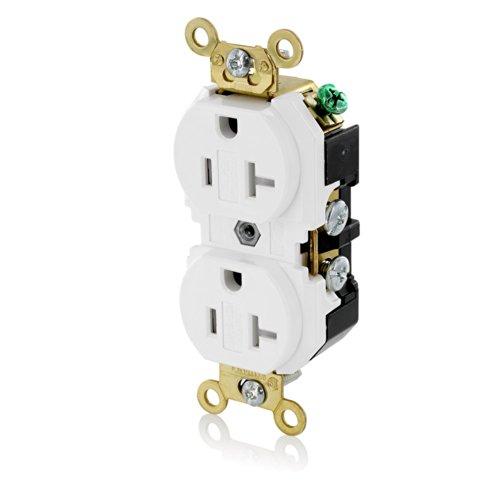
The one to put in an unheated garage. Extra heavy-duty industrial grade, a brass strap, back or side wiring, tamper-resistant shutters as standard, and the widest published temperature range in this group.
What is good
- Published to -40 C and up to 75 C, the widest range in this group
- Brass strap rather than plated steel, which is the mark of the top grade
- Back or side wiring, so an electrician can make a tidier, lower-resistance joint
- Tamper-resistant shutters included rather than a separate part number
- 250-cycle overload test at 200% of rating, published
What is not
- Roughly ten times the price of the plain commercial part
- Tamper-resistant shutters are stiff at first and some people dislike them
- Still a 120 V, 20 A outlet -- it does not change Level 1 charging speed
- Leviton publishes a tamper-resistant notice worth reading before you fit it in a garage
| Rating | 20 A, 125 V AC, NEMA 5-20R |
|---|---|
| Grade | Extra Heavy-Duty Industrial Specification Grade |
| Tamper resistance | Yes, shuttered |
| Grounding | Self-grounding |
| Body and face | Nylon |
| Strap | Brass, 0.050 in |
| Termination | Back or side wire; 14-10 AWG |
| Operating temperature | -40 C to 75 C |
| Temperature rise | Max 30 C after 250 cycles at 200% of rated current |
| Flammability | Rated V-2 per UL94 |
| Standards | UL 498, CSA C22.2 No. 42, Fed Spec W-C 596 |
| Warranty | 10 years limited |
| UPC | 078477868720 |
Skip this if: Skip it if the outlet is indoors and warm and you would rather spend four dollars than thirty-five. Tamper-resistant shutters also make a stiff plug stiffer for the first few insertions.
Specifications above are the manufacturer’s published figures. Source: Leviton. We have not tested this unit — see how we pick.
2. A garage 120 V outlet that needs GFCI protection
Leviton GFTR2 20 A SmartlockPro self-test hospital grade GFCI receptacle
Leviton · NEMA 5-20 · 20 A / 2.4 kW
The GFCI version, and the one the code conversation is usually about: a Class A 5 mA self-test device rated 20 A with a 10 kA short-circuit rating, tamper-resistant, with the wallplate in the box.
What is good
- Class A 5 mA trip level published, which is the figure the code language is written around
- Self-test, so the device checks its own trip mechanism rather than relying on you pressing the button
- V-0 flammability and a 10 kA short-circuit rating -- the toughest ratings in this group
- Tamper-resistant and hospital grade, with the wallplate included
- Back and side wiring, solid or stranded
What is not
- 2-year warranty, against 10 years on the non-GFCI parts
- Do not stack it behind a GFCI breaker; pick one device or the other
- Narrower published range than the 5362-SG (-35 C against -40 C)
- Hospital grade is a cost a garage may not need; the plain GFCI version is cheaper
| Rating | 20 A, 125 V AC, NEMA 5-20R |
|---|---|
| Trip level | Class A, 5 mA plus or minus 1 mA |
| Self-test | Yes -- SmartlockPro self-test, with power indication |
| Grade | Extra Heavy-Duty Hospital Grade |
| Tamper resistance | Yes |
| Short-circuit current rating | 10 kA |
| Body / face material | Polycarbonate body, PBT face |
| Strap | Galvanized steel |
| Termination | Back and side wire; 14-10 AWG solid or stranded |
| Operating temperature | -35 C to +66 C |
| Flammability | Rated V-0 per UL94 |
| Standards | UL 943, UL 498, CSA C22.2 No. 42 & 144, Fed Spec W-C-596 |
| In the box | Wallplate included |
| Warranty | 2 years limited |
Skip this if: Skip it if the circuit is already protected by a GFCI breaker at the panel -- two devices in series is how you get mystery trips. Skip it too if you want a 10-year warranty; this one is two years.
Specifications above are the manufacturer’s published figures. Source: Leviton. We have not tested this unit — see how we pick.
3. A garage or utility outlet where the face plate matters
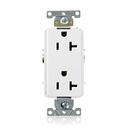
Leviton Decora Plus 16342 20 A spec grade duplex receptacle
Leviton · NEMA 5-20 · 20 A / 2.4 kW
The same electrical job as the CR020 in a Decora face, with a thermoplastic nylon body and face, a tougher published overload test and the same 10-year warranty. Buy it when the outlet is somewhere you look at.
What is good
- Published 250-cycle overload test at 200% of rating -- a tougher stated test than the plain commercial part
- Thermoplastic nylon body and face rather than unspecified plastic
- Decora opening matches the rest of a modern plate run
- 10-year warranty
- 1 HP motor rating, a useful proxy for inrush tolerance in a garage
What is not
- Costs more than the CR020 for the same amperage and voltage
- Needs a Decora wallplate, a second purchase if you do not have one
- No tamper resistance
- Side wire only
| Rating | 20 A, 125 V AC, NEMA 5-20R |
|---|---|
| Grade | Commercial Specification Grade; Leviton markets the line as Heavy-Duty Industrial |
| Grounding | Self-grounding |
| Body and face | Thermoplastic nylon |
| Strap | Zinc-plated steel |
| Termination | Side wire; 14-10 AWG |
| Temperature rise | Max 30 C after 250 cycles at 200% of rated current |
| Operating temperature | -40 C to 60 C |
| Flammability | Rated V-2 per UL94 |
| Horsepower | 1 HP at rated voltage |
| Warranty | 10 years limited |
| UPC | 078477788264 |
Skip this if: Skip it if the outlet lives behind a workbench -- the CR020 is electrically equivalent and cheaper. Skip it too if you want tamper resistance.
Specifications above are the manufacturer’s published figures. Source: Leviton. We have not tested this unit — see how we pick.
4. Replacing a worn garage outlet used for Level 1 charging
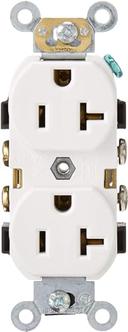
Leviton CR020 20 A commercial spec grade duplex receptacle
Leviton · NEMA 5-20 · 20 A / 2.4 kW
The cheapest step out of builder-grade for a 120 V garage outlet: a commercial specification grade 20 A receptacle with brass line contacts, a self-grounding strap and a 10-year warranty, for the price of a sandwich.
What is good
- Brass line contacts and a published temperature-rise test, which builder-grade parts do not state
- Self-grounding strap, so the ground does not depend on a box screw
- 10-year warranty on a part that costs a few dollars
- Specified terminal torque, which is the number a careful electrician will actually use
- The right grade for an outlet that holds a plug under load for eight hours a night
What is not
- No tamper resistance at this grade
- Side wire only -- no back-wire clamp
- It is still a 20 A, 120 V outlet: it does not make Level 1 charging faster
- Changing a receptacle is electrician work for most people, which is a call-out charge on a $4 part
| Rating | 20 A, 125 V AC, NEMA 5-20R |
|---|---|
| Grade | Commercial Specification Grade |
| Grounding | Self-grounding |
| Line contacts | Brass, 0.031 in thick |
| Ground clips | Brass |
| Strap | Zinc-plated steel |
| Termination | Side wire; 14-10 AWG; 14-18 in-lb terminal torque |
| Temperature rise | Max 30 C after 100 cycles at 150% of rated current |
| Operating temperature | -40 C to 60 C |
| Flammability | Rated V-2 per UL94 |
| Standards | UL 498, Fed Spec W-C-595G, CSA C22.2 No. 42 |
| Warranty | 10 years limited |
Skip this if: Skip it if the outlet shares a 15 A circuit with half the garage -- the receptacle is not the problem then, the circuit is. Skip it too if you want tamper resistance; the 5362-SG is the version with it.
Specifications above are the manufacturer’s published figures. Source: Leviton. We have not tested this unit — see how we pick.
5. Travel and rentals
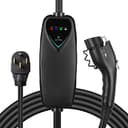
Lectron portable Level 2 charger
Lectron · J1772 · 32 A / 7.7 kW · 21 ft cable
A plug-in portable that runs at Level 2 speed from a NEMA 14-50 and drops to a standard wall outlet with the included adapter. The travel unit, not the garage unit.
What is good
- Level 2 speed from a NEMA 14-50 without an installed charger
- Falls back to a standard household outlet with the adapter
- Small enough to keep in the trunk
What is not
- 32 A ceiling, meaningfully slower than a 48 A wall unit
- Not weather-rated for permanent outdoor mounting
- Repeated plugging and unplugging wears a NEMA 14-50 receptacle faster than a hardwired unit
| Maximum output | 32 A / 7.7 kW at 240 V |
|---|---|
| Connector | SAE J1772 |
| Plug | NEMA 14-50, with an adapter for a standard outlet |
| Use | Portable. Lives in the car, not on the wall |
Skip this if: Skip it if this is your only charger and you have a garage. A wall unit is faster and does not live in your trunk.
Specifications above are the manufacturer’s published figures. Source: Lectron. We have not tested this unit — see how we pick.
What Level 1 actually gets you
It is worth closing on the thing the outlet is for. The Department of Energy puts Level 1 at roughly 5 miles of range per hour against about 25 for Level 2. Over a 10-hour night that is around 50 miles, which is more than the average US daily drive -- so for a second car, a plug-in hybrid or a short commute, 120 V is a complete answer rather than a stopgap. Do you need a Level 2 charger walks through where the line is, and the best Level 1 EV charger covers the cord itself.
The fifth pick below is the cord, and it is here because it is the one that works both ways: the Lectron portable runs at Level 2 speed from a 240 V outlet and drops to a standard wall outlet with the adapter in the box. If you are specifying a good 120 V receptacle today and may add a 240 V circuit later, that is the cord that follows you across. The four receptacles above it are the part that stays in the wall.
FAQ
Questions people actually ask
What kind of outlet do I need for Level 1 EV charging?
Does a better outlet make Level 1 charging faster?
Should the garage outlet be GFCI protected for EV charging?
Can I use a 15 amp outlet for Level 1 charging?
Is it safe to charge an EV from an extension cord?
Sources
Where these numbers come from
- 5362-SGW, 20 Amp Duplex Receptacle, Industrial Grade, Tamper-Resistant — LevitonExtra Heavy-Duty Industrial Specification Grade, tamper-resistant, 20 A, 125 V, back or side wire, NEMA 5-20R, self-grounding. Operating temperature -40C to 75C; temperature rise max 30C after 250 cycles at 200 percent rated current; strap material brass .050 in; body and face nylon; flammability V-2 per UL 94; standards UL 498, CSA C22.2 No. 42, FedSpec W-C 596; warranty 10-Year Limited. Read 2026-11-07.
- GFTR2-HGW, 20 Amp SmartlockPro GFCI Receptacle, Hospital Grade — LevitonSmartlockPro Self-Test GFCI duplex receptacle, Extra Heavy-Duty Hospital Grade, wallplate included, tamper-resistant, power indication, 20 A, 125 V, back and side wire, NEMA 5-20R, self-grounding. Trip level Class A, 5mA plus or minus 1mA; short circuit current rating 10kA; flammability V-0 per UL 94; operating temperature -35C to +66C; standards UL 943, UL 498, CSA C22.2 No. 42 & 144, FedSpec W-C-596; warranty 2-Year Limited. Read 2026-11-07.
- 16342-W, 20 Amp Decora Plus Duplex Receptacle, Industrial Grade — LevitonDecora Plus, Heavy-Duty Industrial Specification Grade, 20 A, 125 V, side wire, NEMA 5-20R, self-grounding. Body and face thermoplastic nylon; strap zinc-plated steel; temperature rise max 30C after 250 cycles at 200 percent rated current; operating temperature -40C to 60C; 1 HP at rated voltage; warranty 10-Year Limited; UPC 078477788264. Read 2026-11-07.
- CR020-W, 20 Amp Duplex Receptacle, Commercial Grade, Self-Grounding — LevitonCommercial Specification Grade, 20 A, 125 V, side wire, NEMA 5-20R, self-grounding. Line contacts brass .031 thick; ground clips brass; strap zinc-plated steel; screw terminal torque 14-18 in-lbs; terminal accommodation 14-10 AWG; temperature rise max 30C after 100 cycles at 150 percent rated current; operating temperature -40C to 60C; standards UL 498, Fed Spec W-C-595G, CSA C22.2 No. 42; warranty 10-Year Limited. Read 2026-11-07.
- Electric Vehicle Charging Infrastructure: charging levels — U.S. Department of Energy, Alternative Fuels Data CenterAC Level 1 uses a 120 V household outlet and adds roughly 5 miles of range per hour of charging, assuming 1.9 kW. AC Level 2 equipment offers charging through 240 V (typical in residential applications) or 208 V (typical in commercial applications) service, can range from 2.9 to 19.2 kW output, and adds roughly 25 miles of range per hour. Read 2026-11-07.
- Charging Electric Vehicles at Home — U.S. Department of Energy, Alternative Fuels Data CenterLevel 1 charging equipment typically comes with the vehicle and plugs into a standard 120 V outlet; most drivers charge at home overnight, and home charging is the least expensive and most convenient option. Read 2026-11-07.
Read next
Related reading
- The best Level 1 EV chargersLevel 1 charging on a normal outlet: what it delivers, and when to buy anything at all.
- The best NEMA 14-50 outlet for EV chargingWhich NEMA 14-50 receptacle to specify, and why the cheap one is a false economy.
- Why your EV charger keeps tripping the GFCI breakerWhy GFCI breakers trip on EV chargers and the safe sequence for diagnosing it.
- Do you actually need a Level 2 charger?The honest test for whether you need a Level 2 charger, or whether Level 1 is enough.