Circuits
Does an EV charger need its own circuit?
Short answer: yes. The longer answer explains the one exception, and why the rule exists at all.
By Sawyer V. · Published September 23, 2026
How this page is funded: we earn a commission if you buy through our Amazon links, at no extra cost to you. It does not change what we recommend, and we say plainly when the honest answer is to buy nothing. Full disclosure.
It is a fair question, because a car charger looks like an appliance and plenty of appliances share circuits. Charging does not, and the reason is duration: an EV draws its full rated current for hours at a time, which is a load profile almost nothing else in a house has.
The rule
NEC 625.42 requires each piece of EV charging equipment to be supplied by a dedicated branch circuit, unless an approved energy management system is used. NEC 625.41 then classifies charging as a continuous load, so the circuit is rated at 125% of the charger's maximum current.
What 125% means in practice
A 40 A charger: 40 x 1.25 = 50 A circuit
A 48 A charger: 48 x 1.25 = 60 A circuit
Read the other way: a 50 A circuit allows 50 x 0.80 = 40 A of continuous charging
This is why a 48 A charger cannot go on a 50 A breaker, even though 48 is less than 50
The Department of Energy makes the same point about home installations: EV charging infrastructure is treated as a continuous load by the NEC, and even a Level 1 cordset is expected to be on a dedicated branch circuit near the parking spot. Breaker and wire size has the full ladder.
What 'dedicated' rules out
- The garage receptacles. The freezer, the compressor and the power tools stay on their own circuit.
- Lighting. A charger drawing 40 A is not something to share with the lights you need to see the fault by.
- A second charger, unless the pair is designed to share through power sharing or an energy management system.
- The dryer, unless you use a listed switching device. Charging from a dryer outlet.
The exception: energy management
The dedicated-circuit rule has one door in it, and it is the reason load-managed chargers exist. Where an approved energy management system is in place, the circuit can be shared or the charger's draw can be limited so the total stays within what the service can carry. NEC 2023 also allows multiple chargers to share a single branch circuit through such a system.
That is how a house with a 100 A service, or a full panel, can end up with a Level 2 charger anyway. Load management explained covers how it works, and chargers with load management covers the units that include it.
What this means for your quote
- A free breaker space is needed for a two-pole breaker -- two slots, not one.
- Spare capacity is a separate question from spare space. Load calculation settles it.
- A cable run from panel to charger. Distance drives cost more than anything except the panel itself. Voltage drop.
- A permit, in most places. The Department of Energy notes that installations must comply with local codes and that permits may be required. Permits.
If the answer comes back as a panel upgrade, get a second quote that prices a load-managed charger instead. Sometimes the cheaper project is the different charger, not the bigger panel.
Plug-in units are not an exception
A charger that plugs into a NEMA 14-50 still wants that receptacle on its own circuit. The receptacle is the connection method; it does not change the load. Hardwired vs plug-in covers what does change between the two.
The breaker that circuit sits on
Two Square D QO examples, one per tier. Only correct for a QO panel -- yours takes the family its label names.
1. Square D QO panels
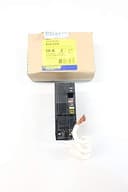
Square D QO250GFI 50 A GFCI breaker
Square D (Schneider Electric) · Panel breaker · 50 A
A 50-amp, two-pole GFCI breaker for Square D QO load centers -- the circuit a 40-amp charger or a NEMA 14-50 outlet needs, with Class A 6 mA ground-fault protection. Only correct if your panel is a QO.
What is good
- The circuit rating a 40 A charger or a NEMA 14-50 receptacle requires
- Ground-fault protection built into the breaker
- UL listed and CSA approved, per the distributor listing
What is not
- Only for Square D QO load centers
- A GFCI breaker plus a charger's own ground-fault detection can nuisance-trip
- Panel work is licensed -- not a part to fit yourself
| Rating | 50 A, 2-pole, 120/240 V |
|---|---|
| Ground-fault protection | Class A, 6 mA |
| Interrupting rating | 10 kA at 120 V |
| Mounting | Plug-in, Square D QO load centers |
| Size | 4.12 x 1.5 x 2.91 in |
| Listings | UL listed, CSA approved |
Skip this if: Skip it if your panel is not a Square D QO. A breaker has to be one your panel is listed to accept, and a QO breaker in another brand's panel is the wrong part.
Specifications above are the manufacturer’s published figures. Source: SimplyBreakers (distributor listing). We have not tested this unit — see how we pick.
2. Square D QO panels
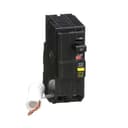
Square D QO260GFI 60 A GFCI breaker
Square D (Schneider Electric) · Panel breaker · 60 A
A 60-amp, two-pole GFCI breaker for Square D QO panels -- the circuit a 48-amp charger needs, with 6 mA ground-fault protection built in. Only correct if your panel is a QO.
What is good
- The exact circuit rating a 48 A charger requires
- Ground-fault protection built into the breaker
- A bolt-on version, the QOB260GFI, is listed for QOB panelboards
What is not
- Only for Square D QO panels
- A GFCI breaker plus a charger's own ground-fault detection can nuisance-trip
- Panel work is licensed -- not a part to fit yourself
| Rating | 60 A, 2-pole, 120/240 VAC |
|---|---|
| Ground-fault protection | GFCI, 6 mA |
| Interrupting rating | 10 kA |
| Mounting | Plug-on, Square D QO |
| Neutral | Pigtail |
| Bolt-on version | QOB260GFI |
Skip this if: Skip it if your panel is not a Square D QO. A breaker has to be one your panel is listed for, and a QO breaker in another brand's panel is the wrong part.
Specifications above are the manufacturer’s published figures. Source: GMES (distributor listing), SimplyBreakers (distributor listing). We have not tested this unit — see how we pick.
FAQ
Questions people actually ask
Can an EV charger share a circuit with anything else?
Can two EV chargers share one circuit?
Does a plug-in charger need a dedicated circuit too?
Why is the circuit bigger than the charger?
Sources
Where these numbers come from
- NEC Article 625: EV charging equipment — WireRef625.41 continuous load rated at 125%, 625.42 dedicated branch circuit and the energy-management exception, 625.54 GFCI protection and the double-GFCI nuisance-tripping problem. Read 2026-09-23.
- Charging Electric Vehicles at Home — U.S. Department of Energy, Alternative Fuels Data CenterOutdoor installation and use are safe with outdoor-rated equipment; EV charging is a continuous load under the NEC; permits may be required; an electrician can say whether a home has the capacity. Read 2026-09-23.
Read next
Related reading
- What size breaker and wire does an EV charger need?Breaker and wire size for every charger amperage, with the 125% rule worked through.
- Load management: charging without a panel upgradeHow load management avoids a panel upgrade, what it costs in speed, and when to use it.
- Can your electrical panel take an EV charger?What a load calculation is, what goes into it, and how to get a rough answer yourself.
- Hardwired or plug-in: which EV charger install is right?NEMA 14-50 or hardwired: amperage limits, cost, portability and what inspectors prefer.