Moving
Taking your EV charger with you when you move
A plug-in charger comes off the wall in two minutes. A hardwired one is a conversation with two electricians and possibly a buyer.
By Sawyer V. · Published September 27, 2026
How this page is funded: we earn a commission if you buy through our Amazon links, at no extra cost to you. It does not change what we recommend, and we say plainly when the honest answer is to buy nothing. Full disclosure.
Anyone who has bought a charger starts thinking about this the moment they list the house. The answer depends on one decision you made at installation: plug-in or hardwired.
If it plugs in
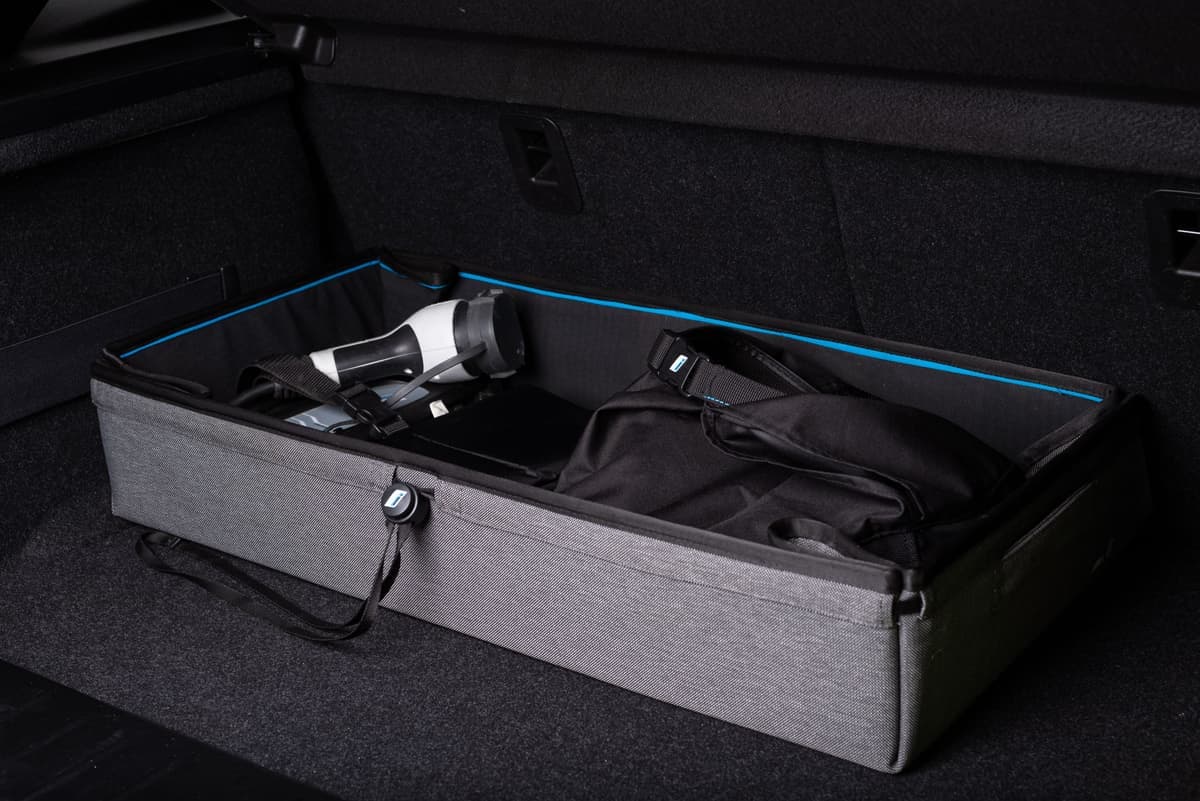
A charger on a NEMA 14-50 is an appliance. Unplug it, take the mounting bracket off the wall, coil the cable, and it is in the car with everything else. The outlet stays -- it is part of the house, and it is a genuine selling point to mention in the listing.
This is the strongest practical argument for buying a plug-in charger in the first place, and it costs nothing at purchase: most makers sell the same unit both ways. Hardwired vs plug-in and plug-in chargers.
If it is hardwired
- An electrician disconnects it and makes the circuit safe -- usually by fitting a blank cover or a receptacle in its place.
- You pay for that visit, and for the install at the new house.
- The old circuit stays behind either way, so the next owner has a ready-made EV circuit.
- Check the new home's panel before booking anything. A 48 A charger needs a 60 A circuit there too.
Two electrician visits for a charger you already own can approach the price of a new one. Get both quotes before deciding it is obviously worth it.
The case for leaving it
- It is a selling feature. A working home charger is a visible, understandable upgrade for an EV-driving buyer.
- No removal or refit cost, and no patching the wall.
- The new house may need different hardware -- a different connector, a different amperage, or an outdoor-rated unit.
- Your next car may have a different port. NACS chargers covers what has changed.
Before you move it
- Find the panel in the new house and photograph the label and the open panel.
- Check the parking spot and measure the cable path. Cable length.
- Get a load calculation if the service looks small. Load calculation.
- Keep the mounting hardware and manual -- the bracket is model-specific and awkward to replace.
- Take photos of the working installation before it comes down, so the next electrician can see how it was wired.
If you are buying rather than selling, this is also a question to ask about the house you are viewing: is the charger included, and if not, does the circuit stay? The circuit is worth more than the box on the wall.
Chargers that move easily
Both plug into a NEMA 14-50, so they come off the wall with the bracket.
1. Grizzl-E toughness, with an app
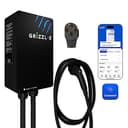
Grizzl-E Classic Connect
United Chargers · J1772 · 40 A / 9.6 kW · 25 ft cable
The next-generation Grizzl-E: 40 A on a NEMA 14-50, a 25 ft cable, a UL Type 4 indoor/outdoor rating -- and, unlike the Classic, Wi-Fi and the Grizzl-E Connect app. Sold with a J1772 or NACS cable.
What is good
- 25 ft cable, a foot longer than the Classic Extreme Edition's
- Wi-Fi app with schedules and charging statistics, which the Classic deliberately lacks
- UL/cUL listed, with a published file number
- Rated to run from -22 F to 122 F
What is not
- 40 A ceiling, with no hardwired 48 A version
- Sold with a NEMA 14-50 plug; the Classic's 6-50 option is not among the Connect listings we found
- The app needs 2.4 GHz Wi-Fi where the charger is mounted
| Maximum output | 40 A / 9.6 kW at 240 V (the maker lists 10 kW) |
|---|---|
| Adjustable | 16 A to 40 A |
| Connector | SAE J1772 or NACS, chosen at purchase |
| Cable | 25 ft (7.6 m) |
| Plug | NEMA 14-50 |
| Enclosure rating | UL Type 4, indoor and outdoor |
| Operating temperature | -22 F to 122 F |
| Size | 10.25 x 6.25 x 3.75 in |
| Connectivity | Wi-Fi (2.4 GHz) and the Grizzl-E Connect app |
| Certification | UL/cUL, file E510712 |
| Warranty | 3 years; 5-year warranty sold separately |
Skip this if: Skip it if you wanted a Grizzl-E precisely because it has no app -- the original Classic is still the no-software choice -- or if you want 48 A. The Classic Connect is a 40 A plug-in unit.
Specifications above are the manufacturer’s published figures. Source: United Chargers. We have not tested this unit — see how we pick.
2. Long reach outdoors
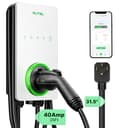
Autel MaxiCharger AC Home
Autel Energy · J1772 · 50 A / 12 kW · 25 ft cable
The 25 ft cable is the longest in this group, and the NEMA 4 case plus a cold-flexible cord make it the easiest unit to live with on an exposed outside wall.
What is good
- 25 ft cable, the longest of the wall units here
- Sold in NEMA 14-50, NEMA 6-50 and hardwired versions
- NEMA Type 4 enclosure rated for rain, snow, hail and sleet
- Wi-Fi and Bluetooth, so it still works if the Wi-Fi drops
What is not
- The 50 A version is hardwired only
- The app has more features than a first-time owner needs
| Maximum output | 50 A / 12 kW hardwired; 40 A / 9.6 kW plug-in |
|---|---|
| Connector | SAE J1772 |
| Cable | 25 ft |
| Enclosure | NEMA Type 4 |
| Certification | Tested to UL standards by CSA |
| Warranty | 3 years |
Skip this if: Skip it if your parking spot is right next to the panel. You are paying for cable you will coil up and never use.
Specifications above are the manufacturer’s published figures. Source: Autel Energy. We have not tested this unit — see how we pick.
FAQ
Questions people actually ask
Can I take my EV charger when I move?
Does the wiring come with me?
Is a home charger a selling point?
Is it cheaper to move a charger or buy a new one?
Sources
Where these numbers come from
- Grizzl-E Classic Connect 40A — United Chargers40 A plug-in charger on a NEMA 14-50 plug, with a 25 ft cable.
- MaxiCharger AC Elite Home 40A specifications — Autel EnergySold in NEMA 14-50, NEMA 6-50 and hardwired versions.
- Charging Electric Vehicles at Home — U.S. Department of Energy, Alternative Fuels Data CenterInstallations must comply with local and state codes and permits may be required; an electrician can say whether a home has the capacity; outdoor installation and use are safe with outdoor-rated equipment. Read 2026-09-27.
Read next
Related reading
- Hardwired or plug-in: which EV charger install is right?NEMA 14-50 or hardwired: amperage limits, cost, portability and what inspectors prefer.
- The best plug-in EV chargersPlug-in chargers for a NEMA 14-50: portable, swappable, and capped at 40 amps.
- The best EV chargers for rentersChargers that leave with you when the lease ends, and what to ask your landlord first.
- The NEMA 14-50 outlet, explainedWhat a NEMA 14-50 is, the circuit it needs, its 40-amp charging limit, and what to specify.