Solar
The best EV chargers for a home with solar
A charger cannot see your solar panels on its own. Solar-matched charging needs a meter, a charger that listens to it, and a car that is at home while the sun is up.
By Sawyer V. · Published September 10, 2026
How this page is funded: we earn a commission if you buy through our Amazon links, at no extra cost to you. It does not change what we recommend, and we say plainly when the honest answer is to buy nothing. Full disclosure.
Any charger will charge your car from a house with solar panels -- the electricity is all the same once it is in your wiring. What "solar charging" actually means is narrower and more useful: a charger that watches how much your panels are producing and charges only from the surplus, rather than drawing from the grid.
Solar picks
Ranked for a first home charger. Every row jumps to the full write-up below.
| # | Product | Best for | Max output | Price |
|---|---|---|---|---|
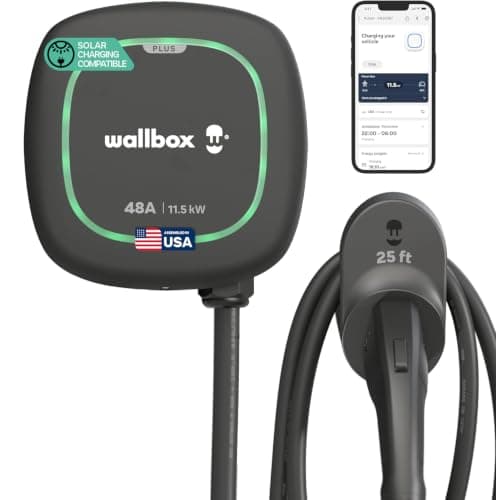
| 1 |  Wallbox Pulsar PlusTight wall space. J1772, 25 ft cable. Wallbox Pulsar PlusTight wall space. J1772, 25 ft cable. | Tight wall space | 48 A11.5 kW | $699.00 · View on Amazon#ad how we are funded · price as of October 27, 2026 |
| 2 | Emporia Level 2 EV Charger (Classic)A first charger, hardwired. J1772, 25 ft cable. | A first charger, hardwired | 48 A11.5 kW | Check price on Amazon#ad how we are funded |
| 3 |  Emporia Vue 3 home energy monitorCircuit-level detail. In-panel sensors. Emporia Vue 3 home energy monitorCircuit-level detail. In-panel sensors. | Circuit-level detail | — | $199.99 · View on Amazon#ad how we are funded · price as of October 27, 2026 |
What it takes
The charger has to know what your panels are producing and what the house is using, moment to moment. That information comes from a meter or monitor at your electrical panel, and each manufacturer wants its own:
| Charger | Needs | What it does |
|---|---|---|
| Wallbox Pulsar Plus | Wallbox Power Meter | Charges from 100% solar or a mix of solar and grid -- you choose in the app |
| Emporia Level 2 | Emporia Vue energy monitor | Starts charging when your panels produce more than the house uses |
The honest catch: timing
Solar produces in the middle of the day. Most cars are at work in the middle of the day. That mismatch is the whole question.
An illustrative sunny day
Suppose your monitor shows 4 kW spare at midday -- your own number will differ
4 kW of surplus for 5 hours = 20 kWh
At 3.5 mi/kWh, about 70 miles of range -- if the car is plugged in at home
Parked at the office, the same car collects none of it.
So solar-matched charging pays off for a specific household: someone who works from home, a second car that stays home, a retired driver. For a commuter car that is home only at night, the sun is down when it plugs in.
Why the monitor is useful anyway
The Emporia Vue measures up to 16 individual circuits, including the EV charger's, and supports solar and net-metering monitoring. Even when the car is not home at midday, it tells you exactly what charging costs and how much headroom your panel has. Emporia Vue vs Sense.
The solar picks in detail
Two chargers that can follow your solar output, and the monitor that makes the Emporia version work. Each entry ends with the case against it.
1. Tight wall space
Wallbox Pulsar Plus
Wallbox · J1772 · 48 A / 11.5 kW · 25 ft cable
The smallest 48 A unit here at roughly 7.8 by 7.9 inches, which matters more than it sounds when the only free wall is beside a door.
What is good
- Smallest body of the 48 A units, under 8 inches square
- Current configurable in steps from 6 A to 48 A
- NEMA Type 4 enclosure, rated down to -22 F
- Weighs 4.4 lb without the cable, so mounting is simple
What is not
- Hardwired only at 48 A, with no plug-in version at full output
- Setup runs through the app, which some owners find fussy
| Maximum output | 48 A / 11.5 kW at 240 V |
|---|---|
| Configurable current | 6 A to 48 A |
| Connector | SAE J1772 |
| Cable | 25 ft |
| Body size | 7.8 x 7.9 x 3.9 inches without the cable |
| Operating temperature | -22 F to 104 F |
| Certification | UL 2594, UL 2231 |
| Warranty | 3 years |
Skip this if: Skip it if you want a plug-in unit you can take with you. The 48 A Pulsar Plus is hardwired.
Specifications above are the manufacturer’s published figures. Source: Wallbox, Wallbox. We have not tested this unit — see how we pick.
2. A first charger, hardwired
Emporia Level 2 EV Charger (Classic)
Emporia · J1772 · 48 A / 11.5 kW · 25 ft cable
The safe default for a first home charger: 48 amps hardwired, a genuinely long cable, a NEMA 4 outdoor-rated case, and no subscription attached to the app.
What is good
- 48 A hardwired is the fastest tier most homes can realistically support
- 25 ft of cable reaches across a two-car garage without a fight
- NEMA Type 4 enclosure is rated for outdoor mounting
- Energy monitoring in the app with no subscription
What is not
- Drops to 40 A if you use the NEMA 14-50 plug rather than hardwiring
- The app is the only way to change the amperage setting
| Maximum output | 48 A / 11.5 kW at 240 V (hardwired) |
|---|---|
| Plug-in output | 40 A with the NEMA 14-50 plug |
| Connector | SAE J1772 |
| Cable | 25 ft |
| Enclosure | NEMA Type 4, indoor or outdoor |
| Certification | UL listed, Energy Star |
| Warranty | 3 years |
Skip this if: Skip it if you want a unit with no app or network connection at all. The Grizzl-E Classic is the simpler machine.
Specifications above are the manufacturer’s published figures. Source: Emporia Energy. We have not tested this unit — see how we pick.
3. Circuit-level detail

Emporia Vue 3 home energy monitor
Emporia · In-panel sensors
Clamps onto your mains and up to 16 individual circuits, so you can see exactly what the EV charger draws and how much headroom your panel really has. Pairs with Emporia's own charger to charge from surplus solar.
What is good
- Up to 16 circuit sensors, so the EV circuit gets its own exact reading
- Wired Ethernet as well as Wi-Fi, which matters inside a metal panel
- Pairs with the Emporia EV charger to charge from surplus solar
- Shows real panel headroom -- useful before deciding on a charger's amperage
What is not
- Sensors go inside the panel, which is electrician territory
- Routing up to 16 clamps is fiddly in a crowded panel
- Only as useful as the time you spend in the app
| Mains sensors | 2 x 200 A |
|---|---|
| Branch circuit sensors | Up to 16 x 50 A |
| Connectivity | 2.4 GHz Wi-Fi, plus 10/100 wired Ethernet |
| Solar | Monitors net metering without extra equipment |
| 3-phase homes | A separate 3-phase/4-wire model is sold |
| Certification | UL certified |
| Warranty | 1 year |
Skip this if: Skip it if you only want a whole-home total. Sixteen circuit sensors is a lot of hardware to route through a panel for one number.
Specifications above are the manufacturer’s published figures. Source: Emporia Energy, Emporia Energy, Excess Solar, Emporia Energy, 3-phase model. We have not tested this unit — see how we pick.
What we would do
If you already have an Emporia Vue, or want circuit-level energy data anyway, the Emporia charger is the natural pairing. If you want to choose between pure solar and a solar-grid mix, the Pulsar Plus with its Power Meter. And if your car is never home in daylight, skip the solar features and schedule off-peak charging instead -- it costs nothing to set up.
FAQ
Questions people actually ask
What is the best EV charger for solar panels?
Do I need a special charger to charge my EV from solar?
Is solar EV charging worth it if I work away from home?
Sources
Where these numbers come from
- Pulsar Plus EV charger -- solar and smart charger — WallboxCharging from 100% solar or a solar-grid mix, and the Power Meter requirement. Fetched 2026-09-10.
- Excess Solar Management — Emporia EnergySurplus-solar charging with an Emporia EV charger and the Vue Energy Monitor. Fetched 2026-09-10.
- Emporia Vue Energy Monitor — Emporia EnergyMains and branch sensor counts, connectivity, net metering, certification and warranty. Fetched 2026-09-10.
- Pulsar Plus datasheet — Wallbox
- Emporia Level 2 EV Charger specifications — Emporia Energy
Read next
Related reading
- Charging an EV from a home batteryWhat a 5 kWh home battery actually gives a car, why 3.84 kW is the number that matters, and the charger setting that makes it work.
- Smart EV chargers: which ones earn the appWhich Wi-Fi chargers earn their price, and why your car may already do the useful part.
- Emporia Vue vs Sense for EV ownersCircuit-level sensors against machine-learning detection, judged on what an EV owner needs to know.
- Emporia vs Wallbox Pulsar PlusTwo 48-amp units compared: a plug-in option against the smallest body here.
- What it costs to charge an electric car at homeThe formula for your real home charging cost, using your own rate rather than an average.