Home energy
Charging an EV from a home battery
The honest answer is yes, slowly, and probably not for the reason you think. A home battery holds a small fraction of a car battery, and it delivers power at roughly a third the rate of a 48-amp charger.
By Sawyer V. · Published October 17, 2026
How this page is funded: we earn a commission if you buy through our Amazon links, at no extra cost to you. It does not change what we recommend, and we say plainly when the honest answer is to buy nothing. Full disclosure.
The verdict first. You can charge a car from a home battery, and in a power cut it is the difference between a car that moves and one that does not -- but as a routine arrangement it is the wrong way around. A home battery's job is to carry the house through a few expensive or dark hours. An EV battery is five to twenty times larger than a home battery, so pointing one at the other drains the small one to put a rounding error in the big one. Charge the car from the grid in the off-peak window and leave the battery to the house. Time-of-use charging is the mechanism that actually saves the money people buy batteries hoping to save.
The capacity arithmetic
Take a published example rather than a hypothetical one. Enphase rates the IQ Battery 5P at 5.0 kWh of energy capacity, with a DC round-trip efficiency of 96% and an AC round-trip efficiency of 90%. The AC figure is the one that matters, because the car is an AC load. So:
One 5 kWh battery, into a car
5.0 kWh stored x 90% AC round-trip efficiency = about 4.5 kWh delivered.
Cadillac Lyriq at 37 kWh/100 mi: 4.5 / 0.37 = about 12 miles.
GMC Sierra EV at 50 kWh/100 mi: 4.5 / 0.50 = about 9 miles.
GMC Hummer EV at 70 kWh/100 mi: 4.5 / 0.70 = about 6 miles.
Those consumption figures are the EPA's published ratings, not estimates. Twelve miles is a useful number to hold on to: it is an errand, not a commute. Three batteries make it about 36 miles, at three times the hardware cost. kWh and amps explained covers why energy and power are different questions, which is the next one.
The power limit is the real constraint
Capacity decides how far. Power decides whether the charger will run at all. Enphase publishes the 5P at 3.84 kW continuous, with short peaks of 7.68 kW for three seconds and 6.14 kW for ten. Compare that with what a home charger asks for:
| Charger setting | Power drawn | Inside 3.84 kW continuous? |
|---|---|---|
| 16 A | 3.8 kW | Just about -- this is the match |
| 24 A | 5.8 kW | No, above continuous rating |
| 32 A | 7.7 kW | No |
| 40 A | 9.6 kW | No |
| 48 A | 11.5 kW | No, three times the rating |
This is why the charger you own matters more than you would expect. A fixed 40-amp unit asks a single small battery for two and a half times what it can give; what happens next depends on your inverter and your installer, and none of the outcomes are good. An adjustable charger set to 16 amps asks for something the battery can actually supply. How to set your EV charger's amps is the procedure, model by model.
What to own if this is the plan
- An adjustable charger with a published low setting. ChargePoint lists Home Flex settings of 16, 24, 32, 40, 48 and 50 A; the 16 A step is the one that fits a single small battery. Grizzl-E publishes 16 A to 40 A on the Classic Connect.
- Or a charger that backs off on its own. Emporia's Pro ships with PowerSmart load management and the Vue 3 monitor in the box, which is the same idea applied to a crowded panel rather than a battery.
- A monitor on the EV circuit. The car reports energy into its battery; your meter and your home battery care about energy out of the wall. Those are different numbers.
- A conversation with whoever installed the battery. Backup capability on the Enphase unit requires its IQ System Controller, and which circuits a battery is allowed to feed is set at install time, not in an app.
The case where it does make sense
An outage. If the grid is down for a day or more and the car is the only way to the pharmacy, twelve miles from the battery is worth having, and a charger dialed to 16 amps will take them. That is a planning question rather than a shopping question, and it has its own page: EV charging in a power outage.
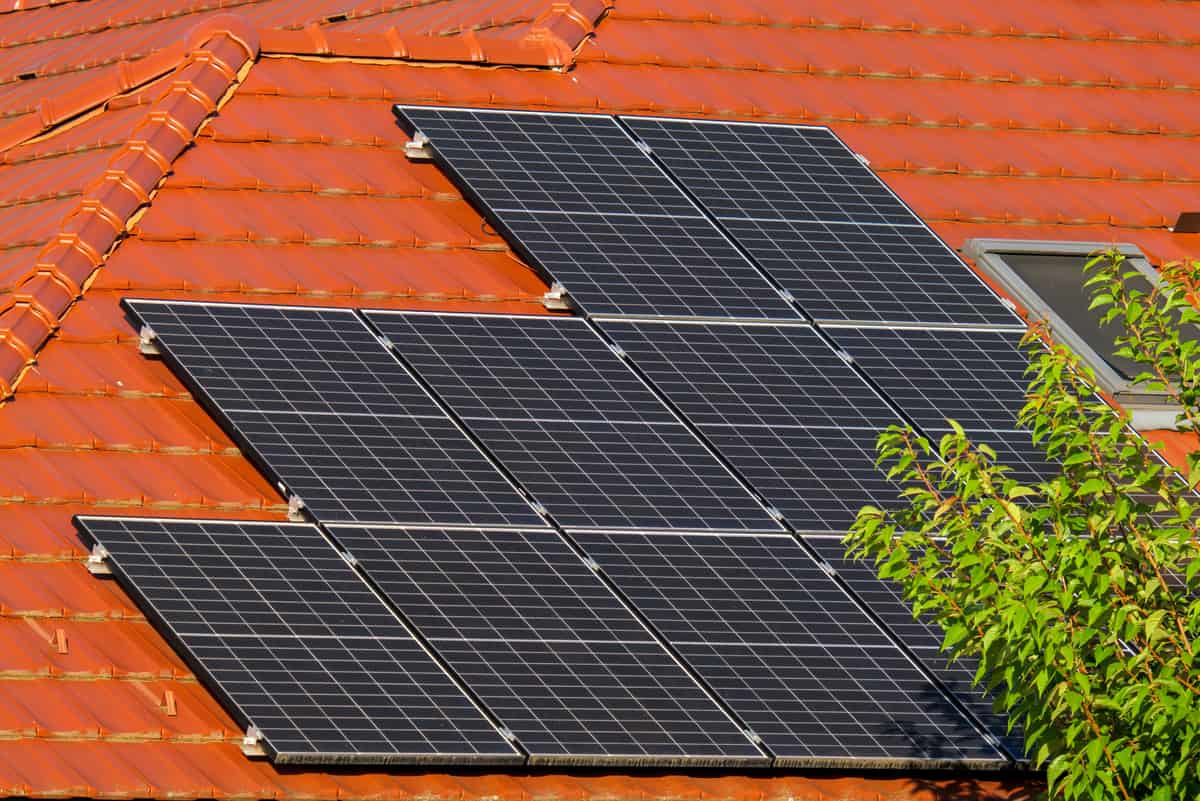
The other honest case is solar with nowhere else to go. If your array is producing more than the house is using and the battery is already full, sending the surplus to the car is better than exporting it for a poor rate -- but the constraint there is sunshine hours, not the battery. Best EV charger for solar covers that timing problem.
The chargers that suit a battery
Adjustable, or self-adjusting, plus the monitor that tells you what actually happened. Live Amazon prices with the date they were read.
1. Homes with an uncertain panel
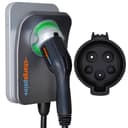
ChargePoint Home Flex
ChargePoint · J1772 · 50 A / 12 kW · 23 ft cable
The most adjustable unit here. It can be set anywhere from 16 A to 50 A, which makes it the one to buy when you do not yet know what your panel will allow.
What is good
- Six selectable amperage settings from 16 A to 50 A
- Sold in both hardwired and NEMA 14-50 versions
- Rated for indoor or outdoor installation
- The app is mature and does not require a subscription
What is not
- 23 ft is a foot shorter than the longest cables in this group
- The 50 A setting needs a bigger circuit than most panels have spare
| Maximum output | 50 A / 12 kW at 240 V |
|---|---|
| Amperage settings | 16, 24, 32, 40, 48 or 50 A |
| Connector | SAE J1772 |
| Cable | 23 ft |
| Installation | Hardwired or NEMA 14-50 |
| Certification | UL listed, Energy Star |
| Warranty | 3 years |
Skip this if: Skip it if your circuit is already fixed and you just want the cheapest safe 40 A unit. You are paying for flexibility you will not use.
Specifications above are the manufacturer’s published figures. Source: ChargePoint, ChargePoint. We have not tested this unit — see how we pick.
2. A tight panel
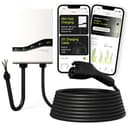
Emporia Pro EV Charger
Emporia · J1772 · 48 A / 11.5 kW · 25 ft cable
Emporia's 48-amp charger with PowerSmart load management built in: the Vue 3 energy monitor comes in the box, and the charger backs off when the rest of the house is busy. The one to look at when your panel is the obstacle.
What is good
- PowerSmart load management included, not an add-on
- Vue 3 energy monitor in the box, for whole-home data
- Emporia says it works even with older 60 or 100 amp services
- J1772 or NACS connector options
What is not
- PowerSmart needs the Vue installed in your panel -- electrician work
- Costs more than the Emporia Classic, which charges at the same 48 A
- Only worth it if your panel is the constraint
| Maximum output | 48 A hardwired; 40 A with a NEMA plug |
|---|---|
| Connector | J1772 or NACS, chosen at purchase |
| Cable | 25 ft |
| Load management | PowerSmart, standard |
| In the box | Emporia Vue 3 energy monitor |
| Installation | NEMA 14-50 plug or hardwired; rear-entry option |
| Certification | UL certified, GFCI-protected |
| Warranty | 3 years |
Skip this if: Skip it if your panel has comfortable room for a full EV circuit. Without that problem you are paying for load management you will not use -- the Emporia Classic charges at the same 48 A.
Specifications above are the manufacturer’s published figures. Source: Emporia Energy, Emporia Energy, Classic vs Pro, Emporia Energy, store. We have not tested this unit — see how we pick.
3. Circuit-level detail
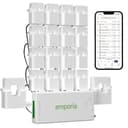
Emporia Vue 3 home energy monitor
Emporia · In-panel sensors
Clamps onto your mains and up to 16 individual circuits, so you can see exactly what the EV charger draws and how much headroom your panel really has. Pairs with Emporia's own charger to charge from surplus solar.
What is good
- Up to 16 circuit sensors, so the EV circuit gets its own exact reading
- Wired Ethernet as well as Wi-Fi, which matters inside a metal panel
- Pairs with the Emporia EV charger to charge from surplus solar
- Shows real panel headroom -- useful before deciding on a charger's amperage
What is not
- Sensors go inside the panel, which is electrician territory
- Routing up to 16 clamps is fiddly in a crowded panel
- Only as useful as the time you spend in the app
| Mains sensors | 2 x 200 A |
|---|---|
| Branch circuit sensors | Up to 16 x 50 A |
| Connectivity | 2.4 GHz Wi-Fi, plus 10/100 wired Ethernet |
| Solar | Monitors net metering without extra equipment |
| 3-phase homes | A separate 3-phase/4-wire model is sold |
| Certification | UL certified |
| Warranty | 1 year |
Skip this if: Skip it if you only want a whole-home total. Sixteen circuit sensors is a lot of hardware to route through a panel for one number.
Specifications above are the manufacturer’s published figures. Source: Emporia Energy, Emporia Energy, Excess Solar, Emporia Energy, 3-phase model. We have not tested this unit — see how we pick.
4. Grizzl-E toughness, with an app
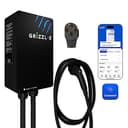
Grizzl-E Classic Connect
United Chargers · J1772 · 40 A / 9.6 kW · 25 ft cable
The next-generation Grizzl-E: 40 A on a NEMA 14-50, a 25 ft cable, a UL Type 4 indoor/outdoor rating -- and, unlike the Classic, Wi-Fi and the Grizzl-E Connect app. Sold with a J1772 or NACS cable.
What is good
- 25 ft cable, a foot longer than the Classic Extreme Edition's
- Wi-Fi app with schedules and charging statistics, which the Classic deliberately lacks
- UL/cUL listed, with a published file number
- Rated to run from -22 F to 122 F
What is not
- 40 A ceiling, with no hardwired 48 A version
- Sold with a NEMA 14-50 plug; the Classic's 6-50 option is not among the Connect listings we found
- The app needs 2.4 GHz Wi-Fi where the charger is mounted
| Maximum output | 40 A / 9.6 kW at 240 V (the maker lists 10 kW) |
|---|---|
| Adjustable | 16 A to 40 A |
| Connector | SAE J1772 or NACS, chosen at purchase |
| Cable | 25 ft (7.6 m) |
| Plug | NEMA 14-50 |
| Enclosure rating | UL Type 4, indoor and outdoor |
| Operating temperature | -22 F to 122 F |
| Size | 10.25 x 6.25 x 3.75 in |
| Connectivity | Wi-Fi (2.4 GHz) and the Grizzl-E Connect app |
| Certification | UL/cUL, file E510712 |
| Warranty | 3 years; 5-year warranty sold separately |
Skip this if: Skip it if you wanted a Grizzl-E precisely because it has no app -- the original Classic is still the no-software choice -- or if you want 48 A. The Classic Connect is a 40 A plug-in unit.
Specifications above are the manufacturer’s published figures. Source: United Chargers. We have not tested this unit — see how we pick.
FAQ
Questions people actually ask
Can you charge an EV from a home battery?
How many miles does a home battery add to an EV?
What charger setting should I use on battery power?
Is it cheaper to charge an EV from a home battery than the grid?
Do I need a special charger to use a home battery?
Sources
Where these numbers come from
- Enphase IQ Battery 5P — Enphase EnergySKU IQBATTERY-5P-1P-NA. Technical specifications: power rating 3.84 kW, energy capacity 5.0 kWh, peak output power 7.68 kW (3 seconds) and 6.14 kW (10 seconds), DC round-trip efficiency 96%, AC round-trip efficiency 90%, depth 7.4 in, width 21.7 in, height 38.6 in, weight 174 lbs. Six embedded IQ8D-BAT microinverters, lithium iron phosphate (LFP) chemistry, passive cooling with no moving parts or fans, 15-year limited warranty, grid-forming capability for backup operation, and backup capability when installed with the IQ System Controller 3/3G. Supports backup, self-consumption and time-of-use modes. Read 2026-10-17.
- Fuel economy of 2026 Cadillac and GMC vehicles — U.S. EPA and U.S. Department of Energy, fueleconomy.govPublished consumption ratings used in the arithmetic on this page: Cadillac Lyriq 37 kWh/100 mi, GMC Sierra EV 50 kWh/100 mi, GMC Hummer EV 70 kWh/100 mi (2025). The EPA rates the 11 kW and 19 kW onboard-charger versions of GM's EVs as separate trims and names the charger in the trim title. Read 2026-10-11.
- ChargePoint Home Flex data sheet — ChargePointAmperage settings of 16, 24, 32, 40, 48 and 50 A, maximum 50 A / 12 kW, 23 ft cable, hardwired or NEMA 14-50 versions, UL listed and ENERGY STAR certified.
- Emporia Pro EV Charger — Emporia EnergyPowerSmart load management included, the Vue 3 energy monitor supplied in the box, 48 A hardwired or 40 A with a NEMA 14-50 plug, 25 ft cable, rear-entry option, UL certified and GFCI protected, 3-year warranty. Emporia says it works even with older 60 or 100 amp services.
- Electric Vehicle Charging Stations: AC Level 2 equipment — U.S. Department of Energy, Alternative Fuels Data CenterAC Level 2 equipment offers charging through 240 V (typical in residential applications) or 208 V (typical in commercial applications) electrical service; a Level 2 unit can range from 2.9 to 19.2 kW output and adds roughly 25 miles of range per hour of charging; Level 1 is about 5 miles per hour, assuming 1.9 kW. All Tesla vehicles come with a J1772 adapter, which allows them to use non-Tesla Level 2 charging equipment. Read 2026-10-17.
Read next
Related reading
- The best EV chargers for a home with solarChargers that match charging to your solar surplus, and when that beats off-peak charging.
- EV charging in a power outageWhy a wall charger stops with the grid, what a battery and a generator really deliver, and the free step that beats both.
- How to set your EV charger's ampsPublished amperage ranges for every charger on this site, the 80% rule, and where each maker puts the setting.
- Charging at night on a time-of-use rateHow time-of-use rates work, how to schedule charging, and how to check the switch pays.
- Charging an EV from a generatorWhy most portable generators refuse to charge an EV, the fix, what it costs per mile, and the cases where it is genuinely worth it.