Winter
The best portable EV charger for cold weather
A wall charger spends winter bolted to a wall. A portable spends it in a trunk at ambient temperature and then gets unrolled on a wet, freezing driveway. Only one of the units on this site publishes a figure for that.
By Sawyer V. · Published November 7, 2026
How this page is funded: we earn a commission if you buy through our Amazon links, at no extra cost to you. It does not change what we recommend, and we say plainly when the honest answer is to buy nothing. Full disclosure.
The verdict: buy the Grizzl-E Mini Connect. Of the five portables this site carries it is the only one whose maker publishes an operating-temperature range, it is the only one in a metal Type 4 indoor/outdoor enclosure, it runs 40 A on a 14-50 with a 25-foot cable, and United Chargers backs it with three years and sells a five-year option at purchase. If your car has a J1772 port rather than NACS, the J+ Booster 2 is the one to look at next -- an aluminum body, ETL certification to UL standards and an IP67, drive-over-resistant rating -- with the caveat that IP67 describes water and dust, not temperature. Everything else in the category is a warm-weather purchase that happens to work in the cold.
Cold-weather portable picks
Ranked for a first home charger. Every row jumps to the full write-up below.
| # | Product | Best for | Max output | Price |
|---|---|---|---|---|
| 1 |  Grizzl-E Mini ConnectA portable that replaces a wall unit. NACS, 25 ft cable. | A portable that replaces a wall unit | 40 A9.6 kW | $349.99 · View on Amazon#ad how we are funded · price as of November 8, 2026 |
| 2 |  J+ Booster 2The best portable overall. J1772, 25 ft cable. | The best portable overall | 40 A9.6 kW | $729.99 · View on Amazon#ad how we are funded · price as of November 8, 2026 |
| 3 |  Lectron Portable Level 2 Tesla EV Charger (40 A)A Tesla-only portable. NACS, 16 ft cable. | A Tesla-only portable | 40 A9.6 kW | $279.99 · View on Amazon#ad how we are funded · price as of November 8, 2026 |
| 4 |  Lectron portable Level 2 chargerTravel and rentals. J1772, 21 ft cable. | Travel and rentals | 32 A7.7 kW | $269.99 · View on Amazon#ad how we are funded · price as of November 8, 2026 |
| 5 | MUSTART Level 2 portable chargerBudget portable. J1772, 25 ft cable. | Budget portable | 40 A9.6 kW |
What winter actually does
Three separate things, and keeping them apart is most of the value of this page. First, range falls: the EPA measures full-electric range dropping roughly 41% at 20 F against 75 F when the cabin heater is running, with more than two thirds of the extra energy going to heating the cabin rather than moving the car. Second, a very cold battery accepts less power until it warms, so a charge can start slower than you expect. Third, the cable stiffens, which is a property of the cable compound.
Only the third is a purchase. The first is physics and the second is the car's thermal management. EV charging in cold weather covers the range and speed effects in full, and why is my EV charging slowly carries the EPA's figures.
What the makers actually publish
| Unit | Operating temperature | Enclosure | Certification | Connector |
|---|---|---|---|---|
| Grizzl-E Mini Connect | -30 C to +50 C (-22 F to 122 F) | Aluminum, Type 4 indoor/outdoor | UL listed, file E510712 | NACS |
| J+ Booster 2 | Not published on the pages we read | Aluminum; IP67, drive-over resistant | ETL certified to UL standards | J1772 |
| Lectron Portable Level 2 Tesla (40 A) | Not published on the pages we read | Portable plug-in unit | UL 2594 / UL 2231, per Lectron | NACS |
| Lectron portable Level 2 (32 A) | Not published on the pages we read | Portable, weather-resistant | Listed to applicable UL standards | J1772 |
| MUSTART Level 2 portable | Not published on the pages we read | Rated by the maker for indoor and outdoor use | See the certification note on its review | J1772 |
This is the same test the best EV charger for cold climates applies to wall units, and the portable category does worse on it. One published range out of five. If you want the number rather than the vibe, there is one unit on this list.
Why a metal case matters more on a portable
A wall charger is fixed, sheltered by the building and never handled. A portable gets coiled, dropped, stood on, driven over and refrozen. The Grizzl-E Mini Connect's aluminum Type 4 case and the J+ Booster 2's aluminum body with a drive-over-resistant IP67 rating are both answers to that, and they are the two units here whose makers describe the physical abuse case at all. EV charger safety certifications explains why a NEMA or IP rating is a separate thing from a UL listing -- both matter, and they are not substitutes.
Where to keep it in winter
- Not on the floor. A control box sitting in slush is the one storage mistake that actually damages equipment. Put it on a shelf, in a bin or on a wall holder -- where to mount a portable EV charger covers that properly.
- Coil it loosely, warm. A cable coiled tight while cold sets in that shape and fights you every night until spring.
- In the trunk, in a bag, if it travels. The case is what gets scuffed first, and a scuffed case is cosmetic -- a scuffed cable is not.
- Check the plug and the connector face for grit before each use. This is what causes most of what gets blamed on the cold. A frozen charge port is the related failure.
- Do not use a heat gun, a hair dryer or de-icer on a connector. The habits on the winter kit page are free and they work.
The five picks
1. A portable that replaces a wall unit
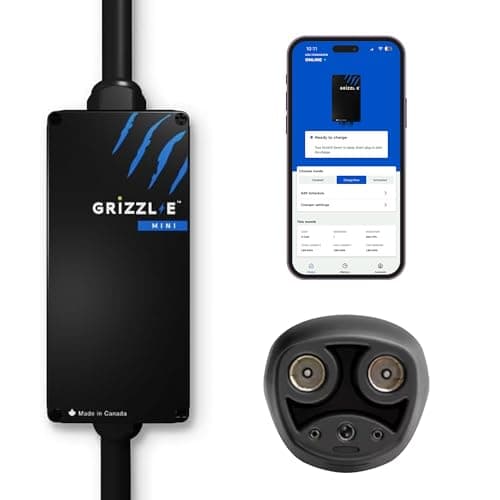
Grizzl-E Mini Connect
United Chargers · NACS · 40 A / 9.6 kW · 25 ft cable
A portable 40 A charger in a metal case, with four adapters, a 25 ft cable and the Grizzl-E Connect app. It does the job of a wall charger and fits in a carrying case.
What is good
- A 25 ft cable, which is wall-charger length on a portable unit
- Four adapters in the box, so one charger covers several outlet types
- Adjustable down to 7 A, lower than most chargers go
- Metal case with a Type 4 indoor/outdoor rating, and a -22 F to 122 F range
- Wi-Fi scheduling and statistics through the Grizzl-E Connect app
What is not
- Priced like a wall charger, not like a spare cable for the trunk
- 40 A is the ceiling, so it cannot match a 48 A hardwired unit
- The live Amazon listing is the NACS version; the J1772 version is sold by the maker
- Heavier than a basic travel cordset at close to 20 lb shipped
- 2.4 GHz Wi-Fi only, like the rest of the Connect range
| Maximum output | 40 A (the maker lists 10 kW) |
|---|---|
| Adjustable | 7 A to 40 A |
| Connector | J1772 or NACS, chosen at purchase |
| Cable | 25 ft (7.6 m) |
| Plug | NEMA 14-50, with four adapters included |
| Enclosure | Aluminum, Type 4 indoor/outdoor rating |
| Operating temperature | -30 C to +50 C (-22 F to 122 F) |
| Size | 6.9 x 3.1 x 2.4 in |
| Weight | 19.84 lb (9 kg), shipped |
| Connectivity | Wi-Fi (2.4 GHz) and the Grizzl-E Connect app |
| Country of origin | Canada, per United Chargers |
| In the box | Charger, 4 adapters, mounting cradle, EasyEvPlug, carrying case |
| Certification | UL, file E510712 |
| Warranty | 3 years, or 5 years chosen at purchase |
Skip this if: Skip it if you want a cheap cable for the trunk. This is a full-price charger that happens to be portable -- and the live Amazon listing is the NACS version.
Specifications above are the manufacturer’s published figures. Source: United Chargers. We have not tested this unit — see how we pick.
2. The best portable overall
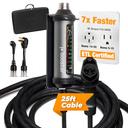
J+ Booster 2
J+ Americas · J1772 · 40 A / 9.6 kW · 25 ft cable
A 40 A portable in a military-grade aluminum body, ETL certified to UL standards and IP67 rated, weighing 2.2 lb without cables. The portable that behaves like a wall unit.
What is good
- 40 A, matching many wall-mounted units
- Eight amperage settings from 6 A to 40 A, so it fits almost any outlet
- Adapters for a wide range of outlets, including NEMA TT-30 for campgrounds
- IP67 and drive-over resistant, which portables usually are not
- 2.2 lb without cables, so it genuinely travels
What is not
- Costs more than most portables, and more than some wall units
- Every extra outlet adapter is a separate purchase
- Still a portable, so it is not rated for permanent outdoor mounting
| Maximum output | 40 A / 9.6 kW at 240 V |
|---|---|
| Adjustable | 6, 8, 12, 16, 20, 24, 32 or 40 A |
| Power range | 1.4 kW to 9.6 kW |
| Connector | SAE J1772 |
| Cable | 21 ft or 25 ft, depending on version |
| Adapters included | NEMA 14-50 and 5-15 |
| Further adapters available | 5-20, 6-15, 6-20, 6-50, TT-30 |
| Weight | 2.2 lb without cables; 7 lb with cables and adapters |
| Body | Military-grade aluminum, drive-over resistant to 6,600 lb wheel loads |
| Rating | IP67 waterproof and dustproof |
| Certification | ETL certified to UL standards |
Skip this if: Skip it if you only ever charge in one place. A hardwired wall unit is cheaper for a fixed installation.
Specifications above are the manufacturer’s published figures. Source: J+ Americas. We have not tested this unit — see how we pick.
3. A Tesla-only portable
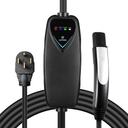
Lectron Portable Level 2 Tesla EV Charger (40 A)
Lectron · NACS · 40 A / 9.6 kW · 16 ft cable
A 40-amp portable with a native NACS connector, so it plugs straight into a Tesla. Sold with or without Wi-Fi, and Lectron publishes UL 2594 / UL 2231 certification.
What is good
- Native NACS connector -- nothing between the plug and a Tesla
- 40 A, the most a 14-50 on a 50 A circuit supplies continuously
- Published UL 2594 / UL 2231 certification
- Choice of an app or a no-app version
What is not
- NACS only -- a J1772 car needs an adapter
- 16 ft of cable, per Lectron's FAQ -- short for a portable, so measure the run
- Needs a 14-50 on a 50 A circuit to run at 40 A
| Output | 40 A / 9.6 kW at 240 V |
|---|---|
| Connector | NACS (Tesla) |
| Plug | NEMA 14-50 |
| Cable | 16 ft, per Lectron's product FAQ |
| Versions | Wi-Fi with the Lectron app, or plug-and-play |
| Certification | UL 2594 / UL 2231, per Lectron |
Skip this if: Skip it if a non-Tesla might ever borrow it. A J1772 portable plus the Tesla's adapter serves both.
Specifications above are the manufacturer’s published figures. Source: Lectron. We have not tested this unit — see how we pick.
4. Travel and rentals
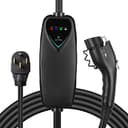
Lectron portable Level 2 charger
Lectron · J1772 · 32 A / 7.7 kW · 21 ft cable
A plug-in portable that runs at Level 2 speed from a NEMA 14-50 and drops to a standard wall outlet with the included adapter. The travel unit, not the garage unit.
What is good
- Level 2 speed from a NEMA 14-50 without an installed charger
- Falls back to a standard household outlet with the adapter
- Small enough to keep in the trunk
What is not
- 32 A ceiling, meaningfully slower than a 48 A wall unit
- Not weather-rated for permanent outdoor mounting
- Repeated plugging and unplugging wears a NEMA 14-50 receptacle faster than a hardwired unit
| Maximum output | 32 A / 7.7 kW at 240 V |
|---|---|
| Connector | SAE J1772 |
| Plug | NEMA 14-50, with an adapter for a standard outlet |
| Use | Portable. Lives in the car, not on the wall |
Skip this if: Skip it if this is your only charger and you have a garage. A wall unit is faster and does not live in your trunk.
Specifications above are the manufacturer’s published figures. Source: Lectron. We have not tested this unit — see how we pick.
5. Budget portable
MUSTART Level 2 portable charger
MUSTART · J1772 · 40 A / 9.6 kW · 25 ft cable
A 40 A portable with an LCD display, adjustable current and a delay timer, at the budget end of the category. The display is genuinely useful on a unit with no app.
What is good
- 40 A from a portable, the same speed as many wall units on a NEMA 14-50
- LCD display shows current, voltage and power without needing an app
- Built-in delay timer for off-peak charging with no phone involved
- Adjustable current, so it works on smaller circuits too
What is not
- Two-year warranty, shorter than the three-year category standard
- We could not verify a specific safety listing from published sources -- confirm before buying
- No app or connectivity of any kind
| Maximum output | 40 A / 9.6 kW at 240 V |
|---|---|
| Adjustable | 15, 25 or 40 A, depending on version |
| Connector | SAE J1772 |
| Cable | 25 ft |
| Plug | NEMA 14-50 |
| Display | LCD showing current, voltage, power and status |
| Delay timer | 1 to 10 hours |
| Warranty | 2 years |
Skip this if: Skip it if you need a documented safety listing you can verify -- see the note below before buying.
Specifications above are the manufacturer’s published figures. Source: MUSTART. We have not tested this unit — see how we pick.
The free fixes that beat the shopping list
- Charge immediately after driving, while the pack is still warm from use. A warm battery accepts power more readily than one that has sat out overnight.
- Precondition the cabin while plugged in, so the energy comes from the wall rather than the battery. The EPA notes that preheating on the charger extends range.
- Plug in every night rather than when low. In winter the cost of topping up is trivial next to starting a cold morning at 20%.
- Hang the cable up and close the port door. Two seconds each, and together they prevent most of what this page is about.
If you are buying for the season rather than for a trip, your winter EV charging kit is the full list in priority order -- and its first pick is a twenty-dollar holster, not a charger.
FAQ
Questions people actually ask
Which portable EV charger is best for cold weather?
Do portable EV chargers work in freezing temperatures?
Does cold weather damage an EV charging cable?
Can I leave a portable charger in the car over winter?
Is a portable charger slower in winter?
Sources
Where these numbers come from
- Grizzl-E Mini — United Chargers40 A / 9.6 kW portable Level 2 charger, 25 ft cable, aluminum Type 4 indoor/outdoor enclosure, UL listed file E510712, NEMA 14-50 plug with four adapters, Grizzl-E Connect app, 3-year warranty with a 5-year option at purchase, published operating temperature -30 C to +50 C.
- J+ BOOSTER 2 — J+ / Ratio Electric40 A portable charger in an aluminum body, ETL certified to UL standards, IP67 rated and drive-over resistant, 25 ft cable.
- Fuel economy in cold weather — U.S. EPA and U.S. Department of Energy, fueleconomy.govRange of a full-electric vehicle can drop by about 41% at 20 F versus 75 F when the cabin heater is used, with more than two thirds of the additional energy going to cabin heating. Read 2026-11-07.
- Electric Vehicle Charging Infrastructure: charging levels — U.S. Department of Energy, Alternative Fuels Data CenterAC Level 1 uses a 120 V outlet and adds roughly 5 miles of range per hour, assuming 1.9 kW. AC Level 2 offers charging through 240 V (typical in residential applications) or 208 V, ranges from 2.9 to 19.2 kW output and adds roughly 25 miles of range per hour. All Tesla vehicles come with a J1772 adapter, which allows them to use non-Tesla Level 2 charging equipment. Read 2026-11-07.
Read next
Related reading
- The best portable EV chargersPortable Level 2 chargers for renters and travelers, with the honest case for buying none.
- The best EV chargers for cold climatesChargers with published low-temperature ratings and cold-flexible cables, plus what winter really costs you.
- Your winter EV charging kitFive winter purchases in priority order, plus the four habits that matter more than any of them.
- The best dual-voltage portable EV chargersPortables that run from a standard outlet and a 240 V outlet, and how fast each one really is.