Troubleshooting
Why is my EV charging so slowly?
Nine causes, in the order to check them. The first four are free to fix and account for most cases -- and only one of them is actually a problem with your charger.
By Sawyer V. · Published October 7, 2026
How this page is funded: we earn a commission if you buy through our Amazon links, at no extra cost to you. It does not change what we recommend, and we say plainly when the honest answer is to buy nothing. Full disclosure.
The verdict before the detail: in the large majority of cases a slow home charge is one of three things -- a current limit set in the car, a 120-volt outlet mistaken for a 240-volt one, or winter. None of those is a fault, and all three are diagnosable in ten minutes without tools. Work down this list in order and stop when you find yours.
The arithmetic you are measuring against
What your setup should deliver
Charger output in kW = amps x volts / 1,000. A 40 A charger at 240 V is 9.6 kW; a 12 A cordset at 120 V is 1.44 kW.
Miles per hour = charger kW / (your car's kWh per 100 miles) x 100.
A 9.6 kW charger on a car using 30 kWh per 100 miles: 9.6 / 30 x 100 = about 32 miles per hour.
If you are getting far less than your own version of that figure, something on the list below is capping it.
For reference, the Department of Energy puts Level 1 at approximately 5 miles of range per hour and Level 2 at approximately 25. Those are the two numbers to compare your experience with first. Run your own with the charging speed calculator.
1. A charging limit set in the car
Check this before anything else. Every EV lets you cap the AC charging current, usually per location, and it is remembered. A limit set once -- at a relative's house, on a weak campground outlet, or by a previous owner -- stays set. Open the charging screen, find the amperage setting, and see what it says. A car limited to 16 A on a 48 A charger is charging at a third of its capability and reporting no fault at all, because nothing is wrong.
2. A 120-volt outlet you thought was 240
If you are getting roughly 4 to 5 miles of range per hour, you are on Level 1. That is the included cordset in a normal household socket, and it is working correctly -- it is simply five times slower than a Level 2 unit. The giveaway is the plug: a NEMA 5-15 has two flat blades and a round pin, where a 240-volt NEMA 14-50 is unmistakably large. Level 1 charging covers whether that is enough for you.
3. Your car's own AC ceiling is lower than your charger
The car and the charger negotiate, and the lower number wins. If your car accepts 32 A and you bought a 48 A charger, you will charge at 32 A forever and that is the car's limit, not a defect. There is no setting and no firmware that changes it. The place to read your car's figure is its own charging screen or its manual -- this site does not publish an onboard rate for a car unless the maker publishes one we can read.
| If the limit is | You will see | Can you change it? |
|---|---|---|
| Set in the car as a preference | Any amperage below the charger's rating | Yes, in the car's charging settings |
| The car's onboard charger hardware | A consistent ceiling, e.g. always 32 A | No |
| The charger's own dip switch or app setting | A ceiling below the unit's rating | Yes, if the circuit supports more |
| The circuit breaker size | The installer's setting, 80% of the breaker | Only with a new circuit |
| The outlet type | 40 A maximum on a NEMA 14-50 | Only by hardwiring instead |
4. It is cold
This one is widely misread, so it is worth being precise. Cold weather does not usually reduce the kilowatts flowing into the car during a Level 2 session. What it does is make each mile cost more energy, so the same charge buys fewer miles. The EPA measures EV fuel economy dropping roughly 39% and range roughly 41% at 20 F compared with 75 F in mixed driving, with about two thirds of the extra energy going to heating the cabin. With the cabin heater off, the figures are 8% and about 12%.
So in a cold snap your charger is working at full speed and your displayed range climbs slower. Both of those are true at once. Two things genuinely help: preheat the cabin while still plugged in, which the EPA notes extends range because the energy comes from the wall rather than the battery, and accept that a very cold battery may also ask for less power while it warms. Cold weather charging covers the rest.
5. The battery is nearly full
A charge that starts quickly and tails off above roughly 80% is the battery management system protecting the cells, and every EV does it. It is far more dramatic on DC fast charging than at home, but it is visible on Level 2 too. Nothing is wrong, and nothing can be configured to prevent it. If your journey only needs a partial charge, the fast part of the curve is the part you are using anyway.
6. Your car is thirstier than the car in the example
Miles per hour depends as much on the car as on the charger. The EPA rates the most efficient Tesla Model Y at 24 kWh per 100 miles and a GMC Hummer EV at 70 -- nearly three times as much. On the identical charger, the Hummer gains roughly a third of the miles per hour. Even wheel choice matters: the same Model Y trim is rated 24 kWh per 100 miles on 18-inch wheels and 26 on 19-inch.
7. Scheduling is quietly doing what you asked
If a charge seems not to have progressed overnight, check whether a schedule is set -- in the car, in the charger's app, or both. A car told to finish by 7 am will wait before starting, and a charger with an off-peak window will refuse to deliver power outside it. Two schedules set in two places is a common and confusing combination; pick one and clear the other. Time-of-use charging.
8. Load management is sharing the circuit
If your charger has load management, or two chargers share one circuit, the unit will throttle when the house or the other car draws power. That is the feature working. It usually appears as a slower charge in the evening and a normal one after midnight. Load management explained.
9. Only now, a fault
If everything above checks out and the charge is still slow, look for a real problem: a connector that is warm to the touch, a plug that is loose in the outlet, a derating caused by high ambient temperature, or a charger reducing current because it is overheating. A warm plug on a NEMA 14-50 is the classic one, and it is a reason to stop and get it looked at, not to live with. Work through EV charger not working and, if a breaker is involved, GFCI nuisance tripping.
How to find out what is actually happening
The car's app reports energy delivered to the battery, which is not the same as energy drawn from the wall -- some is lost as heat in the cable and the onboard charger. If you want the real draw, measure the circuit: an energy monitor with a sensor on the EV circuit shows exactly what the charger pulled and when, which settles arguments about schedules and throttling in one evening. A connected charger with its own reporting does most of the same job.
What makes the invisible visible
A connected charger that logs its own sessions, and a monitor that reports the circuit itself. Prices are live from Amazon and carry the date they were read.
1. A first charger, hardwired
Emporia Level 2 EV Charger (Classic)
Emporia · J1772 · 48 A / 11.5 kW · 25 ft cable
The safe default for a first home charger: 48 amps hardwired, a genuinely long cable, a NEMA 4 outdoor-rated case, and no subscription attached to the app.
What is good
- 48 A hardwired is the fastest tier most homes can realistically support
- 25 ft of cable reaches across a two-car garage without a fight
- NEMA Type 4 enclosure is rated for outdoor mounting
- Energy monitoring in the app with no subscription
What is not
- Drops to 40 A if you use the NEMA 14-50 plug rather than hardwiring
- The app is the only way to change the amperage setting
| Maximum output | 48 A / 11.5 kW at 240 V (hardwired) |
|---|---|
| Plug-in output | 40 A with the NEMA 14-50 plug |
| Connector | SAE J1772 |
| Cable | 25 ft |
| Enclosure | NEMA Type 4, indoor or outdoor |
| Certification | UL listed, Energy Star |
| Warranty | 3 years |
Skip this if: Skip it if you want a unit with no app or network connection at all. The Grizzl-E Classic is the simpler machine.
Specifications above are the manufacturer’s published figures. Source: Emporia Energy. We have not tested this unit — see how we pick.
2. Circuit-level detail
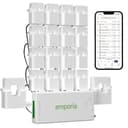
Emporia Vue 3 home energy monitor
Emporia · In-panel sensors
Clamps onto your mains and up to 16 individual circuits, so you can see exactly what the EV charger draws and how much headroom your panel really has. Pairs with Emporia's own charger to charge from surplus solar.
What is good
- Up to 16 circuit sensors, so the EV circuit gets its own exact reading
- Wired Ethernet as well as Wi-Fi, which matters inside a metal panel
- Pairs with the Emporia EV charger to charge from surplus solar
- Shows real panel headroom -- useful before deciding on a charger's amperage
What is not
- Sensors go inside the panel, which is electrician territory
- Routing up to 16 clamps is fiddly in a crowded panel
- Only as useful as the time you spend in the app
| Mains sensors | 2 x 200 A |
|---|---|
| Branch circuit sensors | Up to 16 x 50 A |
| Connectivity | 2.4 GHz Wi-Fi, plus 10/100 wired Ethernet |
| Solar | Monitors net metering without extra equipment |
| 3-phase homes | A separate 3-phase/4-wire model is sold |
| Certification | UL certified |
| Warranty | 1 year |
Skip this if: Skip it if you only want a whole-home total. Sixteen circuit sensors is a lot of hardware to route through a panel for one number.
Specifications above are the manufacturer’s published figures. Source: Emporia Energy, Emporia Energy, Excess Solar, Emporia Energy, 3-phase model. We have not tested this unit — see how we pick.
FAQ
Questions people actually ask
Why is my EV charging so slowly at home?
Does cold weather make an EV charge more slowly?
Why does my EV charge fast at first and then slow down?
My charger is 48 amps but the car only takes 32. Can I fix that?
How many miles per hour should a Level 2 charger add?
Sources
Where these numbers come from
- Electric Vehicle Charging Infrastructure: charging levels — U.S. Department of Energy, Alternative Fuels Data CenterAC Level 1 adds approximately 5 miles of range per hour of charging. AC Level 2 runs at 240 V, delivers 2.9 to 19.2 kW, and adds approximately 25 miles of range per hour, on the J1772 or J3400 (NACS) connector. Read 2026-10-07.
- Fuel economy in cold weather — U.S. EPA and U.S. Department of Energy, fueleconomy.govFor electric vehicles, fuel economy can drop roughly 39% in mixed city and highway driving and range can drop by 41% at 20 F compared with 75 F. About two thirds of the extra energy consumed is used to heat the cabin. With the cabin heater not used, EV fuel economy is 8% lower and range about 12% lower at 20 F than at 75 F. Preheating the cabin while plugged into the charger can extend range. Read 2026-10-07.
- Fuel economy of 2026 electric vehicles — U.S. EPA and U.S. Department of Energy, fueleconomy.govConsumption spread used on this page: Tesla Model Y Standard RWD 24 kWh per 100 miles on 18-inch wheels and 26 on 19-inch; Model Y Performance AWD 32; GMC Hummer EV 70 (2025 model year). Read 2026-10-07.
- ENERGY STAR certified electric vehicle chargers — U.S. EPA, ENERGY STARCertified chargers are tested by a nationally recognized testing laboratory and use less energy when idle. Read 2026-10-07.
Read next
Related reading
- EV charging speed calculatorCalculate charging speed and time from your own numbers, with the working shown.
- How long does it take to charge an EV at home?The formula for your own charging time, and why empty-to-full is the wrong question.
- EV charging in cold weatherWhat cold does to range and charging, and the habits that make winter a non-event.
- Your EV charger is not working: what to checkThe six usual causes of a charge that will not start, in the order worth checking them.
- How many amps do you actually need?Three checks that determine your charger amperage, and why the smallest one wins.