Hosting
Charging a houseguest's EV when you do not own one
Somebody is driving an electric car to your house for a few days. In most houses the answer is a dedicated outlet and no purchase at all -- here is how to tell, and what to buy in the cases where that is not enough.
By Sawyer V. · Published November 7, 2026
How this page is funded: we earn a commission if you buy through our Amazon links, at no extra cost to you. It does not change what we recommend, and we say plainly when the honest answer is to buy nothing. Full disclosure.
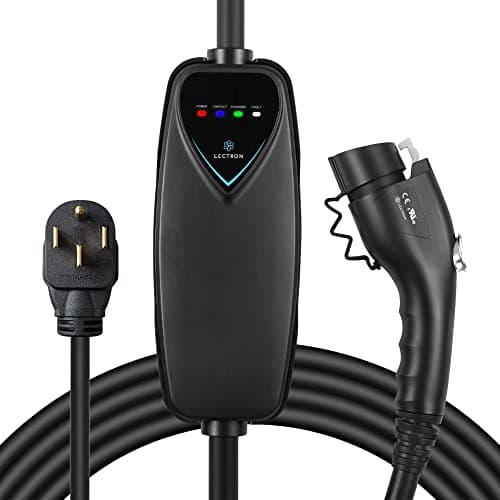
The verdict: in most houses, buy nothing. Clear the way to one receptacle your guest can reach from where they will park, make sure nothing else is on that circuit, and let them use the cord that came with their car. If you host EV drivers often, or if a 10-hour night of 120 V charging genuinely is not enough for the driving they will do, the single best purchase is a portable Level 2 charger -- it needs no electrician, no permission and no hole in a wall, and it goes in your own car later. The Lectron portable is the one to buy for a one-off: Level 2 speed from a 240 V outlet, and it drops to a standard wall outlet with the adapter in the box.
Guest-charging picks
Ranked for a first home charger. Every row jumps to the full write-up below.
| # | Product | Best for | Max output | Price |
|---|---|---|---|---|
| 1 |  Lectron portable Level 2 chargerTravel and rentals. J1772, 21 ft cable. | Travel and rentals | 32 A7.7 kW | $269.99 · View on Amazon#ad how we are funded · price as of November 8, 2026 |
| 2 |  Splitvolt Splitter Switch (NEMA 14-30 to 14-50)A 14-30 dryer outlet and a charger with a 14-50 plug. NEMA 14-50. | A 14-30 dryer outlet and a charger with a 14-50 plug | 24 A5.8 kW | $390.00 · View on Amazon#ad how we are funded · price as of November 8, 2026 |
| 3 | 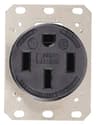 Hubbell HBL9450A NEMA 14-50 receptacleThe receptacle to specify. NEMA 14-50. | The receptacle to specify | 50 A12 kW | $64.99 · View on Amazon#ad how we are funded · price as of November 8, 2026 |
| 4 |  Grizzl-E Mini ConnectA portable that replaces a wall unit. NACS, 25 ft cable. | A portable that replaces a wall unit | 40 A9.6 kW | $349.99 · View on Amazon#ad how we are funded · price as of November 8, 2026 |
| 5 | Lectron J1772 extension cableExtra reach, done properly. J1772, 20 ft cable. | Extra reach, done properly | 40 A9.6 kW | |
| 6 |  Leviton 1450R EV charging receptacleThe EV-specific alternative. NEMA 14-50. | The EV-specific alternative | 50 A12 kW | $43.30 · View on Amazon#ad how we are funded · price as of November 8, 2026 |
The arithmetic that usually ends the conversation
Level 1 charging gets talked about as a stopgap. For a visitor it is usually the answer. The Department of Energy puts a 120 V cord at roughly 5 miles of range per hour. Plugged in from 8 pm to 7 am that is about 55 miles, and a guest who arrives with half a battery and drives to dinner and back does not need more than that. Over a four-day stay it is well over 200 miles of replenishment from an outlet you already own.
What a 120 V outlet gives a visiting car
Level 1 rate, per the Department of Energy: about 5 miles of range per hour
A normal overnight plug-in: 11 hours
5 mi/h x 11 h = about 55 miles of range per night
Over a four-night stay: about 220 miles, for the cost of the electricity
Where it falls down is a long drive home. If your guest arrives low and has 250 miles to cover on the way back, two nights of Level 1 will not fill the car, and they will be stopping at a fast charger anyway -- which is fine, and is what fast chargers are for. The question to ask is not "can I fill their car" but "can I make their stay easy". The answer is almost always yes with one outlet.
The four routes, in order of cost
| What you have | Do this | Rough speed | Who should skip it |
|---|---|---|---|
| A 120 V garage or exterior outlet | Nothing. Clear the circuit and let them use their own cord | About 5 miles of range per hour | Nobody. Try this first, every time |
| A four-prong NEMA 14-30 dryer outlet | A certified splitter switch, plus their portable charger | About 20 miles of range per hour at 24 A | A house with an older three-prong 10-30 -- no adapter makes that one safe |
| No 240 V outlet, and you host often | Buy a portable Level 2 charger that lives in a drawer | Up to about 25 miles of range per hour | A one-time visit -- the 120 V outlet already covers it |
| An electrician booked anyway | Have a proper NEMA 14-50 receptacle fitted | Up to about 25 miles of range per hour | Anyone whose panel is already full; that is a bigger project |
| An outlet that does not reach the car | A purpose-built J1772 extension, never a household cord | Unchanged | Anyone who can simply park closer |
The dryer-outlet route, which is the surprise
A lot of houses already have a 240 V outlet and do not think of it as one. A modern four-prong dryer receptacle is a NEMA 14-30, and a certified splitter switch plugs into it and gives you a NEMA 14-50 socket -- which is the plug nearly every portable EV charger ships with. Splitvolt publishes 24 A continuous and automated switching, so the dryer and the car cannot both draw at once, and the part is cETLus listed by Intertek. That is roughly 20 miles of range per hour, four times the 120 V cord, from hardware you unplug and put away afterwards.
Two cautions. The old three-prong NEMA 10-30 is a different animal with no separate ground, and no adapter turns one safely into the other -- charging from a dryer outlet is explicit about that, and the best dryer outlet splitter has the fitment table. And the splitter is the easy half: your guest still needs a portable charger with a 14-50 plug, so ask whether they travel with one before you buy anything.
Ask about the connector, not the brand
If you do buy a charger, the one question that decides which is the shape of the plug on their car. A NACS connector is the small, sleek one; J1772 is the larger round one with a flat top. A Tesla can use a J1772 charger through the adapter that the Department of Energy notes comes with every Tesla, so a J1772 unit is the more universal buy -- but a NACS household with no adapter in the trunk will be stuck. Plug types explained has pictures, and EV charging adapters covers which direction is which.
The six, in order of cost
1. Travel and rentals
Lectron portable Level 2 charger
Lectron · J1772 · 32 A / 7.7 kW · 21 ft cable
A plug-in portable that runs at Level 2 speed from a NEMA 14-50 and drops to a standard wall outlet with the included adapter. The travel unit, not the garage unit.
What is good
- Level 2 speed from a NEMA 14-50 without an installed charger
- Falls back to a standard household outlet with the adapter
- Small enough to keep in the trunk
What is not
- 32 A ceiling, meaningfully slower than a 48 A wall unit
- Not weather-rated for permanent outdoor mounting
- Repeated plugging and unplugging wears a NEMA 14-50 receptacle faster than a hardwired unit
| Maximum output | 32 A / 7.7 kW at 240 V |
|---|---|
| Connector | SAE J1772 |
| Plug | NEMA 14-50, with an adapter for a standard outlet |
| Use | Portable. Lives in the car, not on the wall |
Skip this if: Skip it if this is your only charger and you have a garage. A wall unit is faster and does not live in your trunk.
Specifications above are the manufacturer’s published figures. Source: Lectron. We have not tested this unit — see how we pick.
2. A 14-30 dryer outlet and a charger with a 14-50 plug
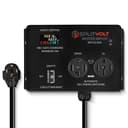
Splitvolt Splitter Switch (NEMA 14-30 to 14-50)
Splitvolt · NEMA 14-50 · 24 A / 5.8 kW
The one most people need: it plugs into a four-prong 14-30 dryer outlet and gives the charger a NEMA 14-50 socket, which is the plug nearly every plug-in EV charger ships with. Still 24 A, because the dryer circuit is still 30 A.
What is good
- A 14-50 EV socket, which is the plug most plug-in chargers already have
- Fits the four-prong 14-30 dryer outlet modern circuits use
- Automated switching, full-color metering display and an easy-reset 24 A breaker
- cETLus listed with the Intertek file number published
- No new circuit, so no panel upgrade
What is not
- A 14-50 socket that still only delivers 24 A -- the outlet looks faster than it is
- The dryer and the charger take turns; they cannot run together
- Indoor use only
- 1-year warranty
| Rating | 240 V ~ 60 Hz, 24 A AC maximum load |
|---|---|
| Wall plug | NEMA 14-30 male, on a 4 ft pigtail |
| Dryer socket | NEMA 14-30 female |
| EV socket | NEMA 14-50 female |
| Switching | Automated between the dryer and EV sockets |
| Display | Full-color screen: real-time kWh, amps, volts and status |
| Protection | Integrated 24 A circuit breaker with easy reset |
| Manual override | Optional manual power-off switch |
| Circuit | Standard 30 A dryer circuits; 24 A max for the NEC safe charging rate |
| Mounting | Integrated wall-mount screw holes |
| Use | Indoor use only |
| Size and weight | 12 x 8.5 x 4 in, 6.7 lb |
| Certification | cETLus, Intertek 5021938, UL 60730-1 / CSA E60730-1 |
| Warranty | 1 year limited |
| SKU | SPS-C2-032-30A |
Skip this if: Skip it if your dryer outlet is the older three-prong 10-30, or if your panel has room for a dedicated circuit -- a real 14-50 circuit charges at 40 A instead of 24 A.
Specifications above are the manufacturer’s published figures. Source: Splitvolt. We have not tested this unit — see how we pick.
3. The receptacle to specify
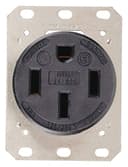
Hubbell HBL9450A NEMA 14-50 receptacle
Hubbell Wiring Device-Kellems · NEMA 14-50 · 50 A / 12 kW
The industrial-grade 14-50 electricians specify when they know the circuit will feed an EV charger every night. Full-size brass contacts and a clamping terminal, not the stab-and-hope design of a builder-grade outlet.
What is good
- Industrial grade, with the clamping terminal design that keeps a high-current connection tight
- Accepts 10 through 4 AWG, so it fits whatever conductor your run needs
- UL listed and CSA certified, with a published file number you can look up
- Weather-resistant rated, which matters for a garage or an outdoor box
What is not
- Costs several times a builder-grade 14-50, which is the entire point
- Installation is licensed electrical work -- this is not a part you fit yourself
- No cover plate included on the single pack
| Rating | 50 A, 125/250 V, 12,500 W maximum |
|---|---|
| Configuration | NEMA 14-50R, 3-pole, 4-wire grounding |
| Wire range | 10 to 4 AWG |
| Grade | Industrial |
| Certification | UL listed (file E2186), CSA certified |
| Standard | NEMA WD-6 compliant |
Skip this if: Skip it only if your charger is being hardwired -- then you do not need a receptacle at all, and hardwiring is the more durable answer.
Specifications above are the manufacturer’s published figures. Source: Hubbell Wiring Device-Kellems. We have not tested this unit — see how we pick.
4. A portable that replaces a wall unit
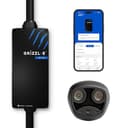
Grizzl-E Mini Connect
United Chargers · NACS · 40 A / 9.6 kW · 25 ft cable
A portable 40 A charger in a metal case, with four adapters, a 25 ft cable and the Grizzl-E Connect app. It does the job of a wall charger and fits in a carrying case.
What is good
- A 25 ft cable, which is wall-charger length on a portable unit
- Four adapters in the box, so one charger covers several outlet types
- Adjustable down to 7 A, lower than most chargers go
- Metal case with a Type 4 indoor/outdoor rating, and a -22 F to 122 F range
- Wi-Fi scheduling and statistics through the Grizzl-E Connect app
What is not
- Priced like a wall charger, not like a spare cable for the trunk
- 40 A is the ceiling, so it cannot match a 48 A hardwired unit
- The live Amazon listing is the NACS version; the J1772 version is sold by the maker
- Heavier than a basic travel cordset at close to 20 lb shipped
- 2.4 GHz Wi-Fi only, like the rest of the Connect range
| Maximum output | 40 A (the maker lists 10 kW) |
|---|---|
| Adjustable | 7 A to 40 A |
| Connector | J1772 or NACS, chosen at purchase |
| Cable | 25 ft (7.6 m) |
| Plug | NEMA 14-50, with four adapters included |
| Enclosure | Aluminum, Type 4 indoor/outdoor rating |
| Operating temperature | -30 C to +50 C (-22 F to 122 F) |
| Size | 6.9 x 3.1 x 2.4 in |
| Weight | 19.84 lb (9 kg), shipped |
| Connectivity | Wi-Fi (2.4 GHz) and the Grizzl-E Connect app |
| Country of origin | Canada, per United Chargers |
| In the box | Charger, 4 adapters, mounting cradle, EasyEvPlug, carrying case |
| Certification | UL, file E510712 |
| Warranty | 3 years, or 5 years chosen at purchase |
Skip this if: Skip it if you want a cheap cable for the trunk. This is a full-price charger that happens to be portable -- and the live Amazon listing is the NACS version.
Specifications above are the manufacturer’s published figures. Source: United Chargers. We have not tested this unit — see how we pick.
5. Extra reach, done properly
Lectron J1772 extension cable
Lectron · J1772 · 40 A / 9.6 kW · 20 ft cable
A purpose-built 40 A J1772 extension -- silver-plated contacts, temperature monitoring, IP66 -- which is a completely different object from a household extension cord. Sold in 20 ft and 40 ft.
What is good
- Rated for 40 A continuous, which a household extension cord is not
- Silver-plated power and signal contacts with temperature monitoring at the joint
- IP66, so it can sit on a wet driveway
- Two lengths, so you can buy the reach you actually measured
What is not
- Every extra connection is one more place to heat up -- moving the charger is still the better fix
- We could not verify a UL listing from published sources; see the note on the page
- 40 ft of EV cable is heavy and awkward to coil
| Maximum current | 40 A |
|---|---|
| Length | 20 ft (6 m) or 40 ft (12 m) |
| Compatibility | Level 1 and Level 2 J1772 chargers |
| Contacts | Silver-plated, with temperature monitoring |
| Rating | IP66 weatherproof |
| Body | High-strength ABS |
Skip this if: Skip it if you can simply move the charger. Relocating a wall unit a few feet along the wall is usually cheaper and always more robust than adding a connection to the chain.
Specifications above are the manufacturer’s published figures. Source: Lectron. We have not tested this unit — see how we pick.
6. The EV-specific alternative
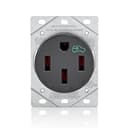
Leviton 1450R EV charging receptacle
Leviton · NEMA 14-50 · 50 A / 12 kW
Leviton's heavy-duty 14-50 designed specifically for EV duty -- long charge sessions and repeated insertions -- rather than for a range that gets plugged in once a decade.
What is good
- Marketed and built specifically for EV duty rather than adapted from an appliance outlet
- Heavy-gauge copper contacts with pressure-wire terminals
- High termination torque spec (75 in-lb), which is what keeps the joint cool
- Same compression-type connectors as the other industrial receptacles
What is not
- Not the same product as Leviton's cheaper 279 series -- check the model number before buying
- Uses the wider 2.465-inch cover plate opening, so your plate has to match
- Installation is licensed electrical work
| Rating | 50 A, 125/250 V |
|---|---|
| Configuration | NEMA 14-50R, 3-pole, 4-wire |
| Contacts | Heavy-gauge copper, pressure-wire terminals |
| Termination torque | 75 in-lb |
| Cover plate opening | 2.465" |
| Designed for | Extended charge times and frequent insertions |
Skip this if: Skip it if your electrician already stocks and prefers the Hubbell. Both are industrial-grade; there is no reason to argue them out of the one they torque correctly by habit.
Specifications above are the manufacturer’s published figures. Source: Leviton. We have not tested this unit — see how we pick.
If you end up hosting EV drivers regularly
At some point this stops being a guest problem and becomes a house decision -- a holiday let, a regularly-visiting family, a driveway other people use. That is a different page: the best EV charger for a rental property ranks wall units on durability and obvious operation rather than peak amperage, which is the right priority when a stranger is using the thing unsupervised. If you are weighing a permanent install, EV charger installation cost is the number to start from.
And one thing worth doing whether you buy anything or not: tell your guest what you have, in a sentence, before they leave home. "There is a 120 V outlet in the garage" or "we have a four-prong dryer outlet in the laundry" lets them arrive with the right charge and the right cable. It costs nothing and it is the single most useful thing a host can provide.
FAQ
Questions people actually ask
Can a guest charge their electric car from a normal outlet at my house?
How long does it take to charge a visiting EV on a household outlet?
Do I need to install an EV charger for visitors?
Can my guest use my dryer outlet to charge?
Is it safe to use an extension cord for a guest's EV?
Sources
Where these numbers come from
- Electric Vehicle Charging Infrastructure: charging levels — U.S. Department of Energy, Alternative Fuels Data CenterAC Level 1 uses a 120 V outlet and adds roughly 5 miles of range per hour, assuming 1.9 kW. AC Level 2 offers charging through 240 V (typical in residential applications) or 208 V, ranges from 2.9 to 19.2 kW output and adds roughly 25 miles of range per hour. All Tesla vehicles come with a J1772 adapter, which allows them to use non-Tesla Level 2 charging equipment. Read 2026-11-07.
- Charging Electric Vehicles at Home — U.S. Department of Energy, Alternative Fuels Data CenterLevel 1 equipment typically comes with the vehicle and plugs into a standard 120 V outlet; home charging is the least expensive and most convenient option, and most drivers charge overnight. Read 2026-11-07.
- Splitvolt Splitter Switch, NEMA 14-30 to 14-50 — SplitvoltPlugs into a NEMA 14-30 dryer outlet and provides a NEMA 14-50 socket for an EV charger; 24 A continuous output; automated switching so only one load draws at a time; cETLus listed by Intertek (control number 5021938) to UL 60730-1; 1-year limited warranty.
- Hubbell HBL9450A NEMA 14-50 receptacle — Hubbell Wiring Device-KellemsIndustrial-grade 50 A, 125/250 V NEMA 14-50 receptacle, weather-resistant rated, UL listed file E2186, CSA certified, NEMA WD-6 compliant.
- Lectron J1772 EV charger extension cable — LectronPurpose-built 40 A J1772 extension with silver-plated power and signal contacts, temperature monitoring at the joint and an IP66 rating; sold in 20 ft and 40 ft lengths.
Read next
Related reading
- Charging an EV from a dryer outletWhat a 30 A dryer circuit allows, why 24 A is the ceiling, and which listed splitters do it safely.
- The best outlet for Level 1 EV chargingWhich 120 V receptacle to specify for nightly Level 1 charging, by grade, with the published temperature and cycle ratings.
- The best EV charger for a rental propertyChargers for a property guests will use: durability, simple operation and access control.
- The best portable EV chargersPortable Level 2 chargers for renters and travelers, with the honest case for buying none.