Off-grid charging
Charging an EV from a generator
It works, it is slow, it is expensive per mile, and the thing that stops most people is not the wattage -- it is a neutral that is not bonded to ground.
By Sawyer V. · Published October 7, 2026
How this page is funded: we earn a commission if you buy through our Amazon links, at no extra cost to you. It does not change what we recommend, and we say plainly when the honest answer is to buy nothing. Full disclosure.
The verdict: a generator is a legitimate emergency and off-grid answer, and a poor everyday one. If you are doing it because the power is out for days, or because the cabin has no service, it is the right tool. If you are doing it to save money or to add range on a trip, the arithmetic below says stop -- a gallon of gasoline moves a gasoline car much further than it moves an EV through a generator.
The grounding problem, which is what actually stops people
This is the part almost nobody tells you in advance. Many portable generators -- inverter models particularly -- are built with a floating neutral, meaning the neutral is not bonded to the generator frame or ground. In a house, that bond exists at the service. On a standalone generator it often does not.
An EV charger checks its grounding before it energizes the connector and will lock out if the conditions are not what it expects. That is the same protective behavior that makes a charger refuse an old two-wire dryer outlet with no separate ground, and it is correct in both cases. So you plug in, the charger shows a fault, and nothing happens -- with a generator that has ample capacity sitting there running.
| Symptom | Likely cause | What to do |
|---|---|---|
| Charger shows a ground or earth fault and will not start | Floating-neutral generator, no ground reference | A neutral-to-ground bond at the generator -- see the next section |
| Charger starts, then trips repeatedly | Generator voltage or frequency wandering under load | Dial the charger down; a smaller current is a steadier load |
| Charger runs at a fraction of its rating | The charger or car is current-limited, or the generator cannot sustain more | This is usually correct behavior, not a fault |
| Generator bogs down or stalls when charging begins | Continuous draw above what the generator can sustain | Reduce the charger's current setting before increasing the generator |
| Nothing works and the generator is 120 V only | No 240 V outlet, so Level 2 is not available at all | Use a Level 1 cordset at about 5 miles of range per hour |
The fix, and the warning attached to it
A bonding plug creates a neutral-to-ground bond inside the generator receptacle, which makes a standalone portable setup behave more like household wiring for equipment that needs that reference. That is the conventional fix and it is sold as an accessory for exactly this purpose.
The code requirements are not optional either. A generator must have a disconnecting means under NEC 445.18, and a grounding electrode is required at the generator under NEC 250.34 where it is a separately derived system. And the rule that matters most: never connect a generator to your house without a transfer switch. Backfeeding through an outlet energizes the utility drop and can kill the line crew working on your street.
How fast it charges
The arithmetic
A charger's draw in watts = amps x volts. A 12 A cordset at 120 V draws 1,440 W; a 16 A charger at 240 V draws 3,840 W.
The generator must sustain that continuously, not as a surge rating.
Miles per hour = charger kW / (car's kWh per 100 miles) x 100.
A 1.44 kW Level 1 cordset on a car using 25 kWh per 100 miles: 1.44 / 25 x 100 = about 6 miles per hour.
A 3.84 kW Level 2 charge dialled to 16 A on the same car: 3.84 / 25 x 100 = about 15 miles per hour.
The Department of Energy puts Level 1 at approximately 5 miles of range per hour and Level 2 at approximately 25. A generator-fed charge lands in the bottom of that span, because most portable generators have no 240 V outlet at all and the ones that do are being asked for a continuous load rather than a peak. Dialling the charger down is the move here: a charger set to 16 A that runs all night beats a charger set to 40 A that stalls the generator in two minutes. Being able to turn the current down is therefore the feature to look for -- see portable charger amperage.
What it costs per mile
Here is the honest version, without an invented generator efficiency figure. By the EPA's own equivalence, one gallon of gasoline holds 33.7 kWh of energy. If a generator could convert all of it to usable charge -- which no generator can -- that gallon would move a 25 kWh/100 mi EV about 135 miles. Real generators convert a minority of that energy, so the true figure is a fraction of 135 miles per gallon, and we are not going to put a number on the fraction without a source for it.
| Source | What it costs per 100 miles | Basis |
|---|---|---|
| Charging at home from the wall | about $4.58 | 25 kWh at the EIA's 18.31 cents/kWh |
| A 30 mpg gasoline car | about $14.51 | 3.33 gal at the EIA's $4.354/gal |
| A generator, at a theoretical 100% conversion | about $3.23 at best, and unreachable | 0.74 gal of the 33.7 kWh-per-gallon equivalence |
| A generator, in reality | Several times the home figure | Real conversion is a minority of the energy; no number is claimed here |
That third row is the one to sit with. Even at an impossible 100% conversion, you are buying something you could have had from the wall for a similar price -- and the real conversion loss means you are paying several times the mains rate for the privilege of a slow charge and an engine running all night.
When it is genuinely the right answer
| Situation | Verdict |
|---|---|
| Multi-day grid outage, car needed for essential trips | Yes. This is what it is for. |
| Remote cabin or property with no electrical service | Yes, with a correctly grounded setup. |
| Build site or off-grid work where a generator is already running | Yes, dialled down. |
| Hurricane or wildfire evacuation planning | Reasonable as a contingency, with the bonding sorted in advance. |
| Routine home charging to save money | No. It costs several times mains power. |
| Carrying a generator on road trips as a range extender | No. The weight, fuel and time all lose to a charging stop. |
| Towing a generator behind the EV while driving | No. It does not work and is not legal to run enclosed. |
If you are going to do it, do it in this order
- Find out whether your generator has a bonded or floating neutral. It is in the manual. Do not guess.
- Sort the grounding before you buy anything else. If the neutral floats and the generator is running standalone portable loads, that is what a bonding plug is for -- and it must never go into house wiring.
- Never backfeed the house. If the generator is to feed premises wiring, that is a transfer switch and an electrician, and the bonding rules change.
- Set the charger's current low and work up. Start at the lowest setting the charger offers and increase only while the generator holds voltage steadily.
- Use Level 1 if the generator is 120 V only. About 5 miles of range per hour is not nothing over twelve hours.
- Watch the connector and the cable for heat. A continuous load on improvised infrastructure is exactly where to check this.
And the honest alternative, for completeness: in most outages the fastest route to a charged car is a working public charger a few miles away, not an engine in the driveway. Emergency charging and home vs public charging both make that case.
Chargers that can dial down far enough
A generator-fed charge needs a charger whose current you can reduce. Both of these do, and both work from an ordinary outlet. Prices are live from Amazon and carry the date they were read.
1. Travel and rentals
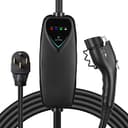
Lectron portable Level 2 charger
Lectron · J1772 · 32 A / 7.7 kW · 21 ft cable
A plug-in portable that runs at Level 2 speed from a NEMA 14-50 and drops to a standard wall outlet with the included adapter. The travel unit, not the garage unit.
What is good
- Level 2 speed from a NEMA 14-50 without an installed charger
- Falls back to a standard household outlet with the adapter
- Small enough to keep in the trunk
What is not
- 32 A ceiling, meaningfully slower than a 48 A wall unit
- Not weather-rated for permanent outdoor mounting
- Repeated plugging and unplugging wears a NEMA 14-50 receptacle faster than a hardwired unit
| Maximum output | 32 A / 7.7 kW at 240 V |
|---|---|
| Connector | SAE J1772 |
| Plug | NEMA 14-50, with an adapter for a standard outlet |
| Use | Portable. Lives in the car, not on the wall |
Skip this if: Skip it if this is your only charger and you have a garage. A wall unit is faster and does not live in your trunk.
Specifications above are the manufacturer’s published figures. Source: Lectron. We have not tested this unit — see how we pick.
2. A portable that replaces a wall unit

Grizzl-E Mini Connect
United Chargers · NACS · 40 A / 9.6 kW · 25 ft cable
A portable 40 A charger in a metal case, with four adapters, a 25 ft cable and the Grizzl-E Connect app. It does the job of a wall charger and fits in a carrying case.
What is good
- A 25 ft cable, which is wall-charger length on a portable unit
- Four adapters in the box, so one charger covers several outlet types
- Adjustable down to 7 A, lower than most chargers go
- Metal case with a Type 4 indoor/outdoor rating, and a -22 F to 122 F range
- Wi-Fi scheduling and statistics through the Grizzl-E Connect app
What is not
- Priced like a wall charger, not like a spare cable for the trunk
- 40 A is the ceiling, so it cannot match a 48 A hardwired unit
- The live Amazon listing is the NACS version; the J1772 version is sold by the maker
- Heavier than a basic travel cordset at close to 20 lb shipped
- 2.4 GHz Wi-Fi only, like the rest of the Connect range
| Maximum output | 40 A (the maker lists 10 kW) |
|---|---|
| Adjustable | 7 A to 40 A |
| Connector | J1772 or NACS, chosen at purchase |
| Cable | 25 ft (7.6 m) |
| Plug | NEMA 14-50, with four adapters included |
| Enclosure | Aluminum, Type 4 indoor/outdoor rating |
| Operating temperature | -30 C to +50 C (-22 F to 122 F) |
| Size | 6.9 x 3.1 x 2.4 in |
| Weight | 19.84 lb (9 kg), shipped |
| Connectivity | Wi-Fi (2.4 GHz) and the Grizzl-E Connect app |
| Country of origin | Canada, per United Chargers |
| In the box | Charger, 4 adapters, mounting cradle, EasyEvPlug, carrying case |
| Certification | UL, file E510712 |
| Warranty | 3 years, or 5 years chosen at purchase |
Skip this if: Skip it if you want a cheap cable for the trunk. This is a full-price charger that happens to be portable -- and the live Amazon listing is the NACS version.
Specifications above are the manufacturer’s published figures. Source: United Chargers. We have not tested this unit — see how we pick.
FAQ
Questions people actually ask
Can you charge an electric car with a generator?
Why won't my EV charger work with my generator?
What size generator do you need to charge an EV?
Is charging an EV with a generator cheaper than mains electricity?
Can I plug a generator into my house to charge the car?
Sources
Where these numbers come from
- Generator bonding plugs: what they do, how they work, and when DIY homeowners need one — Bad Wolf USAStates that many portable generators, especially inverter-style units, are built with a floating neutral, meaning neutral is not bonded to the generator frame or ground; that some devices perform ground-assurance checks and lock out for safety if they do not see the grounding conditions they expect; that a bonding plug creates a neutral-to-ground bond inside the generator receptacle; and that a bonding plug must never be plugged into a standard household electrical system, with bonding rules changing when a generator feeds premises wiring through a transfer switch. Read 2026-10-07.
- WireRef project guide: whole-house generator wiring and NEC requirements — WireRefA generator must have a disconnecting means per NEC 445.18. A grounding electrode is required at the generator per NEC 250.34 for separately derived systems. Never connect a generator without a transfer switch -- backfeeding endangers utility workers. Read 2026-10-07.
- Electric Vehicle Charging Infrastructure: charging levels — U.S. Department of Energy, Alternative Fuels Data CenterAC Level 1 adds approximately 5 miles of range per hour of charging at 1.9 kW. AC Level 2 runs at 240 V, delivers 2.9 to 19.2 kW, and adds approximately 25 miles of range per hour. Read 2026-10-07.
- Fuel economy of the 2026 Tesla Model Y Long Range RWD — U.S. EPA and U.S. Department of Energy, fueleconomy.govPublishes the equivalence "1 gallon of gasoline = 33.7 kWh" and rates this trim at 25 kWh per 100 miles. Read 2026-10-07.
- Gasoline and Diesel Fuel Update: U.S. regular gasoline prices — U.S. Energy Information AdministrationWeek ending 2026-10-05, released 2026-10-06. U.S. average regular gasoline $4.354 per gallon. Read 2026-10-07.
- Electric Power Monthly, Table 5.3: average price of electricity by end-use sector — U.S. Energy Information AdministrationData for July 2026, released 2026-09-24. U.S. average residential price 18.31 cents per kWh. Read 2026-10-07.
Read next
Related reading
- Running low with nowhere to chargeWhat genuinely helps if you run low, and why emergency battery packs are not the answer.
- Are portable EV chargers worth it?The four cases where a portable is the right answer, and the cases where it is a compromise.
- 16 A, 32 A or 40 A: portable charger amperageWhat 16 A, 32 A and 40 A deliver overnight, which outlet each needs, and how to choose.
- The best dual-voltage portable EV chargersPortables that run from a standard outlet and a 240 V outlet, and how fast each one really is.
- Is charging an EV cheaper than gas?Real EIA and EPA figures for October 2026: cost per 100 miles for EVs and gas cars, by state, and the break-even electricity rate.