Decisions
Are portable EV chargers worth it?
For some owners a portable is the whole charging setup. For others it is a wall charger with a worse plug. The difference is entirely about where you park.
By Sawyer V. · Published September 27, 2026
How this page is funded: we earn a commission if you buy through our Amazon links, at no extra cost to you. It does not change what we recommend, and we say plainly when the honest answer is to buy nothing. Full disclosure.
There is a persistent idea that portable chargers are a lesser product -- something you keep for emergencies while a real charger lives on the wall. That is true of the cordset in your trunk and false of a 40 A portable with a 25 ft cable, which is simply a plug-in wall charger you can unbolt.
What you actually give up
| Portable Level 2 | Plug-in wall charger | |
|---|---|---|
| Maximum output on a 14-50 | Up to 40 A | Up to 40 A |
| Maximum output overall | 40 A | 40 A plugged in; 48 A if hardwired |
| Cable length | 16 to 25 ft, depending on the unit | Up to 25 ft |
| Weather rating | Varies -- some are indoor only | Usually outdoor-rated |
| Takes it with you | Yes | Yes, if plug-in |
| Multiple outlet types | Often, with adapters | No |
| Tidiness on the wall | Cradle or hook | Purpose-built mount |
Read that table and the honest conclusion is that the gap is small, and it narrows further if you were never going to hardwire. The 48-amp tier is the one thing a portable cannot reach. 48-amp chargers.
The four cases where a portable wins
1. You rent, or you will move
Nothing is attached to the building, and the charger leaves with the furniture. Chargers for renters and taking your charger with you.
2. You charge in more than one place
A second home, a family garage, a workplace outlet, a campground. One unit with adapters covers all of them, and the alternative is buying several chargers. RV parks and campgrounds.
3. Your outlet is unusual
A dryer circuit, a welder outlet, an older three-prong socket. Portables are the part of the market that ships adapter sets for exactly this. Outlet types.
4. You are not sure yet
A portable plus an existing outlet is the cheapest way to find out what your charging habits really are before committing to an installation. If you later hardwire, the portable becomes the travel unit rather than dead money.
When a portable is the wrong buy
- You want the fastest home charging. 48 A is hardwired, always.
- It will never move. A wall charger is tidier, better mounted and usually better rated for weather.
- You need an outdoor-rated unit and the portable you are looking at is not one. Check the rating, not the marketing.
- You want scheduling and energy data on a cheap unit -- most budget portables have neither, although the better ones do.
What to check before buying one
- The amperage, and whether your circuit can supply it. Portable amperage compared.
- The plug and adapters included, against the outlets you will actually use.
- The cable length -- portables run short, and 16 ft disappears fast.
- The certification. A listing from a recognized laboratory, not a claim of compliance. Certification wording.
- The weather rating, if it will ever be used outdoors.
Three portables, three budgets
A compact 32 A unit, a 40 A unit with interchangeable plugs, and a 40 A metal-cased unit with an app.
1. Travel and rentals
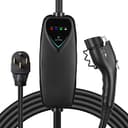
Lectron portable Level 2 charger
Lectron · J1772 · 32 A / 7.7 kW · 21 ft cable
A plug-in portable that runs at Level 2 speed from a NEMA 14-50 and drops to a standard wall outlet with the included adapter. The travel unit, not the garage unit.
What is good
- Level 2 speed from a NEMA 14-50 without an installed charger
- Falls back to a standard household outlet with the adapter
- Small enough to keep in the trunk
What is not
- 32 A ceiling, meaningfully slower than a 48 A wall unit
- Not weather-rated for permanent outdoor mounting
- Repeated plugging and unplugging wears a NEMA 14-50 receptacle faster than a hardwired unit
| Maximum output | 32 A / 7.7 kW at 240 V |
|---|---|
| Connector | SAE J1772 |
| Plug | NEMA 14-50, with an adapter for a standard outlet |
| Use | Portable. Lives in the car, not on the wall |
Skip this if: Skip it if this is your only charger and you have a garage. A wall unit is faster and does not live in your trunk.
Specifications above are the manufacturer’s published figures. Source: Lectron. We have not tested this unit — see how we pick.
2. The best portable overall
J+ Booster 2
J+ Americas · J1772 · 40 A / 9.6 kW · 25 ft cable
A 40 A portable in a military-grade aluminum body, ETL certified to UL standards and IP67 rated, weighing 2.2 lb without cables. The portable that behaves like a wall unit.
What is good
- 40 A, matching many wall-mounted units
- Eight amperage settings from 6 A to 40 A, so it fits almost any outlet
- Adapters for a wide range of outlets, including NEMA TT-30 for campgrounds
- IP67 and drive-over resistant, which portables usually are not
- 2.2 lb without cables, so it genuinely travels
What is not
- Costs more than most portables, and more than some wall units
- Every extra outlet adapter is a separate purchase
- Still a portable, so it is not rated for permanent outdoor mounting
| Maximum output | 40 A / 9.6 kW at 240 V |
|---|---|
| Adjustable | 6, 8, 12, 16, 20, 24, 32 or 40 A |
| Power range | 1.4 kW to 9.6 kW |
| Connector | SAE J1772 |
| Cable | 21 ft or 25 ft, depending on version |
| Adapters included | NEMA 14-50 and 5-15 |
| Further adapters available | 5-20, 6-15, 6-20, 6-50, TT-30 |
| Weight | 2.2 lb without cables; 7 lb with cables and adapters |
| Body | Military-grade aluminum, drive-over resistant to 6,600 lb wheel loads |
| Rating | IP67 waterproof and dustproof |
| Certification | ETL certified to UL standards |
Skip this if: Skip it if you only ever charge in one place. A hardwired wall unit is cheaper for a fixed installation.
Specifications above are the manufacturer’s published figures. Source: J+ Americas. We have not tested this unit — see how we pick.
3. A portable that replaces a wall unit
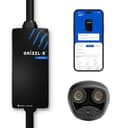
Grizzl-E Mini Connect
United Chargers · NACS · 40 A / 9.6 kW · 25 ft cable
A portable 40 A charger in a metal case, with four adapters, a 25 ft cable and the Grizzl-E Connect app. It does the job of a wall charger and fits in a carrying case.
What is good
- A 25 ft cable, which is wall-charger length on a portable unit
- Four adapters in the box, so one charger covers several outlet types
- Adjustable down to 7 A, lower than most chargers go
- Metal case with a Type 4 indoor/outdoor rating, and a -22 F to 122 F range
- Wi-Fi scheduling and statistics through the Grizzl-E Connect app
What is not
- Priced like a wall charger, not like a spare cable for the trunk
- 40 A is the ceiling, so it cannot match a 48 A hardwired unit
- The live Amazon listing is the NACS version; the J1772 version is sold by the maker
- Heavier than a basic travel cordset at close to 20 lb shipped
- 2.4 GHz Wi-Fi only, like the rest of the Connect range
| Maximum output | 40 A (the maker lists 10 kW) |
|---|---|
| Adjustable | 7 A to 40 A |
| Connector | J1772 or NACS, chosen at purchase |
| Cable | 25 ft (7.6 m) |
| Plug | NEMA 14-50, with four adapters included |
| Enclosure | Aluminum, Type 4 indoor/outdoor rating |
| Operating temperature | -30 C to +50 C (-22 F to 122 F) |
| Size | 6.9 x 3.1 x 2.4 in |
| Weight | 19.84 lb (9 kg), shipped |
| Connectivity | Wi-Fi (2.4 GHz) and the Grizzl-E Connect app |
| Country of origin | Canada, per United Chargers |
| In the box | Charger, 4 adapters, mounting cradle, EasyEvPlug, carrying case |
| Certification | UL, file E510712 |
| Warranty | 3 years, or 5 years chosen at purchase |
Skip this if: Skip it if you want a cheap cable for the trunk. This is a full-price charger that happens to be portable -- and the live Amazon listing is the NACS version.
Specifications above are the manufacturer’s published figures. Source: United Chargers. We have not tested this unit — see how we pick.
FAQ
Questions people actually ask
Are portable EV chargers as fast as wall chargers?
Is a portable charger safe to use every day?
Do I need a portable charger if I have a wall charger?
Can a portable charger be mounted on a wall?
Sources
Where these numbers come from
- Charging Electric Vehicles at Home — U.S. Department of Energy, Alternative Fuels Data CenterMost EVs come with a portable Level 1 cordset; many owners meet daily needs charging overnight; a Level 1 cordset expects a dedicated branch circuit near the parking spot; outdoor use is safe with outdoor-rated equipment. Read 2026-09-27.
- Electric Vehicle Charging Infrastructure: charging levels — U.S. Department of Energy, Alternative Fuels Data CenterAC Level 1 about 5 miles of range per hour at 1.9 kW; AC Level 2 about 25 miles per hour, with equipment ranging from 2.9 to 19.2 kW. Read 2026-09-27.
- Lectron Level 2 EV chargers — LectronOutput, cable length and plug type for the Lectron portable Level 2 charger.
- Portable Level 2 EV charger 40A (UL) -- J+ Booster 2 — J+ Booster40 A portable output, 25 ft cable, interchangeable plugs and UL listing.
- Grizzl-E Mini Connect 40A — United ChargersPortable 40 A / 10 kW, adjustable 7-40 A, J1772 or NACS, NEMA 14-50 plug with four adapters, 25 ft cable, aluminum enclosure with a Type 4 indoor/outdoor rating, UL E510712, 2.4 GHz Wi-Fi and the Grizzl-E Connect app, -30 C to +50 C, 6.9 x 3.1 x 2.4 in, 9 kg shipped, country of origin Canada, carrying case and mounting cradle in the box, 3-year or 5-year warranty. Read 2026-09-27.
Read next
Related reading
- Portable vs wall-mounted EV chargerWho a portable charger is worth it for, and who should put one on the wall instead.
- The best portable EV chargersPortable Level 2 chargers for renters and travelers, with the honest case for buying none.
- How to choose a portable EV chargerThe six checks that separate a portable charger you can trust from one you should not.
- Grizzl-E Mini Connect reviewA 40 A portable with a 25 ft cable, four adapters and an app. Who should buy it over a wall unit.