Long runs
Voltage drop on a long EV charger run
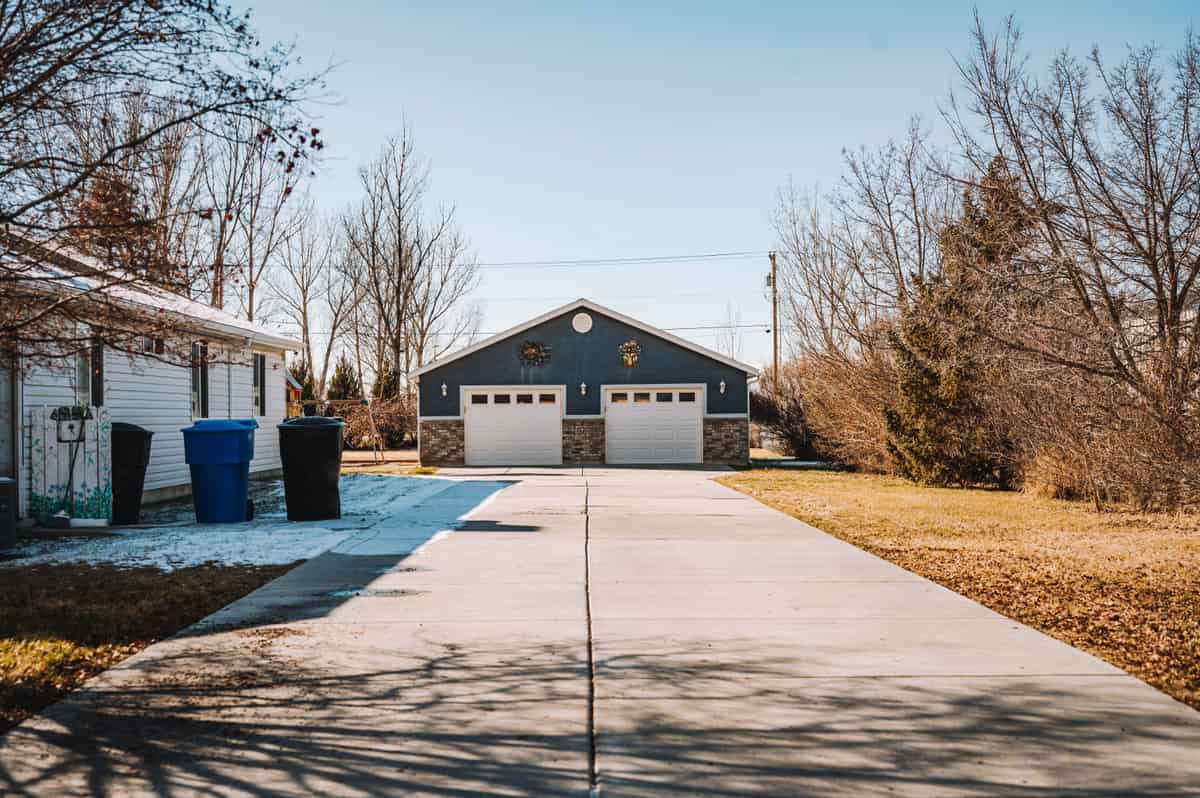
Distance is the quiet line item on an EV charger quote. Past about 100 feet, the conductor stops being sized by amps alone.
By Sawyer V. · Published September 23, 2026
How this page is funded: we earn a commission if you buy through our Amazon links, at no extra cost to you. It does not change what we recommend, and we say plainly when the honest answer is to buy nothing. Full disclosure.
Every conductor has resistance, so some voltage is lost between the panel and the far end. On a lamp circuit nobody notices. On an EV circuit pulling 40 or 48 amps for eight hours through 120 feet of wire, it shows up as heat in the wall and a slower charge in the driveway.
What voltage drop costs you
Why a lower voltage is a slower charge
Your car draws a set current -- say 40 A
Power delivered = current x voltage at the car
40 A x 240 V = 9.6 kW
40 A x 228 V (a 5% drop) = 9.1 kW
Same hours plugged in, about 5% less energy in the battery
Five percent is not a catastrophe, which is why this is a design detail rather than an emergency. But the wasted energy becomes heat in the conductor for the whole charging session, every night, which is the part worth engineering out.
The published table
| Circuit | Material | 25 ft | 50 ft | 100 ft | 150 ft | 200 ft |
|---|---|---|---|---|---|---|
| 30 A | Copper | 10 | 10 | 10 | 8 | 6 |
| 30 A | Aluminum | 8 | 8 | 8 | 6 | 4 |
| 40 A | Copper | 8 | 8 | 8 | 6 | 4 |
| 40 A | Aluminum | 6 | 6 | 6 | 4 | 3 |
| 50 A | Copper | 6 | 6 | 6 | 6 | 4 |
| 50 A | Aluminum | 4 | 4 | 4 | 4 | 2 |
Two things stand out. First, distance does nothing at all until it does: a 50 A copper circuit stays at #6 all the way out to 150 ft, then steps up. Second, aluminum starts a size or two larger and steps up on the same schedule. Aluminum vs copper covers that choice.
Where the length actually comes from
- Measure the route, not the distance. Wire goes up the wall, along a joist, through the attic and back down. That can be twice the map distance.
- Add the trench. A detached garage run includes the depth down and back up at each end.
- Add the panel and enclosure slack at both ends.
- Use the one-way length when someone asks for it -- the tables above are stated that way.
Most surprise quotes come from step one. The charger looks 40 feet from the panel, and the wire has to travel 95 feet to get there.
The ways to shorten the problem
- Move the charger closer to the panel and run a longer charging cable instead -- up to 25 ft is available. Long-cable chargers.
- Run a feeder to a subpanel at the far end, and keep the branch circuit short. Subpanels.
- Charge at a lower current. A 40 A charger on a long run costs less in copper than a 48 A one.
- Take the bigger conductor. Wire is cheaper than a second trench.
That first option is the one people forget. A charging cable is not a branch circuit: moving the charger 30 feet closer to the panel and letting the cable cover the distance can be the cheapest fix on the list. Where to mount covers the placement side of it.
If a longer cable is the cheaper fix
Both carry 25 ft of cable, which can buy back a good deal of conductor on a long run.
1. Grizzl-E toughness, with an app
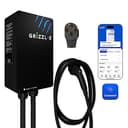
Grizzl-E Classic Connect
United Chargers · J1772 · 40 A / 9.6 kW · 25 ft cable
The next-generation Grizzl-E: 40 A on a NEMA 14-50, a 25 ft cable, a UL Type 4 indoor/outdoor rating -- and, unlike the Classic, Wi-Fi and the Grizzl-E Connect app. Sold with a J1772 or NACS cable.
What is good
- 25 ft cable, a foot longer than the Classic Extreme Edition's
- Wi-Fi app with schedules and charging statistics, which the Classic deliberately lacks
- UL/cUL listed, with a published file number
- Rated to run from -22 F to 122 F
What is not
- 40 A ceiling, with no hardwired 48 A version
- Sold with a NEMA 14-50 plug; the Classic's 6-50 option is not among the Connect listings we found
- The app needs 2.4 GHz Wi-Fi where the charger is mounted
| Maximum output | 40 A / 9.6 kW at 240 V (the maker lists 10 kW) |
|---|---|
| Adjustable | 16 A to 40 A |
| Connector | SAE J1772 or NACS, chosen at purchase |
| Cable | 25 ft (7.6 m) |
| Plug | NEMA 14-50 |
| Enclosure rating | UL Type 4, indoor and outdoor |
| Operating temperature | -22 F to 122 F |
| Size | 10.25 x 6.25 x 3.75 in |
| Connectivity | Wi-Fi (2.4 GHz) and the Grizzl-E Connect app |
| Certification | UL/cUL, file E510712 |
| Warranty | 3 years; 5-year warranty sold separately |
Skip this if: Skip it if you wanted a Grizzl-E precisely because it has no app -- the original Classic is still the no-software choice -- or if you want 48 A. The Classic Connect is a 40 A plug-in unit.
Specifications above are the manufacturer’s published figures. Source: United Chargers. We have not tested this unit — see how we pick.
2. Long reach outdoors
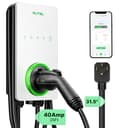
Autel MaxiCharger AC Home
Autel Energy · J1772 · 50 A / 12 kW · 25 ft cable
The 25 ft cable is the longest in this group, and the NEMA 4 case plus a cold-flexible cord make it the easiest unit to live with on an exposed outside wall.
What is good
- 25 ft cable, the longest of the wall units here
- Sold in NEMA 14-50, NEMA 6-50 and hardwired versions
- NEMA Type 4 enclosure rated for rain, snow, hail and sleet
- Wi-Fi and Bluetooth, so it still works if the Wi-Fi drops
What is not
- The 50 A version is hardwired only
- The app has more features than a first-time owner needs
| Maximum output | 50 A / 12 kW hardwired; 40 A / 9.6 kW plug-in |
|---|---|
| Connector | SAE J1772 |
| Cable | 25 ft |
| Enclosure | NEMA Type 4 |
| Certification | Tested to UL standards by CSA |
| Warranty | 3 years |
Skip this if: Skip it if your parking spot is right next to the panel. You are paying for cable you will coil up and never use.
Specifications above are the manufacturer’s published figures. Source: Autel Energy. We have not tested this unit — see how we pick.
FAQ
Questions people actually ask
How far can you run wire for an EV charger?
What voltage drop is acceptable?
Does voltage drop slow down charging?
Is it cheaper to move the charger or upsize the wire?
Sources
Where these numbers come from
- Voltage drop tables — CerrowireConductor size for a maximum 3% voltage drop at 240 V single phase by run length, copper and aluminum. Assumes steel conduit, 0.9 power factor, 86 F ambient and no more than 3 current-carrying conductors. Read 2026-09-23.
- Ampacity charts: wire size and amp ratings, copper and aluminum — CerrowirePublished ampacity by conductor size and temperature rating, for both copper and aluminum. Read 2026-09-23.
- NEC Article 625: EV charging equipment — WireRef625.41 continuous load rated at 125%, 625.42 dedicated branch circuit and the energy-management exception, 625.54 GFCI protection and the double-GFCI nuisance-tripping problem. Read 2026-09-23.
Read next
Related reading
- What size breaker and wire does an EV charger need?Breaker and wire size for every charger amperage, with the 125% rule worked through.
- Aluminum vs copper wire for an EV chargerPublished ampacities side by side, why aluminum goes up a size, and what has to be checked.
- Installing an EV charger in a detached garageTrenching, subpanels and existing feeds: what drives the cost of a detached-garage install.
- Do you need a subpanel for an EV charger?When a charger needs a subpanel instead of a breaker, and why space and capacity are different problems.