Load management
The best EV chargers with load management
Load management lets a charger watch the rest of the house and back off when it is busy. It is the difference between a panel upgrade and no panel upgrade for a lot of homes.
By Sawyer V. · Published September 10, 2026
How this page is funded: we earn a commission if you buy through our Amazon links, at no extra cost to you. It does not change what we recommend, and we say plainly when the honest answer is to buy nothing. Full disclosure.
The expensive part of home charging is often not the charger but the capacity to run it. If a load calculation says your panel cannot carry a full-size EV circuit, load management is the alternative to an upgrade: the charger takes what the house is not using, moment to moment.
Load-management picks
Ranked for a first home charger. Every row jumps to the full write-up below.
| # | Product | Best for | Max output | Price |
|---|---|---|---|---|
| 1 |  Emporia Pro EV ChargerA tight panel. J1772, 25 ft cable. Emporia Pro EV ChargerA tight panel. J1772, 25 ft cable. | A tight panel | 48 A11.5 kW | $599.00 · View on Amazon#ad how we are funded · price as of October 27, 2026 |
| 2 |  Wallbox Pulsar PlusTight wall space. J1772, 25 ft cable. Wallbox Pulsar PlusTight wall space. J1772, 25 ft cable. | Tight wall space | 48 A11.5 kW | $699.00 · View on Amazon#ad how we are funded · price as of October 27, 2026 |
| 3 | Tesla Wall Connector (Gen 3)Tesla owners. NACS, 24 ft cable. | Tesla owners | 48 A11.5 kW | Check price on Amazon#ad how we are funded |
Two different things share one name
| Charger | Kind | What it needs |
|---|---|---|
| Emporia Pro | Whole-home (PowerSmart) | The included Vue 3, installed in your panel |
| Emporia Classic | Whole-home (PowerSmart add-on) | A Vue monitor plus the PowerSmart upgrade, at extra cost |
| Wallbox Pulsar Plus | Whole-home (Dynamic Load Management) | A Wallbox Power Meter |
| Tesla Wall Connector | Between chargers (power sharing) | Two or more Wall Connectors |
Whole-home systems put a monitor on your service and adjust the charger as the rest of the house turns on and off -- Emporia describes PowerSmart as using real-time readings from the Vue to keep total use under your service limit. Power sharing is narrower: it divides one circuit between several chargers, which helps two EVs, but it does not see your dryer or your heat pump. Load management explained.
Who needs it
- A load calculation came back tight and the alternative is a service upgrade. Panel upgrades.
- A 100-amp or smaller service. Chargers for a 100-amp panel.
- Two EVs on one circuit -- where power sharing, whole-home management or both can help.
The picks in detail
Two whole-home systems and one power-sharing charger, each with the case against it.
1. A tight panel
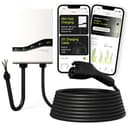
Emporia Pro EV Charger
Emporia · J1772 · 48 A / 11.5 kW · 25 ft cable
Emporia's 48-amp charger with PowerSmart load management built in: the Vue 3 energy monitor comes in the box, and the charger backs off when the rest of the house is busy. The one to look at when your panel is the obstacle.
What is good
- PowerSmart load management included, not an add-on
- Vue 3 energy monitor in the box, for whole-home data
- Emporia says it works even with older 60 or 100 amp services
- J1772 or NACS connector options
What is not
- PowerSmart needs the Vue installed in your panel -- electrician work
- Costs more than the Emporia Classic, which charges at the same 48 A
- Only worth it if your panel is the constraint
| Maximum output | 48 A hardwired; 40 A with a NEMA plug |
|---|---|
| Connector | J1772 or NACS, chosen at purchase |
| Cable | 25 ft |
| Load management | PowerSmart, standard |
| In the box | Emporia Vue 3 energy monitor |
| Installation | NEMA 14-50 plug or hardwired; rear-entry option |
| Certification | UL certified, GFCI-protected |
| Warranty | 3 years |
Skip this if: Skip it if your panel has comfortable room for a full EV circuit. Without that problem you are paying for load management you will not use -- the Emporia Classic charges at the same 48 A.
Specifications above are the manufacturer’s published figures. Source: Emporia Energy, Emporia Energy, Classic vs Pro, Emporia Energy, store. We have not tested this unit — see how we pick.
2. Tight wall space

Wallbox Pulsar Plus
Wallbox · J1772 · 48 A / 11.5 kW · 25 ft cable
The smallest 48 A unit here at roughly 7.8 by 7.9 inches, which matters more than it sounds when the only free wall is beside a door.
What is good
- Smallest body of the 48 A units, under 8 inches square
- Current configurable in steps from 6 A to 48 A
- NEMA Type 4 enclosure, rated down to -22 F
- Weighs 4.4 lb without the cable, so mounting is simple
What is not
- Hardwired only at 48 A, with no plug-in version at full output
- Setup runs through the app, which some owners find fussy
| Maximum output | 48 A / 11.5 kW at 240 V |
|---|---|
| Configurable current | 6 A to 48 A |
| Connector | SAE J1772 |
| Cable | 25 ft |
| Body size | 7.8 x 7.9 x 3.9 inches without the cable |
| Operating temperature | -22 F to 104 F |
| Certification | UL 2594, UL 2231 |
| Warranty | 3 years |
Skip this if: Skip it if you want a plug-in unit you can take with you. The 48 A Pulsar Plus is hardwired.
Specifications above are the manufacturer’s published figures. Source: Wallbox, Wallbox. We have not tested this unit — see how we pick.
3. Tesla owners
Tesla Wall Connector (Gen 3)
Tesla · NACS · 48 A / 11.5 kW · 24 ft cable
48 A, a 24 ft cable and a four-year warranty, the longest in this group. The catch is the connector: Gen 3 is NACS, so a J1772 car needs an adapter.
What is good
- Four-year warranty, longer than the three-year standard here
- Up to six units can share one circuit for a two-EV household
- Wi-Fi with over-the-air firmware updates
- Scheduled departure and charge stats live in the Tesla app
What is not
- NACS connector, so a J1772 car needs an adapter on every charge
- Hardwired only
| Maximum output | 48 A / 11.5 kW at 240 V |
|---|---|
| Connector | NACS (Tesla) |
| Cable | 24 ft |
| Installation | Hardwired |
| Power sharing | Up to six units can be linked |
| Warranty | 4 years |
Skip this if: Skip it if you drive a J1772 car and do not want to keep an adapter on the cable. Buy a J1772 unit instead.
Specifications above are the manufacturer’s published figures. Source: Tesla, Tesla. We have not tested this unit — see how we pick.
FAQ
Questions people actually ask
What is EV charger load management?
Do I need load management for my EV charger?
Does the Tesla Wall Connector have load management?
Sources
Where these numbers come from
- Emporia Pro EV Charger — Emporia EnergyPowerSmart load management, the bundled Vue 3, and the Classic-vs-Pro feature table. Fetched 2026-09-10.
- Emporia Classic vs. Pro EV chargers: which is right for you? — Emporia EnergyHow PowerSmart uses the Vue's readings; output, cable and warranty for both models. Fetched 2026-09-10.
- Pulsar Plus EV charger — WallboxDynamic Load Management with a Wallbox Power Meter. Fetched 2026-09-10.
- Wall Connector Gen 3 installation manual — TeslaPower sharing between Wall Connectors.
Read next
Related reading
- Load management: charging without a panel upgradeHow load management avoids a panel upgrade, what it costs in speed, and when to use it.
- The best EV chargers for a 100-amp panelChargers that fit a 100-amp service, and the three ways to avoid an upgrade.
- Emporia Vue vs Sense for EV ownersCircuit-level sensors against machine-learning detection, judged on what an EV owner needs to know.
- Do you need a panel upgrade for an EV charger?When a panel upgrade is genuinely needed, what it costs, and the cheaper alternatives.
- Emporia Pro EV charger review48 A, the Vue 3 in the box and PowerSmart load management: who it is for.
- Emporia Pro vs Wallbox Pulsar PlusTwo 48 A chargers with whole-home load management, and what each needs to do it.
- Emporia vs Emporia ProBoth charge at 48 A. The Pro adds load management and an energy monitor for a full panel.