New builds
Roughing in an EV charger for a new build
While the walls are open, an EV circuit is a line item. After the drywall goes up, it is a project. Here is what to ask for now.
By Sawyer V. · Published September 23, 2026
How this page is funded: we earn a commission if you buy through our Amazon links, at no extra cost to you. It does not change what we recommend, and we say plainly when the honest answer is to buy nothing. Full disclosure.
Builders will fit what is on the plan and nothing else. An EV charger rarely makes the plan, because it is not required and it adds cost to a bid that is being compared with other bids. Asking for it yourself, early, is the difference between a few hundred dollars now and a much larger job later with finished walls in the way.
What to ask for, in order
1. Service capacity
The load calculation for the house should include an EV circuit from the start. It is far cheaper to specify the service correctly than to upgrade it in two years. The Department of Energy notes that some homes simply do not have the capacity for Level 2 charging, and that is a decision made at design time. Load calculation.
2. Panel space
Two adjacent slots for a two-pole breaker, kept free. Panels fill up fast in a new house, and a panel with no room is the most annoying version of this problem: the capacity exists, and there is nowhere to connect it.
3. A path to the parking spot
Conduit from the panel to the wall where the charger will live -- and out to the driveway if that is where the car parks. Conduit is cheap, and it is the item that turns a future installation into an afternoon. Size it for a 60 A circuit rather than the minimum, and leave a pull string in it.
4. The circuit itself, if the budget allows
Wire it and terminate it. A 60 A circuit runs a 48 A charger later, and nothing stops you from putting a 40 A charger on it in the meantime. The dedicated-circuit rule explains why it cannot share with the garage outlets.
| You specify | Later you need | Rough cost now |
|---|---|---|
| Nothing | Full installation, possibly a panel upgrade | Zero |
| Panel space only | The whole run, through finished walls | Very little |
| Conduit and panel space | Pull wire, fit breaker and charger | Low |
| A complete 60 A circuit | Hang the charger | Moderate |
| Circuit plus receptacle | Plug in a charger | Moderate |
Receptacle or hardwired?
A NEMA 14-50 receptacle keeps your options open: any plug-in charger works, and you can take it with you. Hardwiring is what the 48 A units need. If you are not sure which charger you will buy, the receptacle is the flexible choice -- and it is the one that lets a portable charger cover you on day one. Hardwired vs plug-in compares them properly.
The two below are the receptacles this site recommends for exactly this job -- an industrial-grade Hubbell, and Leviton's part sold specifically for EV charging. The 14-50 outlet covers why it matters.
Things worth doing at the same time
- A second conduit to the far side of the garage or to a second bay, for the second EV.
- Whole-home surge protection, which is easiest to fit while the panel is being worked on. Surge protectors.
- Space for an energy monitor in the panel, if load management is likely. Load management.
- A weatherproof box on the driveway wall if outdoor charging is even possible later.
What to skip
- Buying the charger now. Models change; the circuit does not. Buy it when you have the car.
- Oversizing past 60 A. Home chargers stop at this tier, and a bigger circuit buys nothing.
- A smart panel you do not need. Useful in specific cases, not a default.
One more practical note: permits and inspection apply to new work like any other, and doing it during the build means it is inspected with everything else. Permits covers what that involves.
If you fit a receptacle
Two parts rated for the continuous load an EV puts on a 14-50.
1. The receptacle to specify
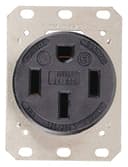
Hubbell HBL9450A NEMA 14-50 receptacle
Hubbell Wiring Device-Kellems · NEMA 14-50 · 50 A / 12 kW
The industrial-grade 14-50 electricians specify when they know the circuit will feed an EV charger every night. Full-size brass contacts and a clamping terminal, not the stab-and-hope design of a builder-grade outlet.
What is good
- Industrial grade, with the clamping terminal design that keeps a high-current connection tight
- Accepts 10 through 4 AWG, so it fits whatever conductor your run needs
- UL listed and CSA certified, with a published file number you can look up
- Weather-resistant rated, which matters for a garage or an outdoor box
What is not
- Costs several times a builder-grade 14-50, which is the entire point
- Installation is licensed electrical work -- this is not a part you fit yourself
- No cover plate included on the single pack
| Rating | 50 A, 125/250 V, 12,500 W maximum |
|---|---|
| Configuration | NEMA 14-50R, 3-pole, 4-wire grounding |
| Wire range | 10 to 4 AWG |
| Grade | Industrial |
| Certification | UL listed (file E2186), CSA certified |
| Standard | NEMA WD-6 compliant |
Skip this if: Skip it only if your charger is being hardwired -- then you do not need a receptacle at all, and hardwiring is the more durable answer.
Specifications above are the manufacturer’s published figures. Source: Hubbell Wiring Device-Kellems. We have not tested this unit — see how we pick.
2. The EV-specific alternative
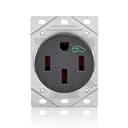
Leviton 1450R EV charging receptacle
Leviton · NEMA 14-50 · 50 A / 12 kW
Leviton's heavy-duty 14-50 designed specifically for EV duty -- long charge sessions and repeated insertions -- rather than for a range that gets plugged in once a decade.
What is good
- Marketed and built specifically for EV duty rather than adapted from an appliance outlet
- Heavy-gauge copper contacts with pressure-wire terminals
- High termination torque spec (75 in-lb), which is what keeps the joint cool
- Same compression-type connectors as the other industrial receptacles
What is not
- Not the same product as Leviton's cheaper 279 series -- check the model number before buying
- Uses the wider 2.465-inch cover plate opening, so your plate has to match
- Installation is licensed electrical work
| Rating | 50 A, 125/250 V |
|---|---|
| Configuration | NEMA 14-50R, 3-pole, 4-wire |
| Contacts | Heavy-gauge copper, pressure-wire terminals |
| Termination torque | 75 in-lb |
| Cover plate opening | 2.465" |
| Designed for | Extended charge times and frequent insertions |
Skip this if: Skip it if your electrician already stocks and prefers the Hubbell. Both are industrial-grade; there is no reason to argue them out of the one they torque correctly by habit.
Specifications above are the manufacturer’s published figures. Source: Leviton. We have not tested this unit — see how we pick.
FAQ
Questions people actually ask
What should I rough in for an EV charger?
What size circuit should I install for future EV charging?
Is conduit enough, or should I pull wire now?
Should I fit a 14-50 outlet or hardwire?
Sources
Where these numbers come from
- Charging Electric Vehicles at Home — U.S. Department of Energy, Alternative Fuels Data CenterOutdoor installation and use are safe with outdoor-rated equipment; EV charging is a continuous load under the NEC; permits may be required; an electrician can say whether a home has the capacity. Read 2026-09-23.
- NEC Article 625: EV charging equipment — WireRef625.41 continuous load rated at 125%, 625.42 dedicated branch circuit and the energy-management exception, 625.54 GFCI protection and the double-GFCI nuisance-tripping problem. Read 2026-09-23.
- HBL9450A straight blade receptacle, industrial grade, 50 A 125/250 V 14-50R — Hubbell Wiring Device-KellemsIndustrial-grade 50 A NEMA 14-50 receptacle specifications.
Read next
Related reading
- The NEMA 14-50 outlet, explainedWhat a NEMA 14-50 is, the circuit it needs, its 40-amp charging limit, and what to specify.
- Hardwired or plug-in: which EV charger install is right?NEMA 14-50 or hardwired: amperage limits, cost, portability and what inspectors prefer.
- The best NEMA 14-50 outlet for EV chargingWhich NEMA 14-50 receptacle to specify, and why the cheap one is a false economy.
- Does an EV charger need its own circuit?The dedicated-circuit rule, the energy-management exception, and what it means for your panel.