Setup
How to set your EV charger's amps
Nearly every home charger can be turned down, and a surprising number of people never do it -- or turn one up past what the circuit behind it can carry. Here is the number, and where the control lives.
By Sawyer V. · Published October 17, 2026
How this page is funded: we earn a commission if you buy through our Amazon links, at no extra cost to you. It does not change what we recommend, and we say plainly when the honest answer is to buy nothing. Full disclosure.
The verdict: find your breaker size, multiply by 0.8, and set the charger to the highest published step at or below that number. If the breaker is 60 amps, set 48. If it is 50, set 40. If it is 40, set 32. If you do not know the breaker size, go and look -- it is written on the handle, and guessing is the one thing you must not do here. Everything else on this page is where each maker put the control.
Why 80%, and where the number comes from
EV charging is a continuous load: the charger pulls its full rated current for three or more hours at a stretch. Code therefore sizes the branch circuit at 125% of the charger's rated current, which is why a 48-amp charger needs a 60-amp breaker. Read from the other end -- you already have the breaker and want to know what the charger may be set to -- the same rule is a multiplication by 0.8.
Both directions of the same rule
Buying: 48 A charger x 1.25 = 60 A breaker.
Setting: 60 A breaker x 0.8 = 48 A charger setting.
40 A charger x 1.25 = 50 A breaker; 50 A x 0.8 = 40 A setting.
32 A charger x 1.25 = 40 A breaker; 40 A x 0.8 = 32 A setting.
A charger draws its rated current continuously, so the breaker is 125% of it: 16 A needs 20 A, 32 A needs 40 A, 40 A needs 50 A, 48 A needs 60 A, 64 A needs 80 A, 80 A needs 100 A. Breaker and wire size.
Published amperage ranges, charger by charger
| Charger | Published range | Where you set it |
|---|---|---|
| Autel MaxiCharger AC 80A | 6 A to 80 A | In the Autel app |
| Wallbox Pulsar Plus | 6 A to 48 A, configurable | In the Wallbox app |
| DEWALT DXPAEV048 | 12 A to 48 A | In the DEWALT EV Charger app, over Bluetooth or Wi-Fi |
| ChargePoint Home Flex | 16, 24, 32, 40, 48 or 50 A | In the ChargePoint app |
| Grizzl-E Classic Connect | 16 A to 40 A | In the Grizzl-E Connect app |
| Grizzl-E Classic | 16, 24, 32 or 40 A | Physical switches on the unit; United Chargers gives it no app |
| Grizzl-E Ultimate 48A | 40, 32, 24, 16 A as published | In the Grizzl-E Connect app |
| Grizzl-E Ultimate 80A | 80, 64, 56, 48, 40, 32, 24, 16 A | In the Grizzl-E Connect app |
| Emporia Pro | 48 A hardwired, 40 A on a plug | In the Emporia app |
| Enphase HCS-80 | No adjustable range published | Fixed: 64 A continuous on an 80 A breaker |
| Leviton EV480 | No adjustable range published | Fixed: 48 A on a 60 A breaker |
Two oddities are worth calling out because they confuse people. The Grizzl-E Ultimate 48A's published step list is 40, 32, 24 and 16 amps -- its own 48-amp rating is not in it, which we flagged when we reviewed it. And the Grizzl-E Classic has no app at all -- United Chargers sells it as a charger whose amperage is set with physical switches rather than software -- so the setting is made on the unit itself. Use the manual that came with yours rather than a figure from the internet, because the hardware has changed across production runs.
The three reasons to turn a charger down
- The circuit is smaller than the charger. The commonest case, and the reason adjustable chargers exist: a 48-amp unit on a 40-amp circuit set to 32 amps is a correct installation, not a compromise.
- The breaker or GFCI keeps tripping. Turning the setting down one step is a legitimate diagnostic step and sometimes the permanent fix. Work through GFCI nuisance tripping first, though -- a trip has causes other than current.
- The panel is full and the house is busy. A lower setting is the manual version of load management. The automatic version is a charger that backs off on its own; load management explained covers both.
What turning it down costs you is less than people expect, because the limit overnight is hours, not amps. At 48 amps a car on a 37 kWh/100 mi rating gains roughly 31 miles an hour; at 32 amps, roughly 21. Over a nine-hour night that is 280 miles against 190 -- and almost nobody drives 190 miles a day. How long to charge at home does that arithmetic properly for your own numbers.
Do not set the limit twice
Most cars can also cap the charging current, and some remember it per location. If you set 32 amps in the car and 32 amps in the charger, you get 32 amps -- fine. If you set 16 in the car months ago and forgot, you get 16 whatever the charger says, and the charger is not broken. Pick one place and keep it there; we would use the charger, because it is the thing that knows about the circuit. The same advice applies to charging schedules, for the same reason. Why is my EV charging slowly starts with exactly this check.
The most adjustable chargers here
Ranked by how much published range the maker gives you, which is what matters if your circuit is the constraint. Live Amazon prices with the date they were read.
1. Homes with an uncertain panel
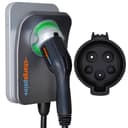
ChargePoint Home Flex
ChargePoint · J1772 · 50 A / 12 kW · 23 ft cable
The most adjustable unit here. It can be set anywhere from 16 A to 50 A, which makes it the one to buy when you do not yet know what your panel will allow.
What is good
- Six selectable amperage settings from 16 A to 50 A
- Sold in both hardwired and NEMA 14-50 versions
- Rated for indoor or outdoor installation
- The app is mature and does not require a subscription
What is not
- 23 ft is a foot shorter than the longest cables in this group
- The 50 A setting needs a bigger circuit than most panels have spare
| Maximum output | 50 A / 12 kW at 240 V |
|---|---|
| Amperage settings | 16, 24, 32, 40, 48 or 50 A |
| Connector | SAE J1772 |
| Cable | 23 ft |
| Installation | Hardwired or NEMA 14-50 |
| Certification | UL listed, Energy Star |
| Warranty | 3 years |
Skip this if: Skip it if your circuit is already fixed and you just want the cheapest safe 40 A unit. You are paying for flexibility you will not use.
Specifications above are the manufacturer’s published figures. Source: ChargePoint, ChargePoint. We have not tested this unit — see how we pick.
2. 80 A with an app and access control
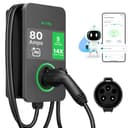
Autel MaxiCharger AC 80A
Autel Energy · J1772 · 80 A / 19.2 kW · 25 ft cable
The connected 80-amp charger: 19.2 kW, adjustable all the way down to 6 A from the app, an RFID card reader and a -40 F to 131 F rating. It asks for a 100 A circuit at full output.
What is good
- 19.2 kW, the ceiling of AC Level 2 charging
- Adjustable from 6 A to 80 A in the app, so one unit fits almost any circuit
- Built-in RFID card reader, which is rare outside access-control models
- Published -40 F to 131 F range, the widest of the 80 A units here
- Long list of published safety standards plus ENERGY STAR certification
What is not
- 80 A continuous needs a 100 A circuit, which most homes cannot spare
- Derates above 113 F, so a hot garage will not see the full figure
- Hardwired only, with no plug-in version
- 4G connectivity is an optional extra, not standard
- Costs far more than the 48 A chargers most households can actually use
| Maximum output | 19.2 kW (240 V AC x 80 A) |
|---|---|
| Adjustable | 6 A to 80 A, in the app |
| Voltage | 208/240 V AC, 60 Hz, single phase |
| Connector | SAE J1772 or NACS |
| Cable | 19 ft (6 m) or 25 ft (7.5 m) |
| Installation | Hardwired; wall or pedestal mount |
| Enclosure | NEMA 3S, IK10 |
| Operating temperature | -40 F to 131 F, derating above 113 F |
| Ground fault | 20 mA CCID |
| Access control | Card reader, ISO 15693 and ISO 14443 A/B |
| Connectivity | Wi-Fi, Ethernet, RS485 and Wi-SUN; 4G optional |
| Metering | ANSI C12.20 (0.5%) compliant |
| Size | 14.5 x 8.5 x 5.1 in; 20.3 lb with the 19 ft cable |
| Warranty | 3 years, extendable up to 5 |
Skip this if: Skip it if your panel cannot spare a 100 A circuit or your car tops out at 11.5 kW -- the 48 A tier does the same job for far less.
Specifications above are the manufacturer’s published figures. Source: Autel Energy. We have not tested this unit — see how we pick.
3. Tight wall space
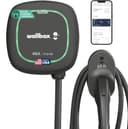
Wallbox Pulsar Plus
Wallbox · J1772 · 48 A / 11.5 kW · 25 ft cable
The smallest 48 A unit here at roughly 7.8 by 7.9 inches, which matters more than it sounds when the only free wall is beside a door.
What is good
- Smallest body of the 48 A units, under 8 inches square
- Current configurable in steps from 6 A to 48 A
- NEMA Type 4 enclosure, rated down to -22 F
- Weighs 4.4 lb without the cable, so mounting is simple
What is not
- Hardwired only at 48 A, with no plug-in version at full output
- Setup runs through the app, which some owners find fussy
| Maximum output | 48 A / 11.5 kW at 240 V |
|---|---|
| Configurable current | 6 A to 48 A |
| Connector | SAE J1772 |
| Cable | 25 ft |
| Body size | 7.8 x 7.9 x 3.9 inches without the cable |
| Operating temperature | -22 F to 104 F |
| Certification | UL 2594, UL 2231 |
| Warranty | 3 years |
Skip this if: Skip it if you want a plug-in unit you can take with you. The 48 A Pulsar Plus is hardwired.
Specifications above are the manufacturer’s published figures. Source: Wallbox, Wallbox. We have not tested this unit — see how we pick.
4. A familiar brand, hardwired
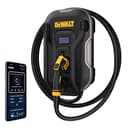
DEWALT 48 A EV Charger (DXPAEV048)
DEWALT · J1772 · 48 A / 11.5 kW · 25 ft cable
A 48 A hardwired charger with a 25 ft cable, an LCD screen and an app, from a brand most garages already trust. Adjustable from 12 A, IP66, CSA certified, three-year warranty.
What is good
- 48 A / 11.5 kW, the top tier a normal 60 A home circuit supports
- Adjustable from 12 A, a wider floor than most chargers offer
- 25 ft cable with a protective cage and an anti-slip handle
- An LCD screen on the unit, so basic status does not depend on a phone
- Scheduling and energy monitoring in a free app, with no subscription
- A three-year warranty backed by 24/7 technical support, and a national install partner
What is not
- Hardwired only -- DEWALT's plug-in version is the separate 40 A model
- DEWALT publishes no operating temperature range for it
- CSA certified, but DEWALT does not name the standard or publish a file number the way Grizzl-E and Lectron do
- No ENERGY STAR certification listed, unlike several rivals at this price
- J1772 only, so a NACS car needs an adapter on every charge
- Costs more than the 48 A chargers most first-time buyers end up with
| Maximum output | 48 A / 11.5 kW |
|---|---|
| Adjustable | 12 A to 48 A |
| Connector | SAE J1772 (DEWALT notes a Tesla adapter is sold separately) |
| Cable | 25 ft, UL certified, with a protective cage and anti-slip handle |
| Installation | Hardwired; mounting bracket and hardware included |
| Enclosure | IP66, described as a NEMA 4X type enclosure |
| Display | LCD screen on the unit |
| Connectivity | Bluetooth and Wi-Fi, through the free DEWALT EV Charger app |
| App features | Start and stop charging, energy monitoring, off-peak scheduling |
| Certification | CSA certified for indoor and outdoor use |
| Maker's range claim | Up to 46 miles of range per hour |
| Warranty | 3-year limited, with 24/7 technical support |
Skip this if: Skip it if you want a plug-in unit -- this one is hardwired, and DEWALT's plug-in version is the 40 A model. Skip it too if a published temperature range matters to you; DEWALT does not list one.
Specifications above are the manufacturer’s published figures. Source: DEWALT. We have not tested this unit — see how we pick.
5. Grizzl-E toughness, with an app
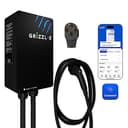
Grizzl-E Classic Connect
United Chargers · J1772 · 40 A / 9.6 kW · 25 ft cable
The next-generation Grizzl-E: 40 A on a NEMA 14-50, a 25 ft cable, a UL Type 4 indoor/outdoor rating -- and, unlike the Classic, Wi-Fi and the Grizzl-E Connect app. Sold with a J1772 or NACS cable.
What is good
- 25 ft cable, a foot longer than the Classic Extreme Edition's
- Wi-Fi app with schedules and charging statistics, which the Classic deliberately lacks
- UL/cUL listed, with a published file number
- Rated to run from -22 F to 122 F
What is not
- 40 A ceiling, with no hardwired 48 A version
- Sold with a NEMA 14-50 plug; the Classic's 6-50 option is not among the Connect listings we found
- The app needs 2.4 GHz Wi-Fi where the charger is mounted
| Maximum output | 40 A / 9.6 kW at 240 V (the maker lists 10 kW) |
|---|---|
| Adjustable | 16 A to 40 A |
| Connector | SAE J1772 or NACS, chosen at purchase |
| Cable | 25 ft (7.6 m) |
| Plug | NEMA 14-50 |
| Enclosure rating | UL Type 4, indoor and outdoor |
| Operating temperature | -22 F to 122 F |
| Size | 10.25 x 6.25 x 3.75 in |
| Connectivity | Wi-Fi (2.4 GHz) and the Grizzl-E Connect app |
| Certification | UL/cUL, file E510712 |
| Warranty | 3 years; 5-year warranty sold separately |
Skip this if: Skip it if you wanted a Grizzl-E precisely because it has no app -- the original Classic is still the no-software choice -- or if you want 48 A. The Classic Connect is a 40 A plug-in unit.
Specifications above are the manufacturer’s published figures. Source: United Chargers. We have not tested this unit — see how we pick.
FAQ
Questions people actually ask
What amperage should I set my EV charger to?
How do I change the amps on my EV charger?
Does turning my charger down make charging much slower?
Can I set my charger higher than the breaker allows?
Why is my charger limited to 40 amps when it is rated 48?
Should I set the current limit in the car or in the charger?
Sources
Where these numbers come from
- NEC Article 625: EV Charging Equipment — WireRef625.41 Continuous Load Rating: EV charging is classified as a continuous load because the EVSE draws its maximum rated current for 3 or more hours during a typical charge session, so the branch circuit is sized at 125% of the rated current -- a 48 A charger requires a 60 A circuit. 625.42 Branch Circuit Requirements: each EVSE requires a dedicated branch circuit unless an approved energy management system controls the load. Read 2026-10-17.
- ChargePoint Home Flex data sheet — ChargePointAmperage settings of 16, 24, 32, 40, 48 and 50 A; maximum 50 A / 12 kW; 23 ft cable; hardwired and NEMA 14-50 versions; UL listed and ENERGY STAR certified.
- Wallbox Pulsar Plus datasheet — Wallbox48 A / 11.5 kW maximum with configurable current from 6 A to 48 A, SAE J1772, 25 ft cable, hardwired, -22 F to 104 F, UL 2594 and UL 2231, 3-year warranty.
- Autel MaxiCharger AC 80A — Autel Energy19.2 kW (240 V AC x 80 A) with output adjustable 6 A to 80 A in the app; 208/240 V AC, 60 Hz, single phase; SAE J1772 or NACS; 19 ft or 25 ft cable; hardwired with wall or pedestal mount; NEMA 3S and IK10 enclosure; -40 F to 131 F with derating above 113 F; UL 2594, UL 2231-1, UL 2231-2, UL 1998 and CSA C22.2 No. 280 plus ENERGY STAR; 3-year warranty extendable to 5. Read 2026-10-01.
- DEWALT Level 2 EV charger, 48 amps (DXPAEV048) — DEWALTUp to 48 A / 11.5 kW with adjustable current from 12 to 48 A, 25 ft UL certified cable, hardwired, IP66 described as a NEMA 4X type enclosure, LCD screen on the unit, Bluetooth and Wi-Fi through the DEWALT EV Charger app with scheduling and energy monitoring, CSA certified for indoor and outdoor use, 3-year limited warranty. Read 2026-10-05.
- Grizzl-E Classic Connect — United Chargers40 A / 9.6 kW with adjustable current from 16 A to 40 A, J1772 or NACS chosen at purchase, 25 ft cable, NEMA 14-50 plug, UL Type 4 indoor and outdoor, -22 F to 122 F, Wi-Fi 2.4 GHz with the Grizzl-E Connect app, UL/cUL file E510712, 3-year warranty.
- Grizzl-E Ultimate 48 — United ChargersMax power 48 A / 11.5 kW, hardwire only, adjustable current published as 40A/32A/24A/16A, J1772 and NACS, 25 ft cable, UL Type 4 indoor/outdoor, OCPP, UL E510712, Wi-Fi 2.4 GHz and mobile app, -22 F to 122 F. Read 2026-10-11.
- Grizzl-E Ultimate — United ChargersMax power 80 A / 19.2 kW, hardwire only, adjustable current published as 80A/64A/56A/48A/40A/32A/24A/16A, J1772 and NACS, 25 ft cable, UL Type 4 indoor/outdoor, OCPP, UL E510712 and Energy Star, Wi-Fi 2.4 GHz and mobile app, -22 F to 122 F. Read 2026-10-11.
- Enphase HCS-80 EVSE data sheet — Enphase Energy64 A continuous / 15.4 kW output on a dedicated 2-pole 80 A breaker, pre-wired 8 AWG 3 ft service whip, SAE J1772 cable at 25 ft or 18 ft, NEMA Type 4 watertight enclosure, integral CCID 20 mA ground-fault protection with auto reset, four LED indicators, NEC Article 625, UL 2594 among others, 5-year warranty. Read 2026-10-01.
- Leviton EV Series 48 A charging station (EV480) — Leviton48 A output at 208/240 V, which Leviton quotes as 11.6 kW, on a 60 A breaker; SAE J1772; 18 ft cord; NEMA Type 3R enclosure; -22 F to 122 F; optional RFID access control disabled when shipped; UL 2594, UL 2231-1, UL 2231-2 and UL 2251 among others; ENERGY STAR certified.
- Fuel economy of 2026 Cadillac and GMC vehicles — U.S. EPA and U.S. Department of Energy, fueleconomy.govPublished consumption ratings used here: Cadillac Lyriq 37 kWh/100 mi, GMC Sierra EV 50 kWh/100 mi, GMC Hummer EV 70 kWh/100 mi (2025). Read 2026-10-11.
Read next
Related reading
- How many amps do you actually need?Three checks that determine your charger amperage, and why the smallest one wins.
- What size breaker and wire does an EV charger need?Breaker and wire size for every charger amperage, with the 125% rule worked through.
- Why your EV charger keeps tripping the GFCI breakerWhy GFCI breakers trip on EV chargers and the safe sequence for diagnosing it.
- Load management: charging without a panel upgradeHow load management avoids a panel upgrade, what it costs in speed, and when to use it.
- Why is my EV charging so slowly?Nine reasons a home charge is slower than expected, in diagnostic order, starting with the four that cost nothing to fix.